
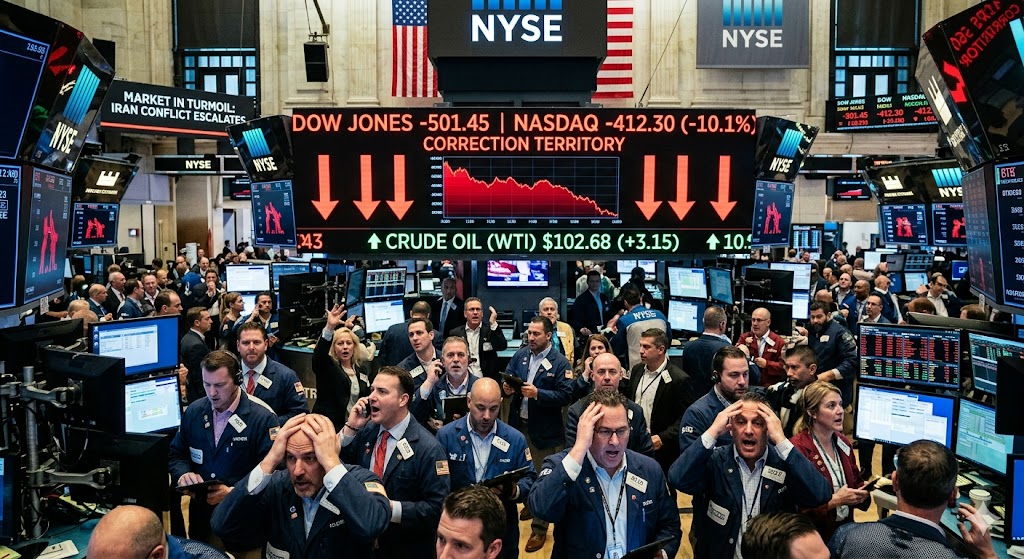
NEW YORK — Wall Street was engulfed in a sea of red on Friday as a volatile cocktail of geopolitical brinkmanship, soaring energy costs, and a shifting technological landscape sent shockwaves through the American economy. Despite a temporary reprieve in rhetoric from the Oval Office, investors fled from risk, sending the tech-heavy Nasdaq Composite deeper into correction territory while oil prices surged on fears of a prolonged Middle Eastern conflict.
The Dow Jones Industrial Average (^DJI) plummeted 493.64 points, or 1.07%, to close at 45,466.47. The S&P 500 (^GSPC) followed suit with a 0.98% decline, while the Nasdaq (^IXIC) bore the brunt of the selling, sliding 1.39% as the “SaaSpocalypse” returned to haunt the software sector.
The Oil Factor: $100 Barrel Becomes the New Reality
The primary engine of Friday’s decline was the black gold. As conflict intensified across the Middle East, investors grew increasingly skeptical that a diplomatic resolution is on the horizon. Crude prices rallied over 2% as the logistical nightmare at the Strait of Hormuz—the world’s most vital oil artery—showed no signs of easing.
- Brent Crude (BZ=F): Traded above $103 a barrel, marking a significant psychological and economic threshold.
- West Texas Intermediate (CL=F): Topped $97, up nearly 4% on the day.
The “Strait of Hormuz premium” is now being baked into every sector of the market. Economists warn that if traffic remains halted into April, the inflationary pressure could force the Federal Reserve into a “higher-for-longer” interest rate stance that many had hoped was nearing its end.
Trump’s 10-Day Deadline: De-escalation or Calm Before the Storm?
In a move that caught many by surprise, President Trump extended his deadline for Iran by 10 days. The administration has given Tehran until April 6 to comply with US demands regarding energy infrastructure or face targeted strikes on power plants.
While the extension suggests a potential path toward de-escalation, the market viewed it with “cautious pessimism.” Uncertainty remains the dominant theme; Iran’s sustained rejection of US diplomatic overtures suggests that the 10-day window may simply be a strategic pause before a significant military escalation.
The “SaaSpocalypse”: AI Fears Decimate Software Stocks
While the war in Iran provided the macro backdrop, a micro-revolution in Artificial Intelligence caused a vertical drop in software equities. The iShares Software Sector ETF (IGV) fell 2.8%, fueled by what analysts are calling the “Agentic Pivot.”
The Rise of the AI Agent
Startups like OpenAI and Anthropic have recently debuted “agentic” capabilities—AI systems capable of performing complex tasks autonomously rather than just generating text. This has sent shivers through the traditional Software-as-a-Service (SaaS) industry.
The fear is simple but devastating: Why would a corporation pay for 500 per-head software seats when five AI agents can perform the same tasks? Cybersecurity giants were hit hardest following reports of a security lapse at Anthropic:
- CrowdStrike (CRWD): Down more than 5%.
- Palo Alto Networks (PANW): Down 5.2%.
“Software contracts are shrinking,” noted Bloomberg analyst Rebecca Torrence. “Enterprise customers no longer want to be locked into multi-year agreements when the AI landscape is shifting every three months. We are seeing a fundamental repricing of how software is valued.”
Gold and the Liquidity Crunch
In a rare move, Gold (GC=F) rebounded by 3% on Friday, jumping to roughly $4,540 per ounce. However, the “safe haven” asset is still on track for its fourth straight weekly loss.
The recent weakness in gold hasn’t been due to a lack of demand, but rather a desperate need for cash. Sprott market strategist Paul Wong noted that rising cross-asset volatility has forced hedge funds and institutional investors into “liquidity-driven deleveraging.”
“When the market moves this fast, investors sell what is liquid to cover losses elsewhere,” Wong explained. “Gold was sold off not because it lost its shine, but because it was the only thing in the portfolio that still had value to harvest for cash.”
A Glimmer of Hope: The Shutdown Ends
Amidst the carnage, there was one piece of domestic stability. In the early hours of Friday, the Senate passed a crucial funding bill. While the bill notably excluded funding for ICE, it successfully secured operations for the TSA and the Department of Homeland Security.
This vote effectively ends the partial federal shutdown that had begun to paralyze American airports. For the markets, this removes one layer of domestic “self-inflicted” economic damage, though it was not enough to offset the massive weight of the energy and AI sectors.
What to Watch Next Week
As we head into the final days of March, three variables will dictate whether the Nasdaq can climb out of correction territory or if the Dow will test further support levels:
- The April 6 Deadline: Any rhetoric from Tehran or Washington regarding the new 10-day window will cause immediate swings in oil futures.
- The Fed’s Reaction: With oil at $103, will the Fed signal a pause or a pivot?
- AI Earnings Narratives: As more “Agentic” tools go live, watch for how legacy software companies defend their subscription models.