

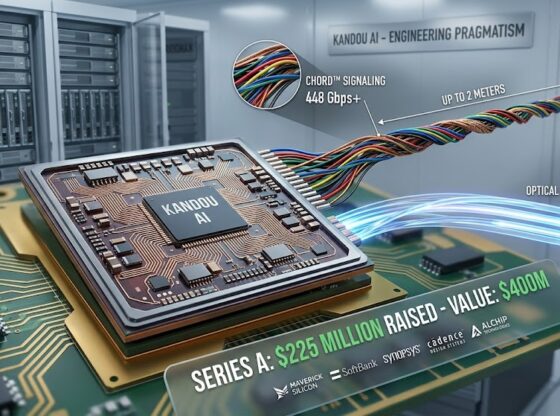

LAUSANNE, Switzerland — In the high-stakes arms race of Artificial Intelligence infrastructure, the prevailing wisdom has long been that “light is the future.” As AI models balloon to trillions of parameters, the industry has begun a multi-billion-dollar migration toward optical interconnects—using photons instead of electrons to move data between chips. However, a veteran of the semiconductor world is betting $225 million that the industry’s oldest workhorse, copper, isn’t just surviving; it’s about to outperform.
Kandou AI, a Swiss-based leader in chip-to-chip link technology, announced on March 28, 2026, that it has secured $225 million in a Series A funding round. While the “Series A” label is a strategic rebrand for a company founded in 2011, the capital infusion represents a massive vote of confidence from a heavyweight syndicate led by Maverick Silicon, with strategic backing from SoftBank, Synopsys, Cadence Design Systems, and Alchip Technologies.
The round, which values the company at $400 million, sets the stage for a definitive technical showdown: Can advanced mathematics extend the life of copper wiring, or is the “Optical Revolution” truly inevitable?
The Rebirth of Kandou: From Bus to AI
The funding marks a pivotal transformation for the firm formerly known as Kandou Bus. Since its inception by EPFL professor Amin Shokrollahi, the company has been a quiet powerhouse in the semiconductor space. Shokrollahi, a world-renowned mathematician, developed the Chord™ signaling technology, a method of sending correlated signals across multiple wires.
In the mid-2010s, this technology found a home in consumer electronics, but the explosion of generative AI has changed the landscape. In 2025, the company underwent a leadership change that signaled its new ambitions. Srujan Linga, a former Goldman Sachs managing director, took the helm as CEO, steering the company toward the heart of the AI data center.
“The bottleneck in AI isn’t just compute power anymore; it’s the ‘tax’ we pay to move data,” says industry analyst Marcus Thorne. “Kandou is arguing that we’ve been overpaying that tax by trying to switch to optics too soon.”
The Physics of the Bottleneck
To understand Kandou AI’s gamble, one must understand the “Interconnect Wall.” As GPUs are clustered together by the tens of thousands to train Large Language Models (LLMs), the wires connecting them have become a liability.
At current signaling speeds of 224 gigabits per second (Gbps), traditional copper interconnects face two massive hurdles:
- Power Drain: Interconnects can consume up to 30% of a cluster’s total power.
- Signal Decay: At high speeds, electrons moving through copper degrade so quickly that the data can barely travel a meter before becoming unreadable.
The industry’s giants have responded by throwing money at photons. In February 2026, Marvell acquired Celestial AI for $3.25 billion to secure its photonic fabric. Just weeks ago, Ayar Labs raised $500 million at a nearly $4 billion valuation for its co-packaged optics. The message seemed clear: Copper is dead for high-end AI.
Chord Signaling: The Mathematical “Cheat Code”
Kandou AI’s thesis is built on Shokrollahi’s Chord signaling. Unlike traditional NRZ or PAM4 signaling, which looks at bits in isolation or small groups, Chord sends signals that are mathematically correlated across a group of wires.
The company claims this allows them to:
- Double or Quadruple Bandwidth: Moving data at 448 Gbps and beyond over existing copper traces.
- Halve Power Consumption: Reducing the thermal load that currently plagues data centers.
- Achieve Shannon Capacity: Reaching the theoretical limit of how much information can be shoved through a physical medium.
By making copper “smarter” through mathematics, Kandou argues that data centers can avoid the “rip and replace” cost of moving to expensive, fragile optical components.
The Strategic Cap Table: A “Who’s Who” of Silicon
Perhaps more important than the $225 million headline figure is who signed the checks. The presence of Synopsys and Cadence—the two titans of Electronic Design Automation (EDA)—suggests that Kandou’s IP will be integrated directly into the software tools used by every major chipmaker in the world.
Alchip, the Taiwanese ASIC giant, provides the manufacturing bridge, while SoftBank provides the sheer scale of the Vision Fund’s ecosystem. This suggests a licensing model similar to Arm Holdings. Kandou doesn’t need to sell every chip; they just need their “Chord” technology to be the standard inside the chips designed by NVIDIA, AMD, and the hyperscalers (Google, Amazon, Meta).
The Valuation Gap: Skepticism or Opportunity?
Despite the massive raise, Kandou AI’s $400 million valuation stands in stark contrast to the multi-billion-dollar valuations of its optical rivals.
| Company | Technology Focus | Recent Valuation / Exit |
|---|---|---|
| Celestial AI | Photonic Fabric (Optical) | $3.25 Billion (Acquisition) |
| Ayar Labs | Co-packaged Optics | $3.8 Billion |
| Kandou AI | Chord Signaling (Copper) | $400 Million |
This “Valuation Gap” is the crux of the debate. To the bulls, Kandou is a massive “value play”—a company offering a 10x cheaper and 10x faster-to-adopt solution than optics. To the bears, the low valuation reflects a belief that copper is an “evolutionary dead end.”
“The risk,” notes Thorne, “is that AI isn’t interested in ‘good enough.’ If next-generation models require terabit-per-second speeds in two years, copper might hit a physical wall that no amount of clever math can climb over.”
Conclusion: Engineering Pragmatism vs. The Optical Hype
Kandou AI’s $225 million buys them more than just R&D time; it buys them a seat at the table during the most critical infrastructure build-out in human history.
If Srujan Linga and Amin Shokrollahi are right, billions of dollars currently being poured into the optical transition may be premature. Data centers might continue to hum on copper for several more hardware generations, saving billions in capital expenditure and megawatts of power.
But in an industry that has shown a relentless appetite for speed, Kandou AI faces a steep climb. They aren’t just fighting other startups; they are fighting the narrative that the age of the electron is over. For now, the “Swiss Wizards of Copper” have the capital to prove that their math can outrun the speed of light.
Key Takeaway: Kandou AI is positioning itself as the “pragmatic” alternative to the expensive optical revolution, leveraging a decade of IP to extend copper’s dominance into the 448 Gbps era. With the backing of the entire semiconductor design ecosystem, the battle for the AI interconnect has officially moved from the laboratory to the cap table.
Frequently Asked Questions: Kandou AI & The Interconnect War
1. What is Kandou AI?
Kandou AI (formerly Kandou Bus) is a Swiss semiconductor company specializing in high-speed, low-power chip-to-chip interconnect technology. Their core mission is to solve the “data bottleneck” in AI clusters using advanced mathematics rather than shifting entirely to fiber optics.
2. What is “Chord™ Signaling”?
Developed by founder Amin Shokrollahi, Chord signaling is a multi-wire signaling method. Unlike traditional methods (NRZ or PAM4) that look at bits individually, Chord sends correlated signals across a group of wires. This allows for:
- Higher Bandwidth: 2x to 4x the speed of traditional copper.
- Lower Power: Up to 50% reduction in power consumption.
- Extended Reach: Keeping copper viable at speeds of 448 Gbps and beyond.
3. Why did they raise $225 million in a “Series A”?
While the company is 15 years old, the “Series A” designation follows a 2025 leadership change and a strategic rebrand. The funding is specifically aimed at capturing the AI infrastructure market, moving away from general consumer electronics toward high-end GPU and data center interconnects.
4. How does Kandou AI differ from companies like Ayar Labs or Celestial AI?
- The Material: Ayar Labs and Celestial AI use Optics (Light). Kandou AI uses Copper (Electrons).
- The Cost: Kandou’s solution is significantly cheaper because it utilizes existing data center wiring and manufacturing processes.
- The Bet: Optical companies believe copper has hit a physical limit; Kandou believes their math can push that limit further out.
5. Who are the key players involved in this round?
The investment syndicate is highly strategic:
- SoftBank: Provides scale and a massive AI ecosystem.
- Synopsys & Cadence: The “big two” of chip design software. Their backing suggests Kandou’s IP will be built into the tools engineers use to design future AI chips.
- Alchip: A major Taiwanese manufacturer that helps bring the designs to physical silicon.
Reference Links & Sources
Official Company Profile
- Kandou AI Official Website: kandou.com
- Kandou AI LinkedIn: linkedin.com/company/kandou-bus
Key Technical Concepts
- Chord Signaling Whitepaper: Research on Multi-wire Signaling (Note: Requires registration on some industry sites).
- Understanding the Interconnect Bottleneck: IEEE Spectrum: The Future of Interconnects
Recent Industry Context (March 2026)
- Marvell Acquisition of Celestial AI: Marvell Investor Relations
- Ayar Labs Series C Funding: Ayar Labs Newsroom
- The Rise of 448G Copper: Ethernet Alliance Roadmap
Financial & Strategic Backers
- Maverick Silicon: maverickcap.com
- SoftBank Vision Fund: visionfund.com
- Synopsys IP Portfolio: synopsys.com/designware-ip