

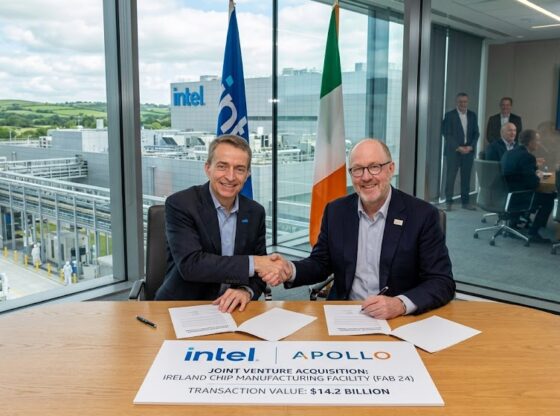

SANTA CLARA, CA – In a massive strategic pivot aimed at consolidating its European manufacturing footprint and refining its balance sheet, Intel Corporation announced on April 1, 2026, that it has reached an agreement to buy back Apollo Global Management’s 49% stake in their joint venture, Fab 34, located in Leixlip, Ireland.
The transaction, valued at $14.2 billion, marks the end of a high-profile financing partnership established in 2024. The move signals Intel’s renewed confidence in its long-term “IDM 2.0” strategy and its desire to retain full control over its most advanced semiconductor manufacturing assets as global demand for AI-capable chips continues to surge.
Financing the Buyback: Cash and Debt Strategy
To fund the multi-billion dollar acquisition, Intel has outlined a structured financial plan:
- $7.7 Billion: Sourced from existing cash on hand and short-term liquid assets.
- $6.5 Billion: Raised through new debt issuances, carefully timed to leverage Intel’s stabilizing credit outlook.
While the addition of $6.5 billion in debt is significant, Intel leadership expects the transaction to be accretive to ongoing earnings per share (EPS). More importantly, the company anticipates that the full ownership of Fab 34 will actually strengthen its credit profile beginning in 2027, as the facility reaches peak production efficiency and generates higher margins without the profit-sharing requirements of a joint venture.
The Significance of Fab 34 in Leixlip, Ireland
Fab 34 is not just another factory; it is the crown jewel of Intel’s European operations.
- Advanced Process Technology: The facility is a primary site for Intel 4 process technology, which utilizes Extreme Ultraviolet (EUV) lithography—a critical requirement for producing the next generation of processors.
- Geopolitical Leverage: By owning 100% of this facility, Intel positions itself as the dominant sovereign-aligned chipmaker in Europe, aligning with the goals of the EU Chips Act to reduce dependency on Asian-based manufacturing.
- Supply Chain Security: Full ownership allows Intel to pivot production schedules more fluidly to meet the demands of its foundry customers and its own internal product lines without needing external partner approval.
Why Now? The Apollo Exit and Intel’s Momentum
In 2024, the partnership with Apollo was seen as a creative “Semiconductor Co-Investment Program” (SCIP) designed to preserve Intel’s cash while building expensive infrastructure. However, with Intel’s recent breakthroughs in RibbonFET and PowerVia technologies, the company’s internal roadmap has accelerated.
“Consolidating our ownership of Fab 34 is a testament to the progress we’ve made in our manufacturing transition,” said an Intel spokesperson. “Retaining the full upside of our Irish operations ensures that our shareholders benefit directly from the high-margin advanced nodes we are now delivering at scale.”
For Apollo Global Management, the $14.2 billion exit represents a successful realization of a long-term infrastructure investment, highlighting the growing trend of private equity firms playing a foundational role in “big-ticket” industrial financing.
Market Outlook and Credit Impact
Wall Street analysts have noted that while the debt load increases in the short term, the removal of the 49% profit-sharing hurdle with Apollo significantly cleans up Intel’s financial reporting.
Key Financial Projections:
| Metric | Impact | Timeline |
|---|---|---|
| Earnings Per Share (EPS) | Accretive (Positive) | Immediate post-close |
| Net Debt | +$6.5 Billion | Q2 2026 |
| Credit Strength | Projected Upgrade | 2027 |
| Manufacturing Margin | Full Retention | Ongoing |
Conclusion: A Bold Step Toward Foundry Dominance
As Intel moves toward 2027, the full acquisition of the Ireland facility serves as a clear message to competitors like TSMC and Samsung: Intel is betting on itself. By reclaiming full control of its European hub, the company is ensuring that its “foundry for the world” vision is built on a foundation of 100% owned, cutting-edge infrastructure.
The deal is expected to close by the end of the second quarter of 2026, subject to customary regulatory approvals.