Geopolitical Tsunami: U.S. Moves to Oust London as Global Maritime Insurance King Amid Mideast Crisis
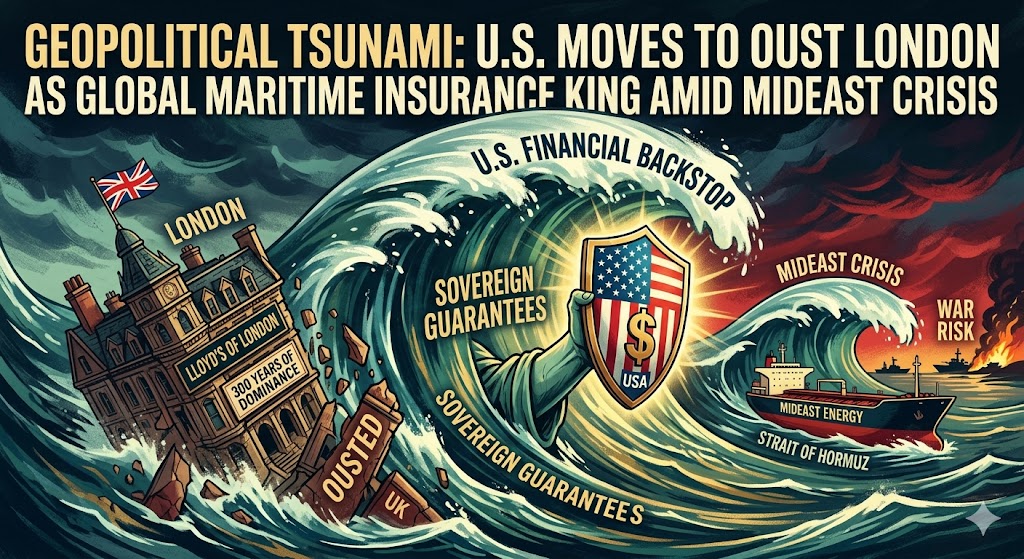
WASHINGTON — In a stunning disruption of a three-century-old global order, the United States is aggressively moving to displace the United Kingdom as the world’s primary guarantor of maritime trade. As the Middle East teeters on the brink of a regional conflagration, “insurance” has transformed from a back-office line item into a high-stakes weapon of 21st-century energy security.
For over 300 years, the global economy relied on a single unwritten rule: if you want to sail a ship through a war zone, you go through Lloyd’s of London. Today, that rule is being rewritten in Washington D.C.
The Death of the ‘London Premium’
For generations, the City of London sat at the epicenter of global commerce, controlling the “war risk” insurance that allows tankers to transit volatile chokepoints like the Strait of Hormuz. However, as tensions in the Persian Gulf reach a breaking point, the private market is buckling.
Insurance premiums for vessels passing through the Gulf have skyrocketed, jumping between five and twenty-five times their standard rates in just a matter of days. For many shipowners, the cost of protection has become more expensive than the cargo itself.
The U.S. Financial ‘Shield’
Enter the U.S. Treasury and the Maritime Administration (MARAD). Sources indicate that the Biden administration is preparing a massive financial backstop—effectively a state-guaranteed insurance fund—to ensure that energy shipments to U.S. allies remain uninterrupted.
By offering sovereign guarantees that private London insurers simply cannot match, the U.S. is doing more than just protecting oil; it is seizing the “invisible lever” of global trade.
“We are witnessing the ‘Americanization’ of maritime risk,” says Dr. Aris Marland, a senior fellow at the Center for Maritime Security. “London reigned because they had the best data and the deepest pools of private capital. But in 2026, private capital isn’t enough to fight a shadow war in the Strait of Hormuz. You need the full faith and credit of the U.S. Treasury.”
The India Connection: A New Power Dynamic
The shift is already rippling through the Global South. For nations like India, which is currently pushing for maximum health insurance coverage for its 1.4 billion citizens, the sudden focus on maritime insurance is a bitter economic pill.
With India’s energy security directly tied to the safety of these sea lanes, New Delhi is increasingly looking toward this new American “safety net” rather than the traditional, and now prohibitively expensive, British markets.
By the Numbers: The Cost of Conflict
| Insurance Metric | Standard Rate (Pre-Crisis) | Current Rate (2026) | Change % |
|---|---|---|---|
| War Risk Premium | 0.05% of Hull Value | 1.25% – 2.5% | +2,500% |
| Transit Coverage | $15,000 / week | $375,000 / week | +2,400% |
| Cargo Indemnity | $2.50 / barrel | $12.00+ / barrel | +380% |
Why It Matters to You
This isn’t just a battle between suits in London and D.C. When insurance rates for tankers spike, the cost is passed directly to the American consumer. This “hidden tax” is what drives up the price of gasoline at the pump and heating oil in the winter. By stepping in as the global insurer of last resort, the U.S. is attempting to stabilize domestic inflation by controlling the risks of the high seas.
As the Strait of Hormuz remains the world’s most dangerous “toll road,” the U.S. has made its move. The “Sentinel of the Seas” is no longer just a destroyer on the horizon; it’s a ledger in Washington.