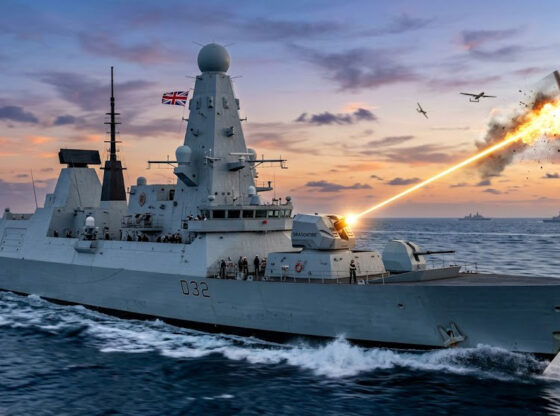

Breaking UK news: In a monumental leap for modern naval warfare, the United Kingdom Ministry of Defence (MoD) has officially confirmed that its highly anticipated DragonFire high-energy laser weapon will be operational and installed on Royal Navy Type 45 destroyers by 2027. This rapid deployment, spearheaded by a newly awarded £316 million ($414 million) production contract, brings the cutting-edge directed-energy weapon into active service five full years ahead of its original schedule.
The successful fielding of DragonFire will mark a historic milestone, establishing the UK as the very first European NATO member to deploy a fully operational shipborne laser weapon. As asymmetric aerial threats—such as low-cost, high-speed suicide drones—continue to reshape the realities of global conflict, the Royal Navy’s transition from kinetic missiles to directed-energy interceptors is poised to alter the strategic calculus of naval defence.
Accelerating the Timeline: From Research to Royal Navy Ships
The accelerated timeline was recently reaffirmed by Defence Minister Lord Coaker, reflecting a renewed governmental commitment to rapidly transitioning disruptive technologies from the laboratory to the front lines. The pivotal £316 million ($414 million) contract, officially awarded in November 2025 to MBDA UK, paves the way for the first two production systems.
This decisive move follows a series of unprecedented, highly successful live-fire trials conducted at the MoD’s Hebrides testing range in Scotland. During these rigorous tests, the DragonFire system achieved a UK first: successfully tracking, targeting, and shooting down highly manoeuvrable drones travelling at speeds of up to 400 mph (approximately 650 km/h)—roughly twice the top speed of a Formula 1 race car.
For the defence supply chain, the acceleration of the DragonFire program is a major victory. The investment is expected to create and sustain nearly 600 highly skilled jobs across the UK, particularly in Scotland, the South West, and the East of England, acting as a vital engine for economic growth within the domestic defence sector.
The Economics of Laser Warfare: $13 Per Shot
Perhaps the most revolutionary aspect of the DragonFire system is its profound cost efficiency. In recent naval engagements—such as those involving HMS Diamond intercepting Houthi rebel drones in the Red Sea—the Royal Navy has been forced to utilise the Sea Viper Principal Anti-Air Missile System (PAAMS). While highly effective, a single Sea Viper interceptor missile can cost upwards of £1 million to £2 million ($1.3 million to $2.6 million). Firing multi-million-dollar munitions to neutralise drones that often cost only a few thousand dollars to manufacture creates an unsustainable economic imbalance for modern militaries.
The DragonFire laser completely inverts this paradigm. Because the weapon relies purely on electricity rather than finite, volatile chemical propellants, the MoD estimates that the cost of firing the 50-kilowatt laser is approximately £10 ($13) per shot.
Furthermore, as long as the Type 45 destroyer’s engines and generators are running, the ship possesses a virtually limitless magazine. This “infinite ammo” capability eliminates the traditional logistical burdens of resupplying physical munitions at sea and ensures that a warship cannot easily have its defensive stockpiles depleted by coordinated swarm attacks.
Unpacking the DragonFire Technology
DragonFire is not merely a single powerful laser, but an intricate fusion of cutting-edge optical engineering and advanced targeting systems. Developed through a collaborative industrial consortium led by MBDA UK, the project leverages the unique expertise of Leonardo UK, QinetiQ, and the government’s Defence Science and Technology Laboratory (DSTL).
At its core, the 50 kW-class system utilises a highly sophisticated “spectral beam-combining architecture.” Instead of relying on one massive, unwieldy laser generator, QinetiQ developed a method to merge multiple high-power glass-fibre laser sources into a single, concentrated beam. This beam boasts near diffraction-limited quality, meaning it maintains a tight, intense focus over vast distances without dispersing in the atmosphere.
Directing this immense energy is the responsibility of Leonardo UK, which designed the system’s advanced beam director. Housed within a fully stabilised turret to compensate for the pitch and roll of a warship at sea, the director utilises state-of-the-art electro-optical sensors and a secondary, lower-power tracking laser. This secondary laser continuously illuminates the target, allowing the system to compensate for atmospheric distortion and keep the primary destructive beam locked on the exact same spot of a moving object.
The resulting precision is staggering. According to the MoD, the DragonFire system is accurate enough to strike a target the size of a £1 coin from a distance of over one kilometre away. By focusing intense thermal energy onto a localised point, the laser can burn through a drone’s aerodynamic control surfaces, detonate its onboard payload, or blind its optical navigation sensors in a matter of seconds.
Real-World Application: Enhancing the Type 45 Destroyer
The decision to integrate the first two DragonFire systems onto the Royal Navy’s Type 45 Daring-class destroyers is highly strategic. These vessels are already widely regarded as some of the most advanced dedicated air-defence platforms in the world.
Currently, a Type 45 relies on a layered defence network to protect carrier strike groups and allied shipping. Its primary shield is the Sea Viper system, utilising Aster 15 and Aster 30 missiles launched from a 48-cell Vertical Launching System (VLS) to intercept medium- and long-range supersonic threats. Closer in, the ships rely on 30mm automated cannons and the radar-guided Phalanx Close-In Weapon System (CIWS), which fires a literal wall of 20mm tungsten bullets to shred incoming targets at the last possible moment.
DragonFire will not replace these existing systems; rather, it will be seamlessly integrated into this layered architecture. By slotting in between the long-range missiles and the last-resort rotary cannons, the LDEW (Laser Directed Energy Weapon) will provide a highly reliable, cost-effective intermediate layer of defence specifically tailored for high-volume, low-cost asymmetric threats. This frees up the expensive Aster missiles to be reserved exclusively for high-tier threats, such as enemy fighter jets or advanced anti-ship cruise missiles.
A New Era for the UK Defence Industry and NATO
The rapid advancement of DragonFire underscores a fundamental shift in UK defence procurement—moving away from decades-long development cycles in favour of getting “minimum deployable capabilities” into the hands of warfighters swiftly.
Chris Allam, MBDA UK’s Managing Director, noted that the recent contract represents a “fundamentally different rapid approach” that will see the system continuously improved and upgraded even after it is deployed on the Type 45s. Meanwhile, QinetiQ—which received a £67 million sub-contract to manufacture the system’s vital laser source—emphasised that this collaborative model is essential for getting disruptive, next-generation technology onto the battlefield at pace.
Looking to the future, the implications of DragonFire stretch far beyond the maritime domain. The underlying spectral beam-combining technology is highly scalable. The MoD and its industrial partners are already exploring how modified variants of the system could be mounted on armoured ground vehicles to protect army bases from mortar fire, or potentially integrated into airborne platforms to serve as missile countermeasures.
As global military powers race to master directed-energy capabilities, the United Kingdom has firmly secured its position at the vanguard. By 2027, when the first Type 45 destroyer sails with the DragonFire turret tracking targets on the horizon, it will not just be defending a single ship—it will be illuminating the future of warfare itself.