

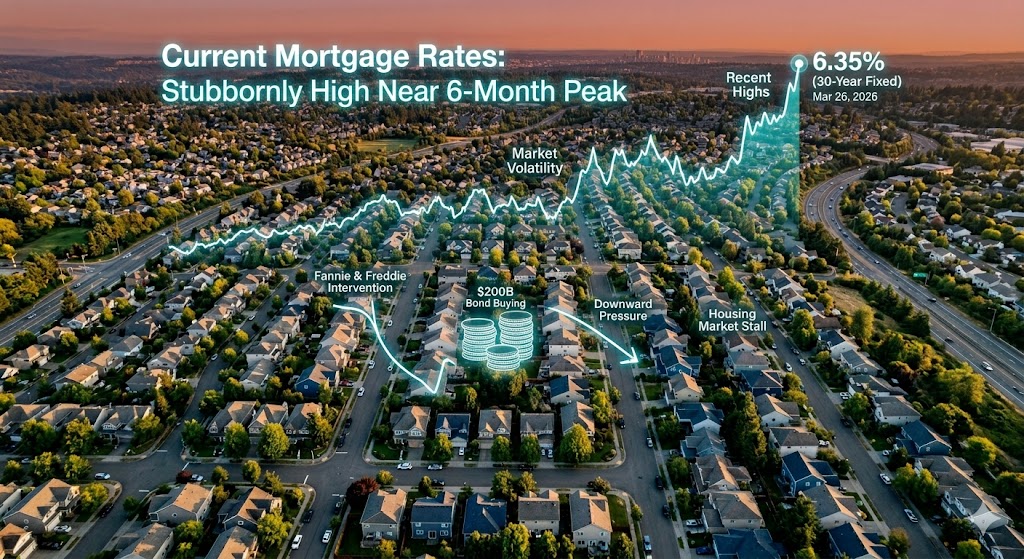

WASHINGTON, D.C. — U.S. homeowners and prospective buyers are facing a “higher-for-longer” reality this week as mortgage rates refuse to budge from their recent six-month highs. Despite early-year optimism for an affordability boost, the latest data from Zillow as of March 26, 2026, shows a market still grappling with economic and geopolitical pressures.
The Daily Numbers: A “Fraction Off” Recent Records
The benchmark 30-year fixed mortgage rate rose another six basis points today, landing at 6.35%. While this remains slightly below the peaks seen earlier in the month, it is a significant jump from the sub-6% levels touched briefly in January.
The shorter-term 15-year fixed mortgage rate followed suit, gaining four basis points to reach 5.81%. For those considering adjustable options, the 5/1 ARM is currently averaging 6.62%, reflecting the premium lenders are placing on future uncertainty.
Comparison of Current Mortgage vs. Refinance Rates
For many, the question is whether to buy now or wait to refinance. Interestingly, mortgage refinance rates are currently trending slightly higher than purchase rates for 30-year terms, a common occurrence when lenders are managing high volume or increased risk.
| Loan Type | Purchase Rate (Avg) | Refinance Rate (Avg) |
|---|---|---|
| 30-Year Fixed | 6.35% | 6.42% |
| 20-Year Fixed | 6.11% | 6.41% |
| 15-Year Fixed | 5.81% | 5.88% |
| 30-Year VA | 5.87% | 5.85% |
The Economic Tug-of-War
The stubbornness of mortgage interest rates is largely attributed to a strong but “noisy” economy. Typically, if employment rates struggle, rates decrease to encourage borrowing. However, current employment remains robust, and with the Iran conflict driving up energy costs and inflation expectations, the Federal Reserve has little room to lower benchmark rates.
Furthermore, while mortgage rates today are being cushioned by Fannie Mae and Freddie Mac’s $200 billion bond-buying program, that intervention is only preventing a worse spike rather than forcing a significant drop.
Is It Still a Good Time to Refinance?
With refinance rates sticking near 6.42%, the “refi wave” that started the year has effectively stalled. Financial experts generally suggest that a refinance is most beneficial when you can secure a rate at least 1% to 2% lower than your current one.
“The break-even point is the most important factor,” says Hal Bundrick, CFP®. “You have to calculate how long you plan to stay in the home versus the closing costs of the new loan.”
Strategies for the Current Market
Despite the high averages, savvy borrowers can still find lower mortgage rates by focusing on factors within their control:
- Boosting Credit Scores: Even a 20-point increase can move you into a different pricing tier.
- Lowering DTI: Paying down credit card debt before applying can significantly improve your offer.
- VA Loans: For eligible veterans, 30-year VA rates remain significantly lower than conventional loans, currently averaging 5.87%.
As the spring home-buying season enters its peak, the market remains a challenge of timing and preparation. While we are far from the historic low of 2.65% seen in 2021, current rates are still historically moderate compared to the double-digit eras of the 1980s.
Would you like me to run a calculation on how much a 0.25% difference in these rates would affect your monthly payment on a specific loan amount?