
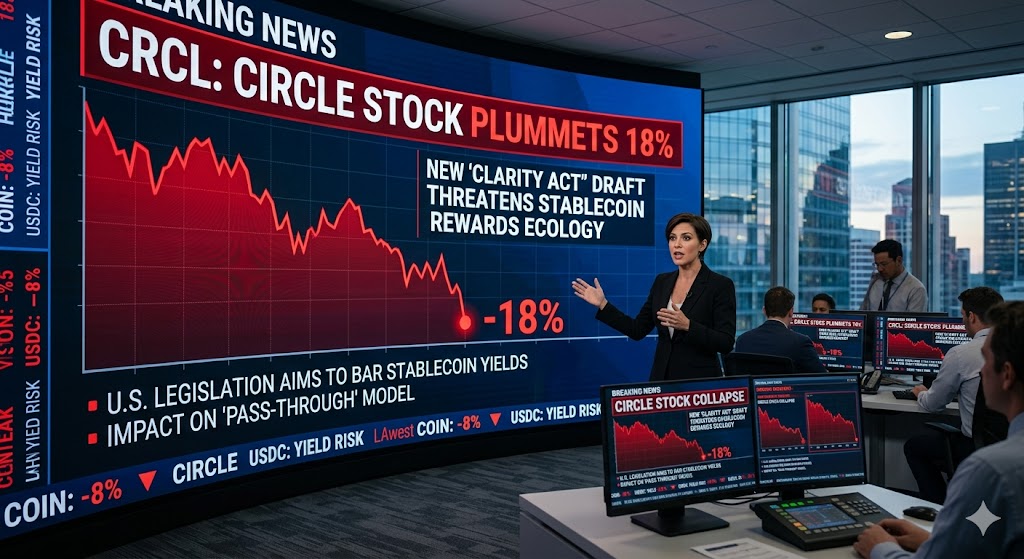
Circle Stock Plummets 18% as New Clarity Act Draft Threatens Stablecoin Reward Ecosystem
NEW YORK — The digital asset market faced a sharp reality check on Tuesday as shares of Circle (CRCL), the issuer of the USDC stablecoin, plummeted as much as 18%. The sell-off was triggered by a leaked draft of the U.S. Clarity Act, which proposes stringent new limits on how stablecoin issuers and platforms can distribute yields and rewards to holders.
The ripple effect was felt immediately across the crypto-equity landscape. Coinbase (COIN), which shares significant revenue with Circle through their joint stablecoin venture, saw its shares drop approximately 8%. The downturn marks a dramatic reversal for Circle, which had enjoyed a blistering 170% rally since early February.
The Catalyst: Cutting the “Pass-Through” Model
The primary driver of the panic is the latest language found in the Clarity Act draft. Legislators are reportedly targeting the “reward” structures that have become the bedrock of stablecoin adoption.
According to the draft, the bill would:
- Bar rewards on passive stablecoin balances.
- Ban structures that are “economically equivalent to interest.”
- Restrict programs that make stablecoin holdings function like traditional bank deposits.
“The Clarity Act could potentially ban yield payments for simply holding a stablecoin and restrict any approach that makes the program equivalent to a bank deposit,” noted Mizuho analyst Dan Dolev. Dolev highlighted that while this might boost short-term profitability for platforms like Coinbase (by allowing them to stop paying out rewards), it severely weakens the long-term incentive for users to hold USDC over other assets.
A “Rug Pull” on Adoption?
For years, the “bull case” for USDC has been its evolution from a mere medium of exchange to a legitimate store of value. By collecting interest on the massive reserves of U.S. Treasuries backing USDC, Circle has been able to share income with partners like Coinbase, who then pass those gains to users in the form of “rewards.”
Amir Hajian, a digital asset researcher at Keyrock, didn’t mince words:
“It pulls the rug on the pass-through model that has been driving stablecoin adoption. It effectively cuts off the oxygen for the current growth strategy.”
Shay Boloor, chief market strategist at Futurum Equities, added that without the ability to offer yield, it becomes significantly harder for tokens like USDC to evolve beyond simple payment rails.
Rivalry Intensifies: Tether’s “Big Four” Strategic Move
Adding pressure to Circle’s position is a major transparency play from its chief rival, Tether (USDT). As Circle grapples with regulatory headwinds in Washington, Tether announced it has finally hired a “Big Four” accounting firm to conduct a full, comprehensive audit of its USDT reserves.
If Tether successfully produces a clean audit, it could eliminate the “transparency premium” that USDC has long enjoyed, potentially leading institutional users to migrate back to the more liquid USDT.
| Feature | Circle (USDC) | Tether (USDT) |
|---|---|---|
| Market Reaction | -18% (Today) | Stable / Improving Sentiment |
| Regulatory Status | Facing “Clarity Act” Restrictions | Offshore / Enhancing Transparency |
| Yield Structure | Threatened by “Interest Equivalence” Ban | Independent Ecosystem Incentives |
| Audit Status | Regular Attestations | Full “Big Four” Audit Underway |
Analyst Perspectives: Overreaction or Existential Threat?
Despite the double-digit drop, several market veterans suggest the carnage may be a classic “shoot first, ask questions later” scenario.
- Owen Lau (Clear Street): “The actual situation doesn’t appear to be as bad as the headline indicates. Circle is still up more than 30% this year, even after today’s drop.”
- Ryan Rasmussen (Bitwise): Rasmussen argues that the long-term outlook remains bright, noting that “there will be workarounds,” such as loyalty programs or non-monetary incentives that replicate the benefits of yield without violating the letter of the Clarity Act.
- Dan Dolev (Mizuho): Dolev pointed out that USDC’s volume continues to outperform expectations, signaling that real-world use cases—such as cross-border payments—are starting to proliferate regardless of the yield environment.
What Happens Next?
The crypto industry is now pivoting its lobbying efforts toward the Senate, hoping to soften the “economically equivalent to interest” clause before the Clarity Act moves to a final vote. For Circle, the focus remains on its path toward a potential IPO, which many believe is still viable if the company can prove its utility as a global payment infrastructure rather than a high-yield savings vehicle.
As of Tuesday evening, Bitcoin also showed signs of fatigue, slipping below the $70,000 mark as broader market uncertainty dampened the “risk-on” appetite of investors.