
Bunker Busters Loaded: US B-1 Bombers Poised to Hit Iran’s Hidden Sites Amid Gulf Oil Shock
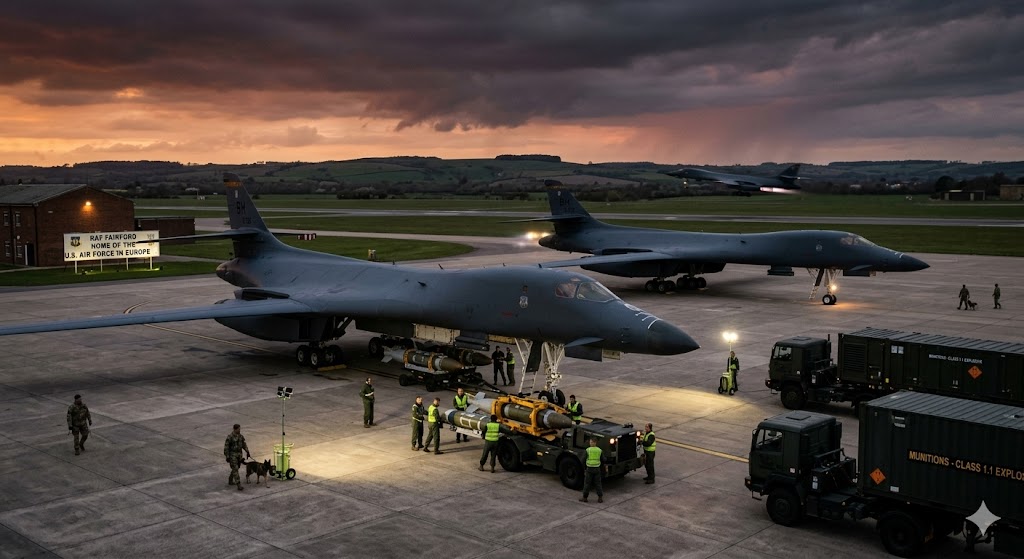
RAF FAIRFORD, United Kingdom — The strategic geography of the 2026 Iran war shifted dramatically this week as a fleet of United States B-1B Lancer bombers touched down at RAF Fairford in Gloucestershire. The deployment, which local witnesses and Al Jazeera teams confirmed on Thursday, March 12, signals a significant escalation in Operation Epic Fury—the joint U.S.-Israeli military campaign that has upended the Middle East since late February.
As the ground crews at the British base were seen maneuvering stocks of GBU-31 Joint Direct Attack Munitions (JDAM)—specifically the massive “bunker-buster” variants—the world remains on edge. The arrival of the heavy bombers coincides with a historic “oil shock,” as crude prices surged past $100 a barrel following the total closure of the Strait of Hormuz.
The Shift in Strategy: From Stand-off to Direct Strikes
For the first ten days of the conflict, the U.S. and Israel relied heavily on long-range standoff missiles and carrier-based F-35 sorties to degrade Iranian air defenses. However, the presence of the B-1B Lancers at RAF Fairford suggests a pivot toward a more aggressive phase of the bombing campaign.
Unlike the stealthy B-2, the B-1B is a supersonic “workhorse” capable of carrying up to 24 massive GBU-31 bombs internally. Military analysts suggest these munitions are destined for Iran’s “hidden sites”—hardened underground facilities housing ballistic missile silos and nuclear research labs in areas like Isfahan and Qom.
“Basing bombers at Fairford significantly shortens turnaround times,” noted one defense expert. “Instead of flying 30-hour round trips from the continental U.S., these crews can now execute precision strikes and be back on British soil in a fraction of the time.”
Starmer’s “Defensive” Pivot
The deployment has sparked a political firestorm in Westminster. On February 28, the day the war began with the assassination of Supreme Leader Ali Khamenei, Prime Minister Keir Starmer insisted that the UK would not be a launchpad for offensive operations.
That stance changed on March 1. Following a drone strike on the British sovereign base at RAF Akrotiri in Cyprus, Starmer authorized the U.S. to use British bases for the “specific and limited defensive purpose” of destroying Iranian missiles “at source.”
- The Cyprus Trigger: The strike at Akrotiri, though causing only minor damage, provided the legal “self-defense” loophole the Starmer government needed to align more closely with Washington.
- The “Churchill” Critique: The delay in granting base access reportedly created a rift with President Donald Trump, who publicly criticized Starmer for not acting with enough resolve, at one point stating, “This is not Winston Churchill we’re dealing with.”
The Global Oil Shock: $120 Peaks and Empty Tankers
While the bombers prepare for their next “pulse” of strikes, the global economy is reeling from the conflict’s maritime fallout.
The International Energy Agency (IEA) declared on Thursday that the war has created the “largest supply disruption in the history of the global oil market,” surpassing even the 1970s crisis.
- Hormuz Closed: New Iranian Supreme Leader Mojtaba Khamenei confirmed in his first public statement that the Strait of Hormuz—the world’s most vital energy artery—will remain closed until Western forces withdraw.
- Supply Crunch: Crude production is down by an estimated 10 million barrels per day.
- Emergency Measures: The IEA has authorized a record release of 400 million barrels from strategic reserves, but analysts warn this is merely a “stop-gap measure” as dozens of tankers sit idle in the Gulf of Oman.
The Human and Military Toll
Operation Epic Fury has already claimed over 2,000 lives across Iran, Lebanon, and Israel. In Iran, the strikes have crippled the command-and-control hierarchy, though retaliatory strikes continue to hit U.S. facilities in Bahrain and Qatar.
| Metric | Status as of March 12, 2026 |
|---|---|
| B-1B Deployment | 8 Aircraft (Fairford & Ramstein) |
| Oil Price (Brent) | $100.42 (fluctuating) |
| Operational Status | Iran airspace largely under U.S. control |
| Diplomatic Status | Strait of Hormuz remains closed by Iran |
The Road Ahead: Destruction “At Source”
The U.S. Central Command (CENTCOM) has made it clear that the goal is the total degradation of Iran’s retaliatory capacity. With the B-1Bs now loaded with bunker-busters at RAF Fairford, the next 48 hours are expected to see some of the most intense bombing of the war.
As the sun sets over the Gloucestershire countryside, the roar of the Lancers’ four GE F101 engines serves as a grim reminder that for the people of the Middle East, the worst of the “Epic Fury” may still be to come.
Would you like me to track the official Ministry of Defence response to the B-1B missions to see if they provide more details on the specific “defensive” targets being hit?