



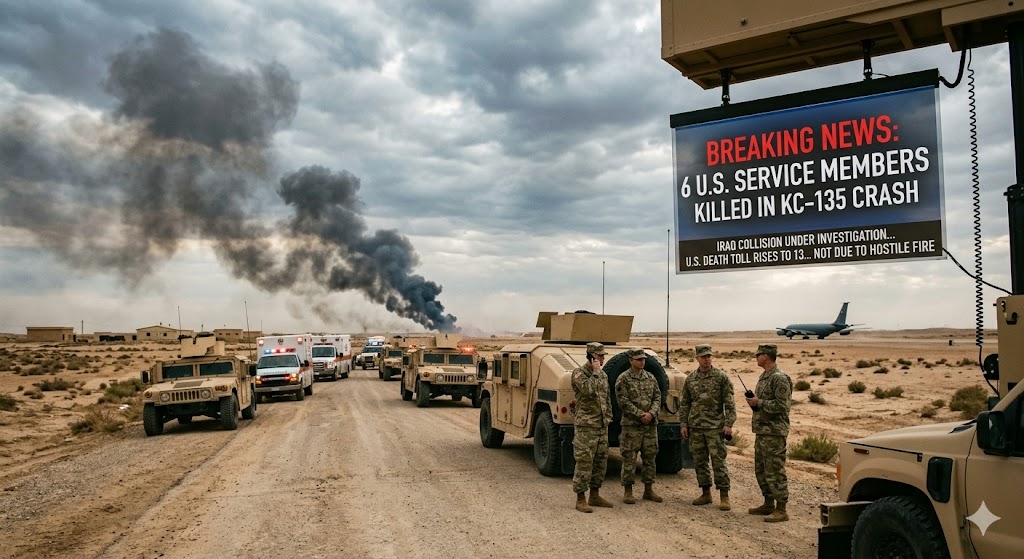
BREAKING: Six U.S. Service Members Killed in Iraq Tanker Crash; U.S. Death Toll Rises
NY INTERNATIONAL NEWS TODAY — U.S. Central Command (CENTCOM) confirmed Friday that all six crew members aboard a U.S. refueling tanker perished after a mid-air collision over western Iraq on Thursday. The incident marks the single deadliest day for American forces since the conflict with Iran began nearly two weeks ago.
The Incident
The aircraft, identified as a KC-135 Stratotanker, was operating in friendly airspace in western Iraq when it collided with another aircraft. While the second aircraft was able to land safely, the KC-135 went down with no survivors.
CENTCOM officials have clarified that while the investigation is ongoing, the crash was not the result of hostile fire or friendly fire. The names of the deceased are being withheld for 24 hours pending “next of kin” notification.
Rising Tensions and Casualties
The crash brings the total U.S. combat-related death toll to 13 as the war nears the 14-day mark. The incident has cast a somber shadow over Washington as military leaders grapple with the operational strain of the conflict.
“Bad things can happen,” Defense Secretary Pete Hegseth stated during a Friday news conference. “American heroes, all of them.”
Dan Caine, Chairman of the Joint Chiefs of Staff, added: “It’s a reminder of the true cost and dedication of the joint force. Our service members make an incredible sacrifice to go forward and do the things that the nation asks of them.”
Operational Context
The KC-135 is a backbone of U.S. aerial operations, providing essential mid-air refueling that allows strike fighters to remain over the battlefield for extended periods. The loss of a tanker and its highly trained crew is a significant blow to the logistics of the ongoing air campaign.
The tragedy comes amidst reports from Secretary Hegseth claiming that Iran’s new Supreme Leader is “wounded and likely disfigured” following recent U.S. strikes, suggesting a highly volatile environment on both sides of the border.
FAQs: Insurance and Benefits for U.S. Service Members Killed in Conflict
The loss of life in a combat zone or during military operations triggers specific federal insurance and survivor benefits. Here is a breakdown of how the U.S. government supports the families of fallen service members.
1. What is SGLI (Servicemembers’ Group Life Insurance)?
Most active-duty service members are automatically enrolled in SGLI.
- Coverage Amount: Up to $500,000.
- Payout: This is a tax-free lump sum paid to the designated beneficiaries. It is designed to provide immediate financial support regardless of the cause of death (combat vs. accident).
2. What is the “Death Gratuity”?
The Death Gratuity is a one-time, tax-free payment of $100,000 made to the next of kin.
- Purpose: To meet immediate financial needs (travel, housing, etc.) before other benefits, like SGLI or monthly survivor payments, begin.
- Timeline: Typically paid within 24 to 72 hours of the service member’s death.
3. Does a “War Clause” in private insurance affect military payouts?
While many private life insurance policies have “War Clauses” that exclude payouts if the death occurs in a combat zone, SGLI does not have a war exclusion. If a service member is killed in Iraq or Iran, SGLI will pay out in full.
Note: Families with private life insurance should check their specific policy for “Accidental Death and Dismemberment” (AD&D) exclusions related to war.
4. What is the Survivor Benefit Plan (SBP)?
The SBP is a monthly annuity paid to the surviving spouse or children.
- Amount: Typically 55% of the service member’s retired pay (calculated as if they had retired with a 100% disability rating at the time of death).
- Duration: Paid for the lifetime of the surviving spouse (unless they remarry before age 55) or until children reach age 18 (or 22 if in college).
5. Are there benefits for education and housing?
Yes. Through the Fry Scholarship, the children and spouses of service members who die in the line of duty after Sept. 10, 2001, are eligible for Post-9/11 GI Bill benefits. This includes:
- Full tuition and fees (at public schools).
- A monthly housing allowance.
- A stipend for books and supplies.
6. Who handles the claims process?
The Casualty Assistance Officer (CAO) is a dedicated military official assigned to the family. They handle all paperwork, explain benefits, and assist with funeral arrangements to ensure the family is not burdened by bureaucracy during their grief.
To help you track the ongoing developments regarding the KC-135 crash and the broader conflict, here are the primary reference links and official sources:
Official Military & Government Sources
- U.S. Central Command (CENTCOM) Statements: Official Press Releases – This is the primary source for casualty counts and incident reports in the Iraq/Iran theater.
- Department of Defense (DoD) News: Defense.gov News Feed – For transcripts of press conferences by Secretary Pete Hegseth and Chairman Dan Caine.
- U.S. Air Force Fact Sheets: KC-135 Stratotanker Technical Data – Technical details on the aircraft involved in the collision.
News & Media Coverage
- Axios: U.S. Death Toll Rises in Iran Conflict – Direct reporting by April Rubin on the geopolitical impact of the crash.
- Military Times: Casualty Reports and Operational Updates – In-depth analysis of the air campaign logistics and service member sacrifices.
- Air Force Times: Safety Investigations and Mid-Air Collisions – Tracking the investigation into why the collision occurred in friendly airspace.
Insurance & Survivor Benefit Resources
- VA.gov: Servicemembers’ Group Life Insurance (SGLI) Overview – Details on the $500,000 payout and beneficiary rules.
- Military OneSource: The Death Gratuity and Immediate Support – Explanation of the $100,000 rapid payment and casualty assistance roles.
- TAPS (Tragedy Assistance Program for Survivors): Support for Fallen Heroes’ Families – A leading non-profit resource for families navigating military loss.
Quick Data Reference
| Incident Detail | Data Point |
|---|---|
| Aircraft Model | KC-135 Stratotanker |
| Total Fatalities (Crash) | 6 Service Members |
| Total U.S. Deaths in Conflict | 13 |
| Conflict Duration | ~14 Days |
| Primary Benefit (SGLI) | $500,000 (Tax-Free) |
Top Stories USA

Anthony DeMayo: A Shadow Over Danvers — High School Senior Charged in ‘Random’ Stabbing of Sleeping Grandmother
DANVERS — The quiet, tree-lined streets of Danvers are once again gripped by the unthinkable. Just over a decade after the town was scarred by the murder of teacher Colleen … Read More
BREAKING: Six U.S. Service Members Killed in Iraq Tanker Crash; U.S. Death Toll Rises
NY INTERNATIONAL NEWS TODAY — U.S. Central Command (CENTCOM) confirmed Friday that all six crew members aboard a U.S. refueling tanker perished after a mid-air collision over western Iraq on … Read More

Sierra Leone Prison Reform: How the “Football for Reform” Initiative is Scoring ESG Investment Goals in 2026
FREETOWN, SIERRA LEONE — In a landmark shift for West African social justice, the intersection of sports, legal advocacy, and high-finance ESG (Environmental, Social, and Governance) investing is creating a … Read More