
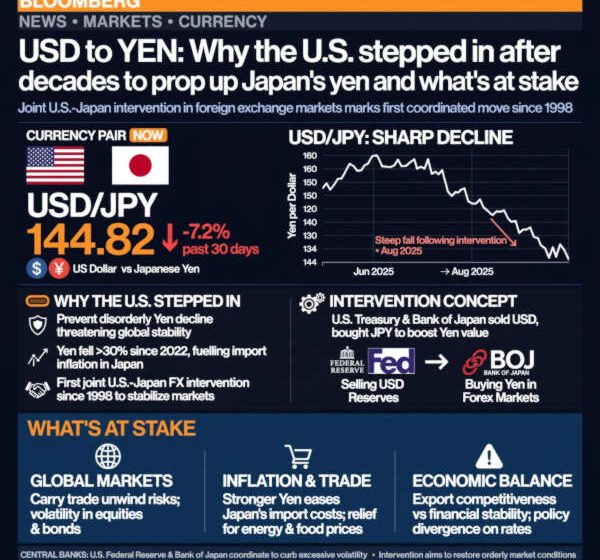
USD to YEN: Why the U.S. stepped in after decades to prop up Japan’s yen and what’s at stake

SINGAPORE / TOKYO / WASHINGTON — The global foreign exchange market was rocked on Monday, August 3, 2026, as the Japanese yen staged an explosive rally against major global currencies. The surge was triggered by official confirmation that Washington and Tokyo had executed a rare, coordinated currency intervention—the first joint operation to buy yen and sell dollars involving the United States in over a decade.
The Japanese currency jumped over 1% during early Asian trading on Monday, hitting a three-month high of 155.20 per dollar before stabilising around 156.46. The move built upon a dramatic 3% surge across late last week, during which the exchange rate retreated from a near 40-year low of 163.73 yen per dollar.
USD/JPY Exchange Rate Trajectory
┌─────────────────────────────────────────────────────────┐
│ July 28, 2026 : ~163.87 (40-Year Yen Low)              │
│ July 31, 2026 : ~160.20 (Pre-Intervention Speculation)  │
│ Aug 01, 2026  : ~157.33 (Joint U.S.-Japan Action)       │
│ Aug 03, 2026  : ~155.20 (Intraday Peak Yen Surge)       │
└─────────────────────────────────────────────────────────┘
The unprecedented willingness of the U.S. Department of the Treasury and the Federal Reserve Bank of New York to directly assist Tokyo in defending its currency has stunned market participants. It marks a pivotal shift in international monetary cooperation, carrying profound implications for global interest rates, U.S. Treasury markets, and the stability of the international financial architecture.
The Catalyst: A Historic Joint Operation
For months, the USD to YEN pair had been spiralling toward levels not seen since the 1980s. The persistent weakness of the yen was fueled by a glaring interest rate differential between the Federal Reserve’s elevated policy rates and the Bank of Japan’s (BOJ) cautious, ultra-gradual pace of monetary tightening.
By late July 2026, the dollar breached 163.80 yen, inflicting severe economic strain on Japan through elevated import costs and rising domestic inflation. While Japan’s Ministry of Finance (MOF) had repeatedly conducted solo yen-buying operations throughout 2024 and 2025, market speculators consistently brushed off those efforts as temporary bumps.
       HISTORIC U.S.-JAPAN CURRENCY INTERVENTIONS
 ┌──────────────────────────────────────────────────────────┐
 │ 1998 — Joint Action to Support the Weakening Yen         │
 │ 2011 — G7 Coordinated Action to Weaken the Surging Yen  │
 │ 2026 — Joint Action to Support the Battered Yen          │
 └──────────────────────────────────────────────────────────┘
Everything changed during late New York trading. Financial reports confirmed that the Federal Reserve Bank of New York, acting on instructions from the U.S. Treasury, sold euros and dollars to purchase Japanese yen.
Japanese Finance Minister Satsuki Katayama officially confirmed the joint operation, stating that the intervention was executed pursuant to bilateral agreements to counter “excessive volatility and disorderly movements in the Japanese yen”. U.S. Treasury Secretary Scott Bessent echoed those sentiments, declaring that Washington “will not hesitate to participate in further joint intervention” alongside Tokyo.
President Donald Trump described the move as a “signal of friendship”. “They have a weakening yen, and they wanted a little bit of help. And we’re always there for Japan,” Trump told reporters, adding that stabilising the Japanese currency would provide a net “financial benefit” and foster broader stability across the world economy.
Why Washington Stepped In: The Underlying Motives
While foreign exchange intervention by a single country is relatively common, coordinated intervention involving the United States is exceedingly rare. History shows that joint interventions carry immense psychological weight in global capital markets.
Financial analysts and macroeconomic strategists point to three critical factors that compelled Washington to step in:
1. Preserving Stability in the U.S. Treasury Market
When Japan intervenes unilaterally to defend the yen, it must sell foreign exchange reserves, which primarily consist of U.S. Treasury securities. As the single largest foreign holder of U.S. government debt, aggressive, uncoordinated liquidations by Tokyo risk driving U.S. Treasury yields significantly higher, spiking borrowing costs for the U.S. government and American consumers alike. By directly participating in foreign exchange markets using alternative reserve balances (such as euro reserves), Washington helped absorb the market impact, preventing a disruptive sell-off in U.S. debt.
2. Preventing a systemic crisis in Japan’s financial system
A runaway depreciation of the yen beyond 165 or 170 per dollar threatened to trigger capital flight from Japan and place immense pressure on regional Japanese banks holding vast foreign liabilities. A systemic shock to Japan—the world’s fourth-largest economy—would quickly ripple through global supply chains and international banking networks.
3. Squeezing Massive Speculative Short Positions
The USD to YEN market had become heavily saturated with “carry trade” investors—speculators who borrow in low-yielding yen to purchase higher-yielding U.S. dollars and assets.
MECHANICS OF THE YEN SHORT SQUEEZE
┌───────────────────────────────────────────────────────────┐
│ Speculators build massive Yen Short positions             │
│                        │                                  │
│                        ▼                                  │
│ Coordinated U.S.-Japan Intervention buying Yen            │
│                        │                                  │
│                        ▼                                  │
│ Rapid USD/JPY price drop triggers stop-loss orders        │
│                        │                                  │
│                        ▼                                  │
│ Mandatory unwinding forces mass Yen purchasing            │
└───────────────────────────────────────────────────────────┘
When official intervention pushes the yen sharply higher, these short sellers are forced to buy back yen rapidly to cover their losses, triggering a self-reinforcing short squeeze that amplifies the currency’s recovery.
Market Reactions: Dollar Falls, Rival Currencies Gain
The impact of the joint action was immediately felt across global financial centres. The U.S. Dollar Index, which measures the greenback against a basket of six major peers, slumped over 1.5%, falling to 99.71.
GLOBAL CURRENCY MOVEMENTS (Post-Intervention)
┌──────────────────────┬──────────────────────┬─────────────────────┐
│ Currency Pair        │ Post-Action Level    │ Direction / Impact  │
├──────────────────────┼──────────────────────┼─────────────────────┤
│ USD / JPY            │ 156.34               │ Yen sharply stronger│
│ EUR / USD            │ 1.1559               │ Euro 1.5-month high │
│ GBP / USD            │ 1.3476               │ Sterling near top   │
│ AUD / USD            │ 0.7033               │ Up 0.18%            │
│ NZD / USD            │ 0.5893               │ Up 0.05%            │
└──────────────────────┴──────────────────────┴─────────────────────┘
“History is clear: joint FX intervention packs a punch, and investors should lean with the official flow, not against it,” noted Elias Haddad, global head of markets strategy at BBH. “Since 1998, all coordinated U.S. FX intervention episodes have proven successful in altering market momentum.”
What’s at Stake: The Long-Term Outlook
While joint interventions create immediate market volatility and alter short-term momentum, economists stress that currency intervention alone cannot permanently fix structural imbalances without alignment in fundamental monetary policy.
                     STAKEHOLDER RISK MATRIX
┌─────────────────────────────────────────────────────────────────┐
│ JAPAN (Import Inflation vs. Export Competitiveness)             │
│ • Pro: Reduces imported energy and food costs for households.   │
│ • Con: Erodes converted overseas earnings for major exporters.  │
├─────────────────────────────────────────────────────────────────┤
│ UNITED STATES (Federal Reserve Policy vs. Yield Control)        │
│ • Pro: Prevents spike in U.S. Treasury yields from liquidations.│
│ • Con: Puts downward pressure on the U.S. Dollar Index.         │
└─────────────────────────────────────────────────────────────────┘
“Outside of a change in either the policy mix or the global growth outlook, encouraging capital repatriation by Japanese institutional investors will be the most powerful policy for influencing the currency over a long period,” noted analysts at Goldman Sachs.
All eyes now turn to incoming macroeconomic data. Investor attention is focused on Friday’s U.S. nonfarm payrolls report, alongside upcoming inflation releases ahead of the September Federal Reserve and Bank of Japan policy meetings. If U.S. economic data continues to show resilience or persistent inflation, expectations for high Fed rates could put renewed upward pressure on the USD to YEN pair—testing the resolve of both Washington and Tokyo.
Frequently Asked Questions (FAQs)
What does “joint intervention” mean in foreign exchange markets?
A joint intervention occurs when two or more central banks or national treasuries coordinate to buy or sell currencies simultaneously in the open foreign exchange market. In this case, the U.S. Treasury (via the Federal Reserve Bank of New York) and Japan’s Ministry of Finance jointly bought Japanese yen and sold foreign currencies to strengthen the yen.
Why is the USD to YEN exchange rate so important for global markets?
The USD to YEN currency pair is one of the most heavily traded FX pairs in the world. Japan is a major global creditor and exporter. Uncontrolled swings in the yen affect global trade balances, energy prices, international supply chains, and the multi-trillion-dollar global carry trade.
When was the last time the U.S. directly helped Japan support the yen?
Prior to the joint action, the last time the U.S. Treasury joined Japan in a coordinated yen-buying operation was in 1998 during the Asian Financial Crisis. The two nations also participated in a joint operation in 2011 alongside other G7 nations, though that action was designed to weaken a surging yen following the Great East Japan Earthquake.