
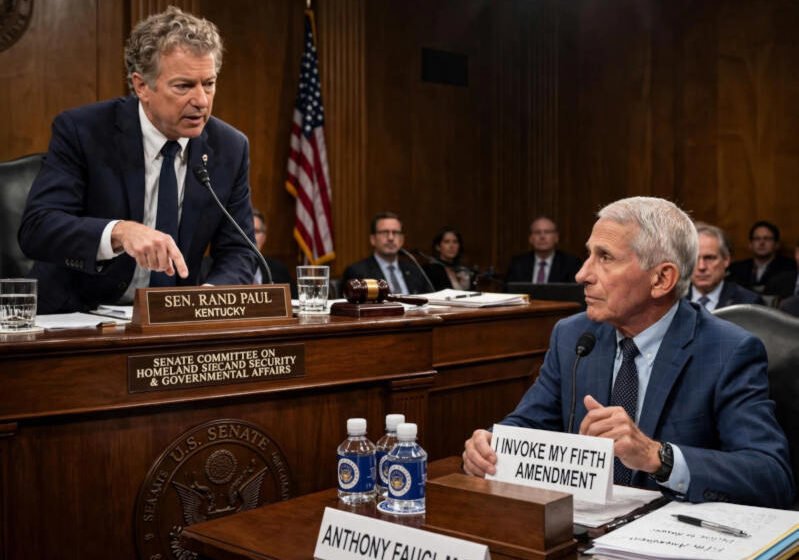
Fauci Claims Fifth Amendment in High-Stakes Hearing as Rand Paul Challenges Scope of Federal Pardon

WASHINGTON – Another latest USA news on Fauci claims 5th Amendment – In a high-stakes confrontation on Capitol Hill, the political and legal battle surrounding the federal government’s handling of the COVID-19 pandemic reached a dramatic turning point. Appearing under subpoena before the Senate Committee on Homeland Security and Governmental Affairs, Dr. Anthony Fauci, former director of the National Institute of Allergy and Infectious Diseases (NIAID), invoked his Fifth Amendment right against self-incrimination more than 100 times.
The hearing, chaired by Sen. Rand Paul (R-Ky.), quickly devolved into a fiery legal standoff. Fauci, who served as the public face of America’s pandemic response for years, declined to answer nearly every substantive question regarding SARS-CoV-2 origins, federal research grants, and public health mandates. His refusal ignited immediate backlash from committee Republicans and media commentators, while setting off a historic push to hold the former public health chief in contempt of Congress.
The Hearing Room Standoff: Invoking the Fifth Over 100 Times
Sitting alone at the witness table, the 85-year-old physician opened the proceedings with a combative statement. Fauci directly accused Sen. Paul of conducting a targeted personal campaign to incarcerate him. Pointing to thousands of pages of personal diary entries and documents that Paul had recently released online, Fauci argued that any substantive testimony would merely serve as fuel for a criminal prosecution.
“Given Senator Paul’s obvious obsession with calling for my prosecution, his repeated slanderous comments about me, and recently his publicly releasing my unredacted personal diary aimed at embarrassing and intimidating me, the only conclusion I can reach is that the sole reason he is calling me before this committee is to get me to say something — anything — that would allow him to meet his repeated pledges to get me behind bars,” Fauci testified.
Following his opening statement, Fauci repeatedly invoked his constitutional right to remain silent—doing so roughly 115 times throughout the session. On the advice of his legal team, he declined to address several critical areas of inquiry:
-
NIH Grant Oversight: The administrative approval process for federal grants awarded to the New York-based EcoHealth Alliance and subsequent sub-awards transferred to the Wuhan Institute of Virology.
-
Gain-of-Function Research: Questions regarding whether federal dollars supported high-risk research aimed at enhancing viral transmissibility or lethality.
-
Personal Log Discrepancies: Newly released personal journal entries that critics claim highlight stark differences between his private uncertainties in early 2020 and his firm public policy declarations.
-
Public Health Directives: The scientific justifications underpinning federal recommendations for early masking mandates, six-foot social distancing rules, and business restrictions.
Tensions escalated dramatically when Chairman Paul ordered Capitol Police to remove Fauci’s primary attorney, David Schertler, from the hearing room. Paul instructed officers to escort Schertler out after the attorney repeatedly interrupted proceedings from the gallery to raise constitutional objections.
Media and Legal Panels React: A Breach of Public Trust
The silent testimony sent shockwaves through political and legal circles, sparking immediate debate over the moral and institutional responsibilities of high-ranking government officials.
During an evening broadcast on Fox News @ Night, a panel of legal scholars and political analysts examined the broader fallout. While acknowledging that every citizen possesses an absolute right to claim Fifth Amendment protections, several legal analysts stressed that public servants who wielded extraordinary executive authority carry an ongoing ethical duty to provide transparency to the taxpayers who funded their decisions.
“When you direct national policy, shut down businesses, dictate school closures, and oversee billions in research dollars, you do not simply retreat behind constitutional silence when asked to account for those decisions,” noted one federal litigator during the broadcast. “The public deserved full disclosures, not a stone wall.”
Panellists emphasised the profound paradox created by the strategy. While the law forbids courts from viewing a Fifth Amendment invocation as an admission of guilt, in the court of public opinion, refusing to answer fundamental questions about taxpayer-funded research severely damages long-term trust in federal scientific institutions.
The Presidential Pardon Dilemma and Legal Exposure
A primary point of contention surrounding the hearing involves the complex legal interaction between presidential pardons and constitutional privileges.
Before leaving office in early 2025, former President Joe Biden granted Dr. Fauci a broad, preemptive federal pardon covering any potential federal offenses committed between 2014 and January 2025. Because a federal pardon eliminates criminal liability for past federal acts, committee Republicans argue that Fauci no longer faces valid criminal exposure for his past actions, thereby invalidating his claim to the Fifth Amendment.
| Jurisdictional & Legal Category | Scope of Preemptive Pardon | Fifth Amendment Applicability |
| Past Federal Offences (2014–2025) | Full immunity against federal criminal prosecution for past conduct. | Contested: Lawmakers argue immunity eliminates self-incrimination risk; defence counsels disagree. |
| Present Live Testimony (2026) | No protection; pardons cannot shield future acts or live perjury. | Valid: Fauci retains full protection against statements that could lead to new perjury charges. |
| State & Local Jurisdiction | Federal pardons do not extend to state criminal codes or civil claims. | Valid: Protection remains intact for potential non-federal legal exposure. |
Defence attorneys and independent legal experts counter that answering complex questions under oath carries fresh, immediate risk. Any discrepancy between current testimony and past statements before Congress could form the basis for new perjury or false-statement charges—offences that a prior pardon cannot cover. For this reason, legal defence scholars argue that invoking the privilege remains a sound tactical necessity.
Sen. Rand Paul Moves for Contempt of Congress
Rejecting the defence’s legal rationale, Sen. Paul announced before adjourning that the committee would not allow the silence to stand without legal pushback. Paul formally scheduled a committee vote to certify Dr Fauci in contempt of Congress.
If the process moves forward, Congress can pursue several distinct procedural avenues:
-
Committee Contempt Vote: The Senate Homeland Security Committee meets to vote on a formal resolution certifying that Fauci unlawfully refused to answer subpoenaed questions.
-
Full Senate Floor Vote: Upon committee approval, the resolution advances to the full Senate floor, where a simple majority vote is required to pass.
-
Department of Justice Referral: Following Senate certification, the leadership refers the citation to the U.S. Attorney for the District of Columbia for criminal prosecution under 2 U.S.C. § 192.
-
Civil Enforcement Action: Alternatively, the Senate can file a civil lawsuit in federal court, seeking an injunction that compels testimony under threat of fines or coercive detention.
“Because you refuse to answer, citing a privilege that is unsupported because of your pardon, and after being denied to do so, this committee has scheduled a vote on a resolution certifying your contempt,” Paul told Fauci at the conclusion of the hearing.
Deep Political Polarisation over Pandemic Governance
The dramatic Capitol Hill showdown reflects the deep political divide that continues to shadow America’s pandemic policy legacy.
While Republican lawmakers view congressional oversight as essential to uncovering the truth regarding lab leaks, grant oversight, and administrative overreach, Senate Democrats forcefully condemned the proceedings. Ranking Member Sen. Gary Peters (D-Mich.) characterised the event as a partisan spectacle aimed at generating headlines rather than advancing legitimate public health solutions. Several Democratic senators walked out of the room during questioning, echoing concerns raised in an open letter signed by over 150 scientific professionals who defended Fauci’s decades of public service.
Nevertheless, as Capitol Hill prepares for the upcoming contempt vote, legal observers note a lasting outcome: when public health policy relies fundamentally on public trust, silence before legislative oversight deepens public scepticism. Whether through judicial rulings, floor debates, or upcoming committee votes, the pursuit of accountability surrounding the nation’s COVID-19 response remains far from complete.
Dr. Fauci invokes Fifth Amendment over 100 times during Senate hearing
This news report provides direct broadcast footage and detailed context regarding Dr Fauci invoking his Fifth Amendment right during his Senate committee appearance.