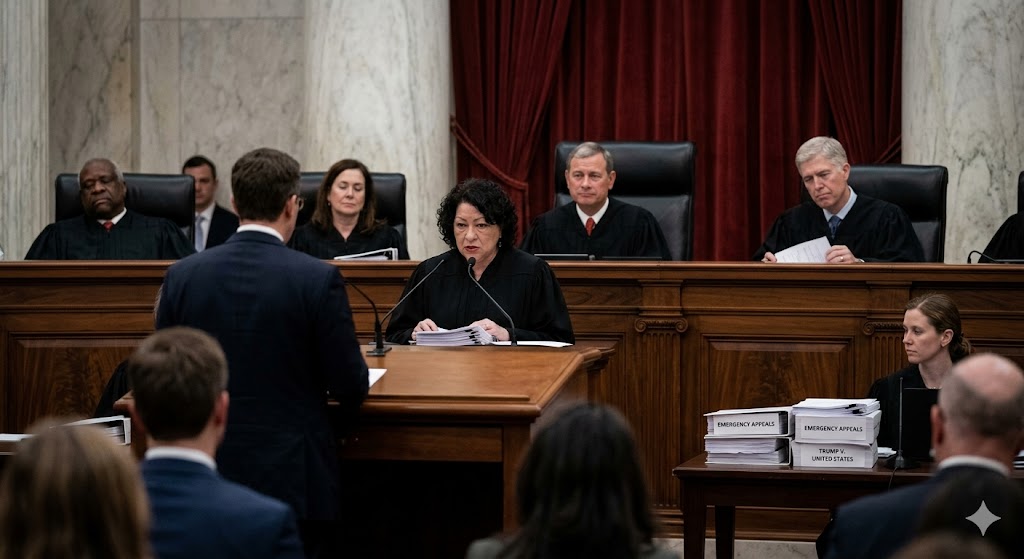
Justice Sotomayor Raises Alarm Over Surge in Emergency Appeals
WASHINGTON — A new flashpoint has emerged inside the U.S. Supreme Court as Sonia Sotomayor publicly criticized what she described as an “unprecedented” surge in emergency appeals filed during the administration of Donald Trump.
Speaking at the University of Alabama School of Law, Sotomayor warned that the increasing reliance on the Supreme Court’s emergency docket—often referred to as the “shadow docket”—is reshaping how major legal decisions are being made in the United States. Her remarks highlight growing concern within the judiciary about how quickly high-stakes policies are being reviewed and decided without full briefing or oral arguments.
“The volume of emergency applications has increased dramatically,” Sotomayor said, emphasizing that the trend is unlike anything seen in the court’s history.
What Is the Emergency Docket?
The Supreme Court’s emergency docket allows justices to issue rapid rulings on urgent legal matters, often involving requests to block or reinstate government policies while lower court litigation continues. Traditionally, such decisions were rare and reserved for extraordinary circumstances.
However, under Trump’s presidency, the use of this process expanded significantly. The administration frequently turned to the court for swift intervention when lower courts blocked key policies, particularly on issues such as immigration, border enforcement, and executive authority.
This growing dependence on expedited rulings has sparked debate about transparency and fairness, as decisions are often issued without detailed explanations.
Conservative Majority’s Legal Philosophy Under Scrutiny
According to Sotomayor, part of the reason behind the Trump administration’s success on the emergency docket lies in the judicial philosophy of the court’s conservative majority. She suggested that several conservative justices believe that temporarily blocking executive actions can cause harm that cannot easily be reversed.
This perspective, she explained, often leads the court to allow policies to remain in effect while legal challenges proceed, rather than pausing them. As a result, administrations—particularly Trump’s—have found a strategic advantage in seeking emergency relief from the Supreme Court.
Sotomayor’s comments reflect a broader ideological divide within the court. Liberal justices tend to favor maintaining lower court rulings that block policies until full review, while conservative justices are more inclined to preserve executive actions during ongoing litigation.
A Pattern of Wins for Trump Administration
During his time in office, Trump secured a series of high-profile victories through emergency appeals. These included cases involving immigration restrictions, asylum policies, and regulatory changes that had been halted by lower courts.
By appealing directly to the Supreme Court, the administration was often able to bypass lengthy legal processes and obtain swift rulings in its favor. This strategy not only allowed key policies to move forward but also set a precedent for future administrations.
Legal experts note that while emergency relief has always been part of the court’s function, its expanded use during this period represents a significant shift in how executive power is contested and upheld.
Criticism of Judicial Transparency
One of the central concerns raised by Sotomayor is the lack of transparency associated with emergency docket decisions. Unlike full opinions issued after oral arguments, these rulings are often brief and unsigned, providing limited insight into the justices’ reasoning.
Critics argue that this undermines public trust in the judiciary and makes it difficult to understand how and why decisions are being made. Sotomayor echoed these concerns, warning that the increasing reliance on such rulings could erode confidence in the court’s impartiality.
She has previously voiced similar criticisms in written dissents, calling for greater accountability and more detailed explanations in emergency decisions.
Broader Implications for the Legal System
The rise in emergency appeals has broader implications for the American legal system. It shifts the balance of power between lower courts and the Supreme Court, allowing the highest court to intervene more frequently and more quickly.
This trend also raises questions about the role of the judiciary in checking executive power. While the Supreme Court is designed to serve as a final arbiter of legal disputes, its increased involvement at early stages of litigation could alter how cases are developed and resolved.
Legal scholars are divided on whether this shift represents necessary efficiency or a troubling departure from established norms.
Intersection With Immigration and Policy Battles
Many of the emergency appeals filed by the Trump administration were tied to immigration policies, including enforcement actions and regulatory changes. These cases often carried significant political and humanitarian implications, adding urgency to legal challenges.
Sotomayor’s remarks come amid renewed debate over immigration enforcement and the role of federal agencies. In related comments, she also criticized the court’s handling of certain immigration rulings, including decisions involving Immigration and Customs Enforcement (ICE).
Her critiques underscore ongoing tensions within the court over how to balance national security concerns with individual rights.
Response From the Court and Legal Community
While Sotomayor’s comments have drawn attention, other members of the court have not publicly responded to her remarks. The Supreme Court traditionally avoids engaging in public disputes, maintaining an image of institutional neutrality.
However, her statements are likely to resonate within the legal community, where debates over the emergency docket have been intensifying. Many legal experts see the issue as one of the most significant procedural developments in recent years.
Some argue that the increased use of emergency appeals reflects the growing complexity and urgency of modern governance. Others warn that it risks undermining the careful deliberation that has long been a hallmark of the Supreme Court.
Political and Public Reactions
The issue is also gaining traction in political circles, where it is becoming part of broader discussions about judicial reform. Critics of the current system are calling for changes to increase transparency and limit the use of emergency rulings.
Supporters, on the other hand, argue that the court must retain flexibility to respond quickly to urgent legal challenges, particularly when national policies are at stake.
Public awareness of the emergency docket has grown in recent years, as high-profile cases have brought attention to the process. Sotomayor’s remarks are likely to further elevate the conversation.
Looking Ahead: A Continuing Debate
As the Supreme Court continues to navigate a complex legal landscape, the role of the emergency docket will remain a key point of contention. Sotomayor’s warning highlights the need for ongoing scrutiny and discussion about how the court operates.
The balance between efficiency and transparency, speed and deliberation, will shape the future of the judiciary. Whether reforms are introduced or current practices continue, the debate sparked by these developments is far from over.
Conclusion
Justice Sonia Sotomayor’s remarks have brought renewed focus to a critical issue within the U.S. Supreme Court. By describing the surge in emergency appeals under the Trump administration as “unprecedented,” she has raised important questions about the evolving role of the court and the principles that guide its decisions.
As legal battles continue and new cases emerge, the use of the emergency docket is likely to remain a defining feature of the judicial process. For now, Sotomayor’s critique serves as a powerful reminder of the challenges facing one of the nation’s most important institutions.