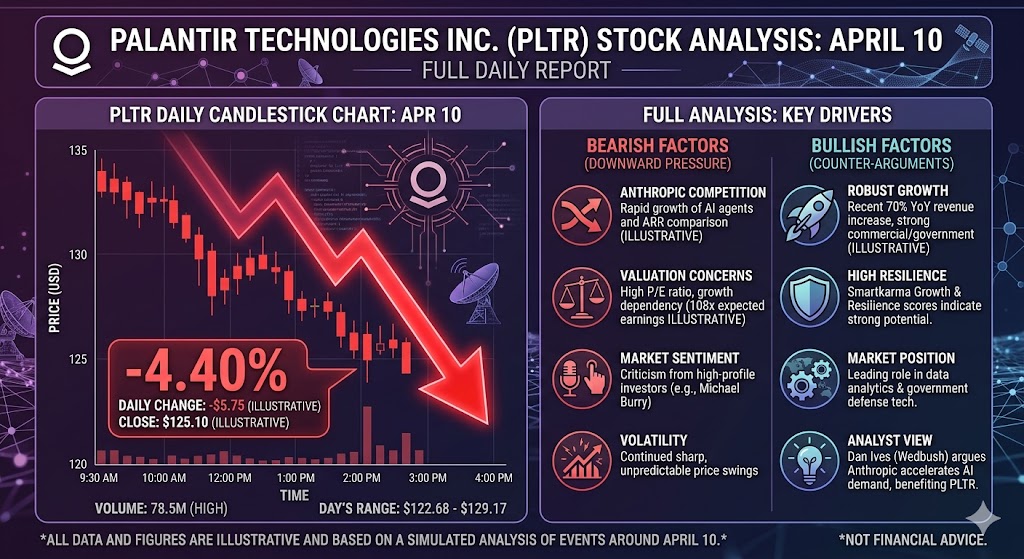
Shares of Palantir Technologies Inc. declined sharply by 4.40% on April 10, 2026, underperforming both its sector and broader market peers. The drop comes amid a mix of rising competitive concerns in artificial intelligence, shifting geopolitical dynamics, and renewed scrutiny over the company’s premium valuation.
While the Software & IT Services sector slipped only modestly, Palantir’s decline stood out, especially compared with other high-profile names like Microsoft Corp. and emerging AI infrastructure firm CoreWeave. The move signals a deeper shift in sentiment toward high-growth AI stocks that have rallied aggressively over the past year.
AI Competition Heats Up: Anthropic Enters the Spotlight
A major catalyst behind the selloff appears to be investor anxiety surrounding intensifying competition in the AI space. Notably, famed investor Michael Burry raised concerns about the rapid rise of Anthropic, a company increasingly viewed as a formidable challenger in enterprise AI solutions.
Burry highlighted Anthropic’s accelerating revenue growth and emphasized the simplicity and accessibility of its AI tools compared to Palantir’s more complex platforms. This commentary quickly reverberated across markets, reigniting debates over whether Palantir can maintain its competitive moat in a fast-evolving AI landscape.
For years, Palantir has differentiated itself through deep integration with government agencies and complex enterprise systems. However, newer AI entrants are focusing on ease of deployment and scalability—qualities that appeal to a broader commercial customer base. This shift may gradually erode Palantir’s edge, particularly in the private sector where competition is intensifying.
Geopolitical “War Premium” Begins to Fade
Another key factor weighing on Palantir’s stock is the recalibration of geopolitical risk premiums. Over recent months, heightened tensions in the Middle East—particularly involving Iran—had boosted defense-related stocks, including Palantir, due to expectations of increased government spending on intelligence and analytics.
However, recent reports of a ceasefire have dampened those expectations. As geopolitical tensions ease, investors are unwinding what analysts call the “war premium” embedded in certain stocks.
Palantir, with its heavy reliance on government contracts, is particularly sensitive to such shifts. The easing of tensions reduces the likelihood of short-term spikes in defense budgets, prompting investors to reassess the company’s near-term growth catalysts.
This transition is crucial: markets are now moving away from speculative geopolitical drivers and refocusing on fundamentals such as revenue growth, margins, and valuation.
Strong Fundamentals Overshadowed by Market Sentiment
Ironically, the selloff comes despite strong recent financial performance from Palantir. The company reported impressive fourth-quarter results, including robust revenue growth and an upward revision of its 2026 guidance.
Its U.S. commercial segment has been a standout performer, reflecting successful expansion beyond its traditional government client base. This diversification has long been viewed as critical for sustaining long-term growth.
Yet, even strong earnings have not been enough to offset investor concerns. The stock continues to trade at a premium relative to peers, making it vulnerable to any negative sentiment or external shocks.
In high-growth sectors like AI, valuation plays a critical role. When expectations are elevated, even minor concerns—whether competitive or macroeconomic—can trigger outsized market reactions.
Analyst Views: Optimism Meets Caution
Wall Street sentiment on Palantir remains mixed. While many analysts continue to maintain “Buy” ratings, citing long-term growth potential in AI and data analytics, others are becoming more cautious.
Several firms have recently lowered their price targets or reiterated “Hold” recommendations, pointing to valuation concerns and increasing competition. The divergence in views reflects broader uncertainty about how the AI market will evolve and which companies will ultimately dominate.
The current volatility in Palantir’s stock suggests that investors are actively reassessing its growth narrative. While the long-term outlook remains promising, the path forward may be more complex than previously anticipated.
Technical Indicators Signal Weak Momentum
From a technical perspective, indicators suggest bearish momentum in the short term. The MACD (12,26,9) stands at -0.64, indicating a sell signal, while the RSI at 35.57 places the stock in a neutral zone.
Meanwhile, the Williams %R at -94.05 signals that the stock is in oversold territory. This could potentially lead to a short-term bounce, but it also reflects the intensity of recent selling pressure.
Traders are likely to monitor these indicators closely in the coming sessions, especially for signs of stabilization or reversal.
Broader AI Sector Repricing Underway
Palantir’s decline is not happening in isolation. The broader AI sector is undergoing a period of recalibration as investors reassess growth expectations, competitive dynamics, and macroeconomic conditions.
Over the past year, AI stocks have seen massive inflows, driven by optimism around generative AI and enterprise adoption. However, as the market matures, differentiation between companies is becoming more pronounced.
Investors are increasingly focusing on:
- Product usability and scalability
- Customer acquisition costs
- Revenue sustainability
- Competitive positioning
In this environment, companies that fail to clearly articulate their unique value proposition may face increased pressure.
What Lies Ahead for Palantir?
Looking forward, Palantir faces a critical juncture. The company must navigate several challenges simultaneously:
- Defending its competitive position against rapidly evolving AI startups
- Maintaining growth momentum in both government and commercial segments
- Justifying its premium valuation in a more skeptical market environment
- Adapting to shifting geopolitical dynamics that influence its core business
Despite these challenges, Palantir still holds significant strengths, including deep expertise in data analytics, strong government relationships, and a growing presence in commercial markets.
The key question for investors is whether these strengths are sufficient to sustain long-term growth in an increasingly crowded AI landscape.
Conclusion
The 4.40% drop in Palantir’s stock reflects more than just a single-day market reaction—it signals a broader shift in how investors are evaluating high-growth AI companies.
Concerns about rising competition from players like Anthropic, combined with fading geopolitical tailwinds and valuation pressures, have created a perfect storm for the stock.
While Palantir’s fundamentals remain strong, the market is clearly demanding more clarity and confidence in its long-term strategy. As the AI race intensifies, the company will need to prove that it can not only keep pace but also maintain its leadership position.
For now, volatility is likely to remain a defining feature of Palantir’s stock, as investors continue to weigh its potential against an increasingly complex and competitive backdrop.