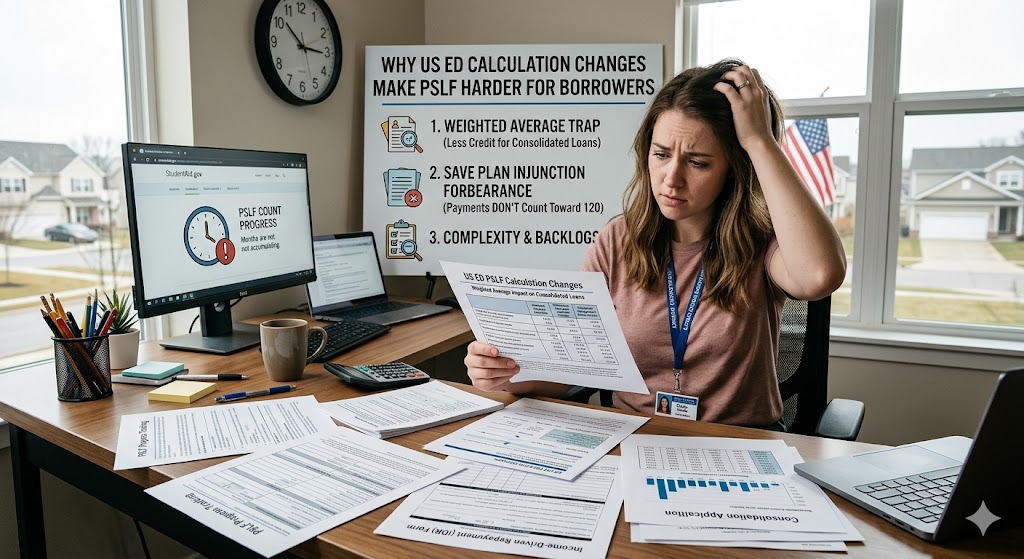
Business News USA: Read on this blog all about why the USA education department’s calculation changes make public service loan forgiveness 2026. For over a decade, the Public Service Loan Forgiveness (PSLF) program has stood as a beacon of hope for millions of Americans. The premise was beautifully simple: dedicate ten years of your life to public service—working as a teacher, a nurse, a firefighter, a public defender, or a non-profit employee—make 120 qualifying monthly payments, and the federal government will forgive the remaining balance of your student loans. It was designed to be a reciprocal agreement, a reward for choosing community over corporate salaries.
However, the reality of PSLF has historically been anything but simple. After years of red tape, systemic servicer errors, and incredibly low approval rates, the Department of Education recently implemented sweeping temporary waivers designed to fix the broken system. For a brief, shining moment, hundreds of thousands of borrowers finally saw their debts wiped clean.
But the landscape has shifted yet again. Between new court injunctions, the end of temporary waivers, and a massive transition in how the government processes these loans, the rules of the game are changing. If you are feeling confused and exhausted by the shifting goalposts, your feelings are entirely validated.
Let’s break down exactly how recent education department calculation changes make public service loan forgiveness harder for borrowers, what is happening behind the scenes, and how you can protect your progress toward financial freedom.
The End of the IDR Account Adjustment and the “Weighted Average” Trap
To understand the current frustration, we have to look at what just ended. To fix historical mismanagement, the Biden-Harris administration introduced the Income-Driven Repayment (IDR) Account Adjustment. This one-time waiver allowed borrowers to consolidate their varied student loans—some of which might have had 80 qualifying payments, while others had 20—and receive the highest payment count across the board. It was a massive lifeline.
That waiver officially expired on April 30, 2024 (with processing continuing through the summer). Now, the Department of Education has reverted to a new, stricter calculation method for borrowers who need to consolidate their loans.
The New Calculation: The Weighted Average
If you consolidate your federal student loans today, you no longer get the highest payment count applied to the new consolidation loan. Instead, the Department of Education uses a “weighted average” calculation based on the principal balances of the loans being consolidated.
- Example: Imagine you have an older loan of $10,000 with 60 qualifying PSLF payments, and a newer loan of $10,000 with 0 qualifying payments from a recent graduate degree.
- The Old Rule (Waiver): If you consolidated them, the new $20,000 loan would be credited with 60 payments.
- The New Rule (Weighted Average): Because the balances are equal, the new consolidation loan will take the average of the payments. Your new $20,000 loan will now only have 30 qualifying payments.
For borrowers who are trying to streamline their finances or bring older loans up to speed with newer ones, this calculation change is a massive blow. It penalizes borrowers for seeking higher education later in their careers and fundamentally slows down their path to forgiveness.
The SAVE Plan Injunction and the Forbearance Nightmare
Perhaps the most jarring disruption currently facing public servants is the legal battle surrounding the Saving on a Valuable Education (SAVE) plan. The SAVE plan was introduced as the most generous IDR plan in history, lowering monthly payments significantly for millions of borrowers. Naturally, hundreds of thousands of PSLF seekers enrolled.
However, in the summer of 2024, federal courts blocked the implementation of the SAVE plan following lawsuits from several states. To prevent borrowers from being charged incorrect amounts while the litigation plays out, the Department of Education placed all SAVE enrollees into a sweeping, interest-free administrative forbearance.
While “no payments and no interest” sounds like a win on the surface, it is a disaster for PSLF seekers.
The Calculation Change: Under standard rules, certain administrative forbearances count toward the 120 payments needed for PSLF. However, the Department of Education explicitly stated that the months spent in this specific SAVE-related litigation forbearance DO NOT count toward PSLF.
- The Impact: Millions of teachers, nurses, and social workers are currently stuck in a holding pattern. They are working their public service jobs, but the clock ticking down to their loan forgiveness has been forcefully paused. A public defender planning to reach their 120th payment in October 2024 might now find themselves waiting until mid-2025 or later, purely because they were automatically placed into a forbearance they did not ask for.
This creates a maddening scenario where borrowers are desperate to make their monthly payments to keep their PSLF count moving, but they literally cannot do so because their accounts are frozen.
The Processing Pause and the “Black Box” of StudentAid.gov
Adding fuel to the fire is the massive administrative overhaul that took place in mid-2024. For years, PSLF was managed by a designated third-party servicer (most recently, MOHELA). The Department of Education decided to bring PSLF processing “in-house” to StudentAid.gov to streamline the process and reduce servicer errors.
To facilitate this transition, the Department of Education paused all PSLF form processing from May through July 2024. During this time, payment counts were not updated, and forgiveness applications were put on hold.
While processing has resumed, the backlog is staggering. Borrowers are submitting their Employer Certification Forms (ECFs) and waiting months to see their payment counts updated.
The Calculation Change:
Because of the transition, the way payments are tracked and displayed has changed. Borrowers are logging into their new dashboards only to find discrepancies. Some are missing months of data from the MOHELA transition; others are seeing payments marked as “ineligible” without clear explanations. The transparency that was promised by moving the system to StudentAid.gov has, for many in the short term, resulted in a “black box” where calculations are seemingly arbitrary and nearly impossible to dispute effectively over the phone due to overwhelmed call centers.
The Buyback Option: A Complex Workaround
In response to the outrage over non-qualifying forbearances (like the current SAVE plan freeze), the Department of Education has highlighted the “PSLF Buyback” program. This is a newly codified rule that allows borrowers to retroactively “buy back” months they spent in specific types of non-qualifying forbearance or deferment.
How the Buyback Calculation Works:
If you have exactly 120 months of qualifying employment, but some of those months don’t count because you were in a forbearance (like the current SAVE injunction), you can submit a request to pay for those missing months. The Department of Education will calculate what your monthly payment would have been during that time based on your income then, and bill you for it. Once you pay that lump sum, those months are credited to your account, pushing you over the finish line.
The Catch:
While this sounds like a great safety net, the calculation and execution of the buyback program are deeply flawed.
- You must already have 120 months of certified employment. You cannot buy back months as you go; you have to wait until the very end of your 10-year journey.
- The processing time is abysmal. Borrowers are reporting waiting months just to receive their buyback offers from the Department of Education.
- Lump-sum anxiety. For a teacher or a social worker, coming up with a lump sum of several thousand dollars to buy back a year of frozen payments is often financially impossible, defeating the purpose of an income-driven forgiveness program.
Navigating the Maze: Action Steps for Public Servants
If you are a borrower caught in the crosshairs of these administrative and legal changes, it is easy to feel defeated. The system feels distinctly stacked against the very people it was built to help. However, there are concrete steps you can take to protect yourself and ensure your public service is ultimately recognized.
1. Document Everything Religiously
Do not trust the system to maintain your records perfectly. Download every single payment confirmation, every billing statement, and every message in your servicer inbox. Keep a dedicated digital folder. If the Department of Education’s new system miscalculates your qualifying payments, your personal paper trail will be your only defense.
2. Certify Your Employment Annually (and Manually if Necessary)
Use the PSLF Help Tool on StudentAid.gov to generate your Employer Certification Form every single year, or immediately if you change jobs. While the digital signature process is faster, if your employer’s HR department struggles with the email link, print the manual form, get it signed in pen, and upload it directly to the portal. Do not wait until year ten to certify a decade of work.
3. Monitor Your IDR Plan Status
If you are caught in the SAVE plan forbearance, you have a difficult choice to make. You can stay in the forbearance, save the money you would have spent on payments, and plan to use the “buyback” option later. Alternatively, you can apply to switch to a different, currently active IDR plan (like standard IBR) so your payments start counting again. Note: Switching plans right now is incredibly slow due to the processing backlog, so weigh this decision carefully.
4. Check Your Consolidation Math
If you are considering consolidating your loans to simplify your payments, you must do the math on the new weighted average calculation. If you have older loans that are very close to the 120-payment mark, it may be financially safer to leave them unconsolidated so they are forgiven on schedule, rather than watering down their progress by combining them with newer loans.
Final Thoughts
The fundamental truth is that public service is difficult, essential work, and the financial stress of student loans only makes it harder. The fact that education department calculation changes make public service loan forgiveness harder for borrowers right now is a bitter pill to swallow after years of promised fixes.
However, the PSLF program is written into law. It cannot simply vanish overnight. While the current administration, the courts, and the servicers wrestle with the mechanics of the program, your best defense is relentless vigilance. Stay informed, keep your records pristine, and do not let administrative chaos deter you from claiming the forgiveness you are rightfully earning every single day you show up to serve your community.