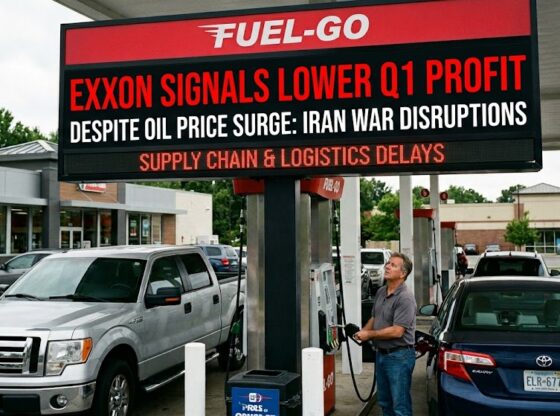

Stock Market News today USA: Earnings Set to Fall Even as Energy Prices Rise
Exxon Mobil Corporation has warned that its first-quarter earnings may decline compared to the previous quarter, despite a sharp rise in global oil and gas prices triggered by geopolitical tensions in the Middle East.
The company’s latest regulatory filing highlights a complex financial picture where higher commodity prices are being offset by large accounting impacts tied to hedging strategies. While oil prices surged following the outbreak of conflict involving Iran, Exxon indicated that these gains will not fully translate into immediate profit growth.
Analysts say this situation underscores how energy companies can experience short-term earnings pressure even during periods of strong market pricing, particularly when financial instruments and delivery delays come into play.
Hedging Impact Creates Multi-Billion Dollar Earnings Hit


A major factor behind the expected earnings decline is a multi-billion dollar hit linked to derivative contracts. Exxon uses hedging strategies to protect against price fluctuations during the time it takes to transport oil and gas shipments to global markets.
In this case, the timing of those contracts has worked against the company in the short term. While upstream operations—responsible for oil and gas production—are expected to benefit from higher prices, downstream operations could see a significant negative impact.
The company estimates:
- Upstream earnings could rise by about $1.4 billion
- Downstream earnings may take a hit of roughly $5.3 billion
This imbalance reflects what analysts describe as a “timing mismatch,” where profits from physical shipments have not yet been realized, even though the associated financial hedges have already affected earnings.
Analysts Point to Temporary Nature of Earnings Dip
Market analysts, including those at RBC Capital Markets, described the earnings outlook as unusually complex due to company-specific and geopolitical factors.
Estimates suggest Exxon’s first-quarter profit could come in around $5 billion, or approximately $1.20 per share. This would mark a notable decline from the fourth quarter, when the company reported adjusted earnings of $7.3 billion, or $1.71 per share.
However, company executives emphasize that the current pressure is temporary. Chief Financial Officer Neil Hansen stated that the negative impact is largely driven by accounting rules and will reverse over time as transactions are completed.
According to the company, once physical shipments tied to these derivative contracts are delivered and recognized, the trades are expected to generate meaningful positive returns.
Supply Chain Disruptions and War Effects Add Pressure
The broader geopolitical situation has also directly affected Exxon’s operations. The conflict has disrupted energy supply chains, particularly through the Strait of Hormuz, a critical route for global oil shipments.
As a result, Exxon said it would record an impairment of between $600 million and $800 million due to supply disruptions that prevented certain cargo deliveries.
Production has also been impacted. The company expects first-quarter oil and gas output to be about 6% lower compared to the previous quarter. This decline reflects operational challenges in key regions affected by the conflict.
Assets in countries such as Qatar and the United Arab Emirates play a significant role in Exxon’s global production portfolio, making the company particularly sensitive to disruptions in the Middle East.
Oil Price Surge Driven by Geopolitical Tensions
Strait of Hormuz Remains Central to Global Supply


The Strait of Hormuz is one of the most strategically important النفط transit routes in the world, handling roughly 20% of global energy flows. Any disruption in this region has immediate consequences for oil prices.
Following the outbreak of war on February 28, benchmark crude prices surged significantly. Brent crude averaged $78.38 per barrel during the first quarter, representing a 24% increase from the previous quarter. At peak levels during the crisis, prices jumped as much as 65%.
These price movements created both opportunities and risks for energy companies. While higher prices boost revenue potential, they also introduce volatility that can complicate trading strategies and financial reporting.
Production Decline Highlights Operational Challenges
Exxon reported that its global production averaged around 5 million barrels of oil equivalent per day in the fourth quarter. However, the company expects a noticeable decline in the first quarter due to disruptions linked to the conflict.
The reduction in output reflects both logistical challenges and broader instability in energy markets. Delays in shipping, restricted access to key routes, and uncertainty around supply chains have all contributed to lower production levels.
Despite these challenges, Exxon remains one of the world’s largest energy producers, with a diversified portfolio that spans multiple regions and segments of the industry.
Outlook for Coming Quarters Remains Positive
Looking ahead, Exxon expressed confidence that profitability will improve in future quarters. As delayed shipments are completed and accounting mismatches are resolved, the company expects to capture the full benefit of higher oil and gas prices.
Executives indicated that the current situation represents a timing issue rather than a structural weakness. Once market conditions stabilize and supply chains normalize, earnings are likely to rebound.
Investors are expected to closely monitor the company’s full first-quarter results, scheduled for release on May 1. These results will provide a clearer picture of how geopolitical events and market volatility have shaped performance across the energy sector.
Bottom Line for Investors and the Energy Market
The latest update from Exxon highlights the complex dynamics of the global oil industry. Even during periods of rising prices, companies can face short-term earnings pressure due to hedging strategies, supply disruptions, and accounting rules.
For investors, the key takeaway is that Exxon’s expected profit decline does not necessarily signal weakening fundamentals. Instead, it reflects temporary factors that are likely to reverse over time.
As global markets continue to respond to geopolitical developments, the performance of major energy companies like Exxon will remain a critical indicator of broader economic trends.