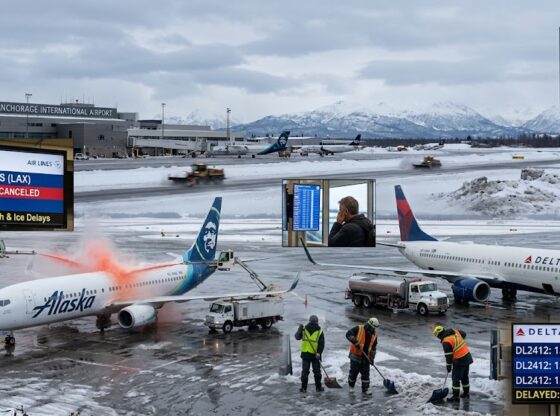

ANCHORAGE — The highly anticipated summer travel season in Alaska is facing severe turbulence before it even fully takes off. In a dual blow to passengers and the state’s massive tourism economy, Delta Air Lines has abruptly scrapped its scheduled summer flights connecting Los Angeles and Anchorage, citing the crushing weight of surging aviation fuel costs. Simultaneously, travelers who are making their way to the Last Frontier are encountering a chaotic ground reality: Ted Stevens Anchorage International Airport has issued stern warnings that severe slush, stubborn ice, and extensive deicing operations are causing massive operational delays.
For the hundreds of thousands of tourists who flock to Alaska’s pristine wilderness, glaciers, and cruise ports every summer, Ted Stevens Anchorage International Airport serves as the primary, and often only, major gateway. Now, a combination of macroeconomic pressures and unforgiving Mother Nature is creating a perfect storm, threatening to ground summer vacation plans and disrupt critical supply chains.
Delta’s Strategic Retreat: The Economics of Surging Fuel Costs
The decision by Delta Air Lines to pull its Los Angeles (LAX) to Anchorage (ANC) route is a stark indicator of the fragile economic tightrope airlines are walking in 2026. The LAX-ANC route, a vital non-stop artery connecting Southern California directly to the heart of Alaska, was highly anticipated by leisure travelers and cruise ship passengers. However, aviation reports released this week indicate that the route has become an unviable casualty of the global energy market.
Aviation fuel is one of the largest operating expenses for any commercial airline. As crude oil prices have surged on the global market due to geopolitical tensions and supply constraints, the cost of refined jet fuel has skyrocketed. For long-haul domestic flights like the near-six-hour journey from Los Angeles to Ted Stevens Anchorage International Airport, the fuel burn is immense.
Delta’s route analysts evidently concluded that passing these exorbitant fuel costs onto consumers through higher ticket prices would severely depress demand, leading to half-empty aircraft and significant financial losses. Consequently, the airline has chosen to reallocate its fleet to shorter, more fuel-efficient routes or higher-yield international destinations where premium cabin demand can offset the price of fuel.
The loss of this direct route is a significant setback for Southern Californians who traditionally escape the summer heat for Alaska’s cooler, adventurous climes. Passengers who had already booked these flights are currently facing the headache of rebooking through connecting hubs in Seattle or Salt Lake City, adding hours of travel time and the increased risk of missed connections.
Ground Zero: The Deep Freeze at Ted Stevens Anchorage International Airport
While Delta’s corporate route planners grapple with spreadsheets and fuel indexes, operations managers on the ground at Ted Stevens Anchorage International Airport are fighting a relentless, physical battle against the elements.
April in Anchorage is historically a transition month, where the brutal Alaskan winter slowly begins to yield to spring. However, this year, Mother Nature has delivered a highly disruptive mix of precipitation. Ted Stevens Anchorage International Airport has been battered by fluctuating temperatures that hover right around the freezing mark, resulting in a treacherous mixture of heavy, wet snow, freezing rain, and dense slush coating the runways, taxiways, and tarmac.
Authorities at Ted Stevens Anchorage International Airport have been forced to issue widespread cautions to airlines and passengers alike. The presence of slush and ice requires constant, intensive runway clearing operations using fleets of massive snowplows and chemical deicers to ensure the friction necessary for safe takeoffs and landings.
More critically, the weather conditions have triggered mandatory, extensive aircraft deicing protocols.
The Bottleneck of Aircraft Deicing
When an aircraft is scheduled to depart Ted Stevens Anchorage International Airport in freezing precipitation, it cannot simply push back from the gate and take off. Even a millimeter of ice or snow on an aircraft’s wings can fatally alter its aerodynamics, reducing lift and increasing drag. Therefore, aircraft must undergo a rigorous deicing process.
At Ted Stevens Anchorage International Airport, this involves taxiing the fully loaded aircraft to designated deicing pads. There, specialized trucks spray the planes with heated Type I deicing fluid—a mixture of propylene glycol and water—to blast away existing snow and slush. If freezing precipitation is actively falling, this is immediately followed by an application of thicker, gel-like Type IV anti-icing fluid, which adheres to the wings and prevents new ice from forming while the plane waits in line for takeoff.
This process is highly effective but incredibly time-consuming. Depending on the size of the aircraft and the severity of the weather, deicing a single commercial jet at Ted Stevens Anchorage International Airport can take anywhere from 15 to 45 minutes. When dozens of aircraft require this treatment simultaneously, a massive bottleneck forms.
Air traffic controllers at Ted Stevens Anchorage International Airport are forced to increase the spacing between departing flights and implement “ground delay programs” for flights originating from other cities across the Lower 48, holding them at their departure gates until airspace and deicing pads open up in Anchorage.
Infrastructure Vulnerabilities and the Ripple Effect
The compounded issues of route cancellations and severe weather delays highlight the delicate nature of critical transportation infrastructure. When essential systems are strained by external forces, the ripple effects are felt across the entire economy.
Much like the unexpected urban infrastructure disruptions seen during the recent nes power outage that left thousands stranded and businesses shuttered without warning, transportation delays at a major hub like Ted Stevens Anchorage International Airport echo throughout the logistical network. Anchorage is not just a passenger hub; it is the fourth busiest air cargo airport in the entire world. When passenger flights are delayed on the tarmac waiting for deicing fluid, cargo jets hauling essential goods, medical supplies, and global e-commerce packages are also caught in the traffic jam.
For the state of Alaska, where geographical isolation makes reliable air travel a matter of basic survival and economic necessity, these disruptions are deeply concerning. Remote communities rely on supplies flown out of Ted Stevens Anchorage International Airport. When the hub slows down, the entire state feels the chill.
The Impact on the Cruising and Tourism Economy
The timing of Delta’s route cancellation and the operational struggles at Ted Stevens Anchorage International Airport could not be worse for the state’s vital tourism sector. Tourism is a multi-billion-dollar pillar of the Alaskan economy, supporting tens of thousands of jobs ranging from tour guides and hotel staff to restaurant owners and charter boat captains.
The summer season is highly condensed, running essentially from mid-May through mid-September. Every single flight arriving at Ted Stevens Anchorage International Airport is a crucial economic engine. Many travelers arriving in Anchorage are doing so to meet massive cruise ships docked in Whittier or Seward, or to embark on multi-day land tours to Denali National Park.
The elimination of Delta’s non-stop Los Angeles flight removes thousands of high-value seats from the market every week. While other carriers like Alaska Airlines continue to serve the route, the sudden decrease in overall capacity will inevitably drive up ticket prices on remaining flights due to the simple laws of supply and demand. This “sticker shock” may force budget-conscious families to rethink their Alaskan vacations entirely.
Furthermore, the immediate delays caused by slush and ice at Ted Stevens Anchorage International Airport are causing logistical nightmares for travelers currently in transit. A delayed flight into Anchorage can mean missing a once-a-day train to Denali, losing a non-refundable day of a wildlife viewing charter, or, worst of all, literally missing the boat if a cruise ship sets sail before delayed passengers can be bussed from the airport to the port.
How Travelers Can Navigate the Chaos
For travelers navigating the current chaotic environment at Ted Stevens Anchorage International Airport or dealing with the fallout of Delta’s route cancellation, aviation experts advise adopting a strategy of extreme flexibility and proactive planning.
- Rebooking Options for LAX Passengers: Travelers holding tickets for the canceled Delta LAX-ANC flights should immediately contact the airline. By federal law, airlines must provide a full refund if a route is canceled and the passenger chooses not to accept an alternative itinerary. However, passengers who still wish to travel should demand to be rebooked on partner airlines or pushed through alternative Delta hubs like Seattle (SEA) or Minneapolis (MSP).
- Monitor Ted Stevens Anchorage International Airport Advisories: Passengers flying into or out of Alaska in the coming weeks should obsessively monitor the operational status of Ted Stevens Anchorage International Airport. Download your airline’s app and enable push notifications for real-time delay alerts.
- Build in Buffer Time: Because of the ongoing deicing delays at Ted Stevens Anchorage International Airport, travelers should never book tight connections. If you are flying into Anchorage to catch a cruise or a train, plan to arrive a full day earlier than necessary. This provides a crucial buffer window if your flight is held on the ground in Seattle or delayed on the tarmac in Anchorage due to ice.
- Travel Insurance: Given the volatility of fuel-driven airline schedules and extreme weather, comprehensive travel insurance is no longer a luxury; it is a necessity. Ensure your policy covers trip interruptions, missed connections, and weather-related delays specifically tied to operations at major hubs like Ted Stevens Anchorage International Airport.
Looking Ahead: The Resilience of Alaska Aviation
Despite the current gloom of canceled routes and slush-covered runways, the aviation industry in Alaska is historically resilient. The operations teams at Ted Stevens Anchorage International Airport are among the most experienced cold-weather professionals in the world. Their snow removal teams, affectionately known in the industry as the “Snow Fleet,” are legendary for their ability to keep the runways open in conditions that would completely paralyze airports in the Lower 48.
The current deicing delays are a frustrating but necessary safety measure, prioritizing human lives over the inconvenience of the clock. As April gives way to May and the temperatures slowly rise above the freezing mark, the ice and slush at Ted Stevens Anchorage International Airport will eventually melt, restoring the airport to its normal, highly efficient operational cadence.
The broader macroeconomic issue of fuel costs, however, remains a looming dark cloud over the industry. Delta’s withdrawal from the Los Angeles-Anchorage market may just be the canary in the coal mine. If jet fuel prices continue their upward trajectory, travelers could see further trimming of long-haul domestic routes by major legacy carriers, forcing a fundamental shift in how Americans access remote, bucket-list destinations like Alaska.
For now, travelers bound for the Last Frontier must pack their patience alongside their parkas. Getting to Alaska this season will require navigating a complex maze of shifting airline schedules and the unpredictable, icy whims of Ted Stevens Anchorage International Airport. Yet, as any seasoned traveler to the state will attest, the moment the wheels touch down and the Chugach Mountains come into view, the grueling journey is always worth the reward.