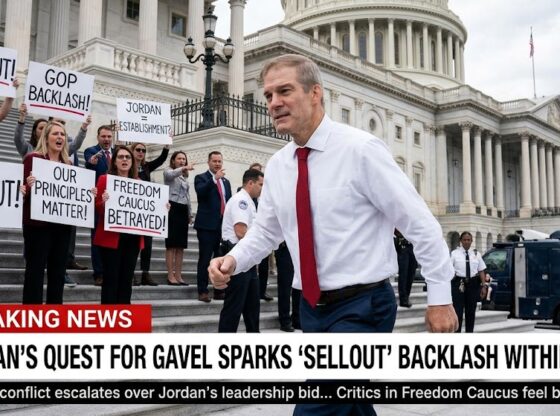

WASHINGTON — For more than a decade, the image of Representative Jim Jordan sprinting through the labyrinthine corridors of the United States Capitol, famously unburdened by a suit jacket, served as the ultimate visual shorthand for conservative rebellion. The Ohio Republican built a national brand, a formidable political war chest, and a fiercely loyal grassroots following by positioning himself as the tip of the spear for the conservative movement’s most combative impulses. He was the perpetual agitator, the man who gleefully tormented Democratic chairs and Republican leadership alike, and the architect of a brand of politics so disruptive that former Republican Speaker John Boehner once famously dismissed him as a “legislative terrorist.”
However, as the spring of 2026 unfolds and the political landscape shifts beneath the weight of President Donald Trump’s return to the White House, a starkly different version of Jim Jordan has emerged. The fiery rhetoric that once defined his committee hearings has been noticeably dialed back. His previously predictable, hardline stances on federal spending and government surveillance have suddenly softened. Within the conservative ranks that once heralded him as an ideological hero, a growing chorus of GOP colleagues is whispering a phrase that was once entirely unthinkable regarding the Ohio conservative: he sold out.
Behind closed doors and increasingly in public corridors, conservative hardliners are accusing the Chairman of the House Judiciary Committee of abandoning his core principles. The prevailing theory for this sudden metamorphosis is as old as Washington itself. Jordan, observers note, has his eyes firmly set on the Speaker’s gavel, and he has seemingly calculated that the path to the top requires him to trade his rebel credentials for the polished, compromising veneer of an establishment dealmaker.
The Metamorphosis of a Firebrand
To fully understand the shockwaves Jordan’s new posture is sending through the Republican conference, one must examine the baseline of his career. Jim Jordan did not just join the conservative insurgency; he was its founding father. As a primary architect of the House Freedom Caucus, Jordan created an institutional home for lawmakers who believed that the Republican establishment was too quick to capitulate to Democrats and too hesitant to use the full leverage of the federal purse strings.
For years, Jordan’s political strategy was simple but brutally effective: demand absolute purity, refuse compromise, and weaponize procedure to grind the legislative gears to a halt if those demands were not met. He was a vocal proponent of shutting down the government rather than funding agencies he viewed as wasteful, weaponized, or misaligned with conservative values. He routinely demanded draconian cuts to federal bureaucracies and insisted on strict, hard-right policy riders on every piece of must-pass legislation.
Yet, since January of last year, a profound quiet has settled over the gentleman from Ohio. According to recent reports, Jordan has taken a much lower-key approach to internal House politics. For a man who built a career on high-profile clashes and viral committee soundbites, this deliberate silence has been deafening to his allies.
The shift was most glaringly on display during the recent, highly contentious congressional squabble over Department of Homeland Security funding. The Senate passed a DHS funding bill that notably omitted massive tranches of funding for federal immigration enforcement agencies. Ordinarily, this is exactly the type of legislative maneuver that would have sent Jordan to the nearest television camera to decry the establishment’s betrayal of border security.
Instead, Jordan’s reaction was jarringly pragmatic. He was reportedly receptive to the Senate’s compromise, noting to colleagues the “upsides of the plan.” To the purists within the Freedom Caucus, conceding ground on immigration enforcement—especially under a Trump administration prioritizing border security—was viewed as an absolute betrayal. Representatives who have long looked to Jordan for their marching orders found themselves entirely at odds with the man who had essentially written their playbook.
The Shadow of the Speaker’s Gavel
The answer to why Jim Jordan is suddenly willing to play ball with the establishment lies not in a sudden change of ideological heart, but in the brutal, unforgiving mathematics of House leadership. To understand Jordan’s 2026 strategy, one must look back to the chaotic autumn of 2023.
Following the historic and unprecedented ouster of Speaker Kevin McCarthy, the House of Representatives was plunged into weeks of paralyzing dysfunction. The internal party mechanics completely stalled, much like a sudden nes power outage plunging a bustling city grid into darkness and confusion. After Majority Leader Steve Scalise withdrew his name from consideration due to insurmountable opposition from the right flank, Jordan saw his golden opportunity.
He became the Republican nominee for Speaker, marking what should have been a crowning achievement for the Freedom Caucus. But what followed was a humiliating, highly public defeat. Over the course of three agonizing floor votes, Jordan not only failed to secure the 217 votes needed to win the gavel, but he bled support with each successive ballot. The moderate wing of the Republican party, along with pragmatic members from districts won by Joe Biden, balked at elevating a man they viewed as an extremist provocateur. They rebuked his aggressive whipping tactics and ultimately forced him to withdraw from the race, paving the way for the ascension of Speaker Mike Johnson of Louisiana.
That public defeat appears to have been a watershed moment for Jordan. The lesson from October 2023 was clear and painful: the hard right possesses the power to veto a Speaker, but they do not possess the numbers to elect one on their own. To win the gavel, a candidate must be palatable to the moderates, the institutionalists, the defense hawks, and the appropriators.
By softening his stance on the DHS budget, Jordan is deliberately signaling to the appropriators that he can be a reliable partner who understands the fundamental necessity of keeping the government open. He is systematically attempting to dismantle the very reasons moderates voted against him three years ago, proving that he can govern, not just disrupt.
The Surveillance State Reversal
If the DHS funding battle opened the door to quiet criticism, Jordan’s recent maneuvering on national security and surveillance blew it entirely off the hinges, sparking open outrage among his former allies.
For years, Jim Jordan has been one of the most prominent, vocal critics of the United States intelligence apparatus. As Chairman of the Select Subcommittee on the Weaponization of the Federal Government, he spent countless hours investigating the FBI, the Department of Justice, and the broader intelligence community. He alleged a deep-state conspiracy aimed at targeting conservatives, parents at school board meetings, and everyday Americans.
A cornerstone of his civil libertarian platform has been his fierce, unyielding opposition to the mass surveillance of American citizens. He specifically took aim at the Foreign Intelligence Surveillance Act, arguing that the government’s surveillance tools were too broad, too invasive, and fundamentally unconstitutional without sweeping, stringent warrant requirements.
Yet, last month, Jordan executed a stunning 180-degree turn. In a move that shocked privacy advocates on both the right and the left, Jordan actively advocated for extending a controversial mass surveillance program. Rather than demanding the sweeping reforms he had championed for years, Jordan worked behind the scenes to smooth over conservative opposition. He helped whip votes to keep the intelligence community’s favored tools intact, effectively carrying water for the very agencies he had spent the last three years claiming were hopelessly weaponized against the American people.
The backlash was immediate and fierce. Colleagues who had stood shoulder-to-shoulder with Jordan in previous fights against the intelligence community expressed feelings of deep betrayal. Libertarian-leaning Republicans were left aghast. How could the chairman of the Weaponization Subcommittee suddenly become the legislative shield for the surveillance state?
By reversing his position on mass surveillance, Jordan is sending a flare up to the powerful defense and intelligence committees. He is showing them that, if given the Speaker’s gavel, he will not let his libertarian streak endanger the national security infrastructure they deem essential. He is trading the applause of the civil liberties crowd for the quiet nod of approval from the national security establishment.
Navigating the Trump White House
Complicating Jordan’s delicate tightrope walk is the looming presence of Donald Trump in the Oval Office. During Trump’s first term, Jordan was his ultimate shield. He aggressively defended the President during two high-profile impeachment inquiries and used his committee perches to launch relentless counter-investigations into Trump’s political rivals. Their alliance was forged in the fire of partisan warfare.
Now, with Trump back in power, the dynamics of that relationship have fundamentally shifted. The Trump administration in 2026 is focused on cementing executive authority, pushing through sweeping legislative packages, and projecting a unified, functional front to the American public. Trump needs a House of Representatives that can pass his agenda. He does not need a House paralyzed by infighting, ideological purity tests, and constant threats of government shutdowns.
By aligning himself with the broader needs of the party and the administration—even when it means compromising his fiercely held past positions—Jordan is positioning himself as the adult in the room. He is trying to prove to Trump, and to the power brokers who surround him, that he is not just a cable news brawler. He wants to be seen as a sophisticated legislative tactician who can manage a fractious conference and deliver bills to the Resolute Desk.
However, this strategy is fraught with immense political peril. Trump’s base, which heavily overlaps with Jordan’s own constituency in Ohio, is highly attuned to perceived sellouts in the “swamp.” They elected Jim Jordan to break the system, not to manage it. If the narrative that Jordan has gone establishment takes deep root, he risks alienating the very voters and grassroots organizations that made him a national figure in the first place.
The Freedom Caucus Civil War
Jordan’s transformation has poured gasoline on an ongoing civil war within the House Freedom Caucus. The group, originally founded as a tight-knit band of principled conservatives willing to buck Republican leadership to limit government size and spending, has increasingly fractured under the weight of its own influence.
On one side of the divide are the pragmatists who believe that governing requires compromise, especially when Republicans hold narrow majorities and control the White House. On the other side are the purists who believe that any concession to the establishment is a betrayal of the voters who sent them to Washington.
By remaining on the sidelines during recent spending fights and actively whipping for surveillance extensions, Jordan has effectively defected to the pragmatists. This has left the purists feeling politically orphaned. They watch as their founding father glad-hands with appropriators, negotiates compromises, and avoids the television cameras during fights he once would have led, wondering if the Jim Jordan of old is gone forever.
“You can’t be the rebel alliance and the empire at the same time,” noted one conservative operative familiar with the internal dynamics of the caucus, speaking on the condition of anonymity. “Jim built his whole career throwing rocks at the glass house of leadership. Now he’s inside the house, trying to reinforce the glass, and telling the people outside to put the rocks down. It’s a very tough sell to the people who bought the rocks in the first place.”
The Burden of Ambition
The political calculation Jim Jordan is making is not unique in the annals of congressional history. Countless firebrands have eventually traded their pitchforks for a seat at the leadership table. But few have done so from such a prominent, ideologically rigid starting point as Jordan.
His current trajectory requires him to thread an impossibly narrow needle. He must convince the moderate wing of the party that his transformation into a pragmatist is genuine and permanent, while simultaneously convincing his hard-right base that his compromises are merely temporary tactical maneuvers necessary to enact a broader conservative agenda.
As the 2026 legislative session progresses, the tension surrounding Jim Jordan will only escalate. Current House Speaker Mike Johnson continues to navigate a treacherous political environment, facing immense pressure from all factions of his conference. Should Johnson stumble, or should a leadership challenge arise following the midterm elections, Jordan is meticulously laying the groundwork to ensure he is viewed as the inevitable, mature successor.
His strategy is a high-stakes political gamble that tests the limits of political reinvention. By shedding the “legislative terrorist” moniker and adopting the posture of an institutionalist, Jordan hopes to finally grasp the Speaker’s gavel that so humiliatingly eluded him in 2023. He is betting that the moderates will forgive his past transgressions, and that the conservative base will eventually understand his compromises.
But in Washington, memory is long, and loyalty is often fleeting. The grassroots activists who fundraise off his name and the right-wing media ecosystem that amplified his voice do not value pragmatism; they value the fight. If Jordan fails to win over the center, he may find that he has already irreversibly sacrificed his standing on the right.
In his quest to lead the entire Republican conference, Jim Jordan risks finding himself a man without a country—alienated from the rebellion he started, distrusted by the establishment he seeks to join, and facing a legacy defined not by the battles he fought, but by the compromises he eventually made. Whether this transformation is remembered as a masterful political evolution or a fatal compromise of core principles will depend entirely on who is holding the gavel when the dust finally settles.