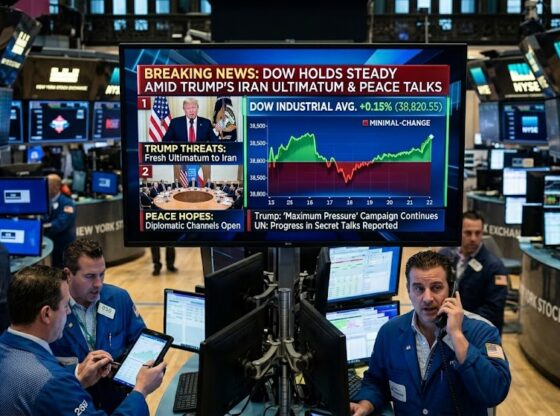


U.S. Stocks Show Resilience Amid Geopolitical Tensions
U.S. financial markets opened the week with cautious optimism as investors balanced rising geopolitical risks against hopes for diplomatic progress. The Dow Jones Industrial Average held steady, while the S&P 500 and Nasdaq Composite posted modest gains.
The stability comes despite fresh threats from President Donald Trump toward Iran, which have injected uncertainty into global markets. Investors appear to be betting that diplomatic efforts may still prevail, preventing a major escalation in the Middle East.
Market sentiment remains fragile, with traders closely monitoring developments related to Iran, energy prices, inflation data, and bond yields.
Market Snapshot: Key Index Performance
As of the latest update:
- Dow Jones Industrial Average: hovering near flatline
- S&P 500: up approximately 0.1%
- Nasdaq Composite: up approximately 0.2%
The relatively muted movement suggests that markets are in a wait-and-watch mode.
Investors are neither panicking nor overly optimistic. Instead, they are cautiously positioning portfolios as new information unfolds.
Trump’s Iran Threats Add Pressure to Markets
Recent statements from Donald Trump regarding Iran have intensified geopolitical concerns.
The U.S. president has issued a deadline tied to Iran-related developments, raising fears of potential military escalation. Such rhetoric typically triggers volatility in global markets, particularly in sectors linked to energy and defense.
However, markets have not reacted sharply—at least not yet.
This suggests that investors are still pricing in the possibility of negotiations or de-escalation.
Geopolitical tensions often act as short-term catalysts for market swings, but long-term impacts depend on actual policy actions rather than statements alone.
Hope for Peace Talks Keeps Markets Stable
Despite the heightened rhetoric, reports of possible peace discussions between the U.S. and Iran have provided a stabilizing effect.
The idea that diplomacy could prevent conflict has helped offset fears.
This dual narrative—threats versus talks—has created a balanced market reaction.
Investors are essentially hedging both scenarios:
- Escalation leading to volatility
- De-escalation supporting market growth
This uncertainty explains why indices are moving only slightly rather than sharply.
Treasury Yields Rise as Inflation Concerns Persist
Another major factor influencing markets is the movement in Treasury yields.
Yields on U.S. government bonds have moved higher as investors prepare for upcoming inflation data and long-term bond auctions.
Rising yields typically signal expectations of:
- Higher inflation
- Potential interest rate adjustments
- Stronger economic activity
However, higher yields can also pressure stock valuations, particularly in growth sectors like technology.
This dynamic is contributing to the cautious tone in equity markets.
Oil Prices and Energy Markets in Focus
Geopolitical tensions in the Middle East often have a direct impact on oil prices.
The Strait of Hormuz, a critical energy route, remains central to the situation. Any disruption could significantly affect global oil supply.
So far:
- Oil prices have shown upward pressure
- Energy stocks have gained attention
- Investors are closely watching supply risks
Higher oil prices can boost energy companies but also increase inflation, which may hurt broader markets.
Gold Gains as Investors Seek Safety
Gold prices have risen modestly as investors turn to safe-haven assets.
Gold typically performs well during periods of:
- Geopolitical uncertainty
- Market volatility
- Currency fluctuations
However, analysts suggest that the upside for gold may be limited if tensions ease quickly.
The current rise reflects caution rather than panic.
Nasdaq Gains Reflect Tech Sector Stability
The Nasdaq Composite’s modest rise indicates continued strength in the technology sector.
Tech stocks often react to:
- Interest rate expectations
- Economic growth forecasts
- Investor risk appetite
Despite rising yields, the sector has managed to hold steady.
This suggests that investors still see long-term value in technology companies.
S&P 500 Signals Broad Market Confidence
The S&P 500’s slight gain reflects overall market resilience.
As a broad index, it includes companies from multiple sectors, making it a key indicator of economic sentiment.
Its performance suggests that:
- Investors are not expecting immediate economic disruption
- Corporate fundamentals remain strong
- Market confidence, while cautious, is intact
Global Markets React to U.S. Developments
International markets are also reacting to U.S. geopolitical and economic signals.
Key trends include:
- European markets showing mixed performance
- Asian markets reflecting cautious optimism
- Currency markets responding to dollar strength
The global economy remains interconnected, meaning developments in the U.S. quickly ripple across markets worldwide.
Investor Strategy: Caution Over Aggression
Current market behavior indicates a shift toward defensive positioning.
Investors are:
- Diversifying portfolios
- Increasing exposure to safe assets
- Monitoring news closely
Rather than making aggressive moves, many are waiting for clearer signals.
This strategy reflects uncertainty but also discipline.
Risks That Could Impact Markets
Several key risks could influence market direction in the coming days:
- Geopolitical Escalation
Any military action involving Iran could trigger sharp market declines. - Inflation Data Surprises
Higher-than-expected inflation could lead to tighter monetary policy. - Bond Market Volatility
Sudden changes in yields could impact equity valuations. - Energy Supply Disruptions
Oil price spikes could affect global economic stability.
Opportunities Emerging in Volatile Conditions
While risks remain, volatility also creates opportunities.
Investors may find value in:
- Energy stocks benefiting from higher oil prices
- Defensive sectors like healthcare and utilities
- Gold and other safe-haven assets
Strategic positioning during uncertain times can yield long-term gains.
Expert Outlook: What Analysts Are Saying
Market analysts generally agree that the current situation is fluid.
Key observations include:
- Markets are resilient but cautious
- Geopolitical headlines will drive short-term movements
- Long-term fundamentals remain strong
Experts advise investors to stay informed and avoid emotional decision-making.
The Role of Federal Reserve Policy
The Federal Reserve remains a critical factor in market direction.
Interest rate decisions, inflation control measures, and economic guidance all influence investor behavior.
If inflation remains high, the Fed may maintain tighter policies, which could impact stock market growth.
Conversely, stable inflation could support continued market expansion.
Market Psychology: Fear vs. Optimism
The current market environment reflects a psychological balance.
On one side:
- Fear of geopolitical conflict
On the other:
- Optimism about diplomacy and economic strength
This balance is why markets are moving sideways rather than sharply.
Investor sentiment is neither overly bearish nor overly bullish.
Short-Term vs. Long-Term Outlook
In the short term, markets are likely to remain volatile.
Key drivers will include:
- Iran-related developments
- Economic data releases
- Federal Reserve signals
In the long term, fundamentals such as corporate earnings and economic growth will play a larger role.
Final Thoughts
The Dow holding steady, alongside modest gains in the S&P 500 and Nasdaq, reflects a market navigating uncertainty with caution.
While Trump’s Iran threats have added tension, hopes for peace talks are preventing panic.
Investors are watching closely, balancing risks with opportunities.
For now, the message from Wall Street is clear:
Stay alert, stay diversified, and expect volatility.