

A Historic Night in Phoenix
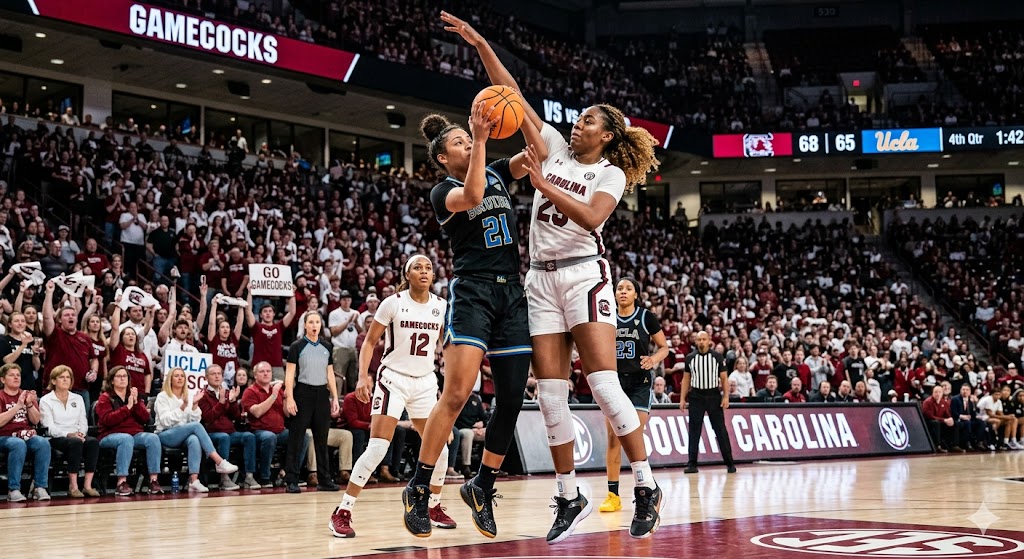
The UCLA Bruins women’s basketball delivered a stunning and historic performance to defeat the South Carolina Gamecocks women’s basketball 79–51 in the NCAA Women’s Basketball Championship final. Played at the Footprint Center in Phoenix, the matchup was expected to be competitive, but UCLA turned it into a one-sided showcase of dominance.
From the opening tip, UCLA imposed its will on both ends of the court. The Bruins combined elite defensive pressure with efficient offense, leaving South Carolina struggling to find rhythm. By halftime, the tone of the game was already clear—UCLA was in complete control.
This victory marks the first national title in UCLA women’s basketball history, ending years of near-misses and establishing the program as a true powerhouse.
UCLA’s Dominance from Start to Finish
UCLA wasted no time asserting control. The Bruins outscored South Carolina 21–10 in the first quarter, fueled by aggressive defense and sharp shooting. The Gamecocks, led by head coach Dawn Staley, found themselves overwhelmed by UCLA’s pace and physicality.
The second quarter saw more of the same. While South Carolina attempted to regroup, UCLA maintained composure and continued executing its game plan. Their defensive rotations disrupted passing lanes, while their offense capitalized on every opportunity.
The third quarter effectively ended the contest. UCLA opened with a decisive 12–3 run, extending the lead beyond 20 points. At that point, South Carolina had no answers for the Bruins’ relentless energy and execution.
Star Performances Define the Championship
The championship was defined by standout individual performances, particularly from UCLA’s core players.
Lauren Betts dominated the paint with authority. Her stat line—14 points, 11 rebounds, and multiple blocks—only tells part of the story. Betts altered countless shots and anchored a defense that completely shut down South Carolina’s inside game. Her impact earned her Most Outstanding Player honors.
Gabriela Jaquez delivered a career-defining performance with 21 points and 10 rebounds. She led the team in scoring and provided consistency throughout all four quarters.
Kiki Rice added 10 points, including a momentum-shifting buzzer-beater at the end of the first quarter. Meanwhile, Gianna Kneepkens and Charlisse Leger-Walker contributed key baskets that kept UCLA’s offense balanced and unpredictable.
On the South Carolina side, Tessa Johnson led with 14 points, offering one of the few bright spots in an otherwise difficult outing.
Tactical Breakdown: Why UCLA Won
UCLA’s victory was not just about talent—it was about execution and strategy.
First, their defense was exceptional. The Bruins forced South Carolina into low-percentage shots and limited their scoring opportunities, particularly in the first half.
Second, UCLA controlled the paint. With Lauren Betts protecting the rim, South Carolina struggled to score inside or secure second-chance points.
Third, UCLA’s balanced scoring made them difficult to defend. Multiple players contributed offensively, preventing South Carolina from focusing on a single threat.
Finally, UCLA’s fast starts in the first and third quarters allowed them to build a commanding lead and maintain momentum throughout the game.
Cori Close’s Legacy-Defining Triumph
At the center of this historic win is head coach Cori Close, who has spent 15 years building UCLA into a championship program.
Close’s philosophy of loyalty and development played a crucial role in this success. In an era where many players frequently transfer, UCLA’s roster was built on continuity and trust. Veterans like Gabriela Jaquez stayed committed to the program, and that commitment paid off in the biggest way possible.
“This has been a calling, not just a job,” Close said after the game, reflecting on the journey. Her leadership has now placed her among the elite coaches in women’s college basketball.
# What This Means for Both Programs
For UCLA, this victory signals the beginning of a new era. With a strong returning core and top recruits on the way, the Bruins are well-positioned to compete for multiple championships in the coming years.
For South Carolina, the loss serves as motivation. Despite the defeat, the Gamecocks remain one of the most dominant programs in the nation under Dawn Staley. Their ability to reload and return stronger is well established.
In the end, the 2026 championship game will be remembered as a defining moment for UCLA. The Bruins didn’t just win—they dominated. Their performance against South Carolina showcased excellence in every aspect of the game, setting a new standard for future champions.
