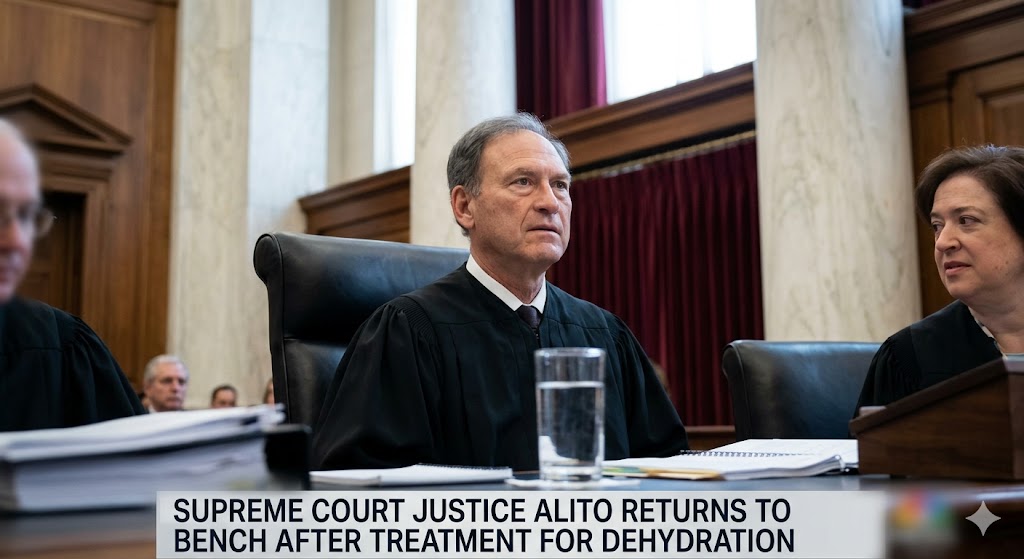


In a brief health-related incident that drew attention in legal and political circles, Samuel Alito was treated at a hospital in Philadelphia in March 2026 after reportedly feeling ill during an event. According to a spokesperson for the Supreme Court of the United States, the 76-year-old justice received medical attention for dehydration and returned home the same day, resuming his duties on the bench shortly afterward.
The episode, while minor in nature, has sparked renewed discussion about the health, longevity, and future of one of the court’s most influential conservative voices, particularly at a time when major legal questions are being debated before the nation’s highest court.
Brief Hospital Visit in Philadelphia
The incident occurred in March while Justice Alito was attending an event in Philadelphia. According to official statements, he began to feel unwell and sought medical care before embarking on what would have been a three-hour drive home.
Medical staff evaluated Alito and administered fluids to address dehydration. After receiving treatment, he was discharged the same evening and returned home as planned. A follow-up examination by his personal physician confirmed that there were no serious underlying health concerns.
The swift nature of the treatment and recovery underscores that the situation was not considered severe. Still, given Alito’s prominent role on the Supreme Court, even a minor health issue naturally drew attention.
Quick Return to Supreme Court Duties
Despite the incident, Justice Alito resumed his responsibilities without delay. He returned to the Supreme Court the following Monday to participate in oral arguments, demonstrating no visible signs of illness.
His participation in the case of Watson v. RNC—a matter with potentially significant implications for election law—highlighted his readiness to continue performing his judicial duties at full capacity.
Observers noted that Alito appeared engaged and active during the proceedings, reinforcing the message from court officials that his health scare had been temporary and fully resolved.
Case Spotlight: Watson v. RNC
The case heard shortly after Alito’s return, Watson v. RNC, centers on whether states can count mail-in ballots that arrive after Election Day, provided they were sent on time.
In Mississippi, the law allows ballots to be counted if they are received within five days after the election. The case raises broader questions about election procedures, state authority, and the interpretation of federal election laws.
The outcome could have nationwide implications, potentially influencing how other states handle mail-in ballots in future elections. Justice Alito’s involvement in such a significant case underscores the importance of his continued presence on the bench.
Longstanding Role on the Supreme Court
Justice Alito has been a key figure on the Supreme Court for nearly two decades. Nominated in 2005 by President George W. Bush, he began serving in 2006 and has since become known for his conservative judicial philosophy.
Over the years, Alito has contributed to numerous landmark decisions, often aligning with the court’s conservative wing. His opinions and legal reasoning have shaped debates on issues ranging from constitutional rights to administrative law.
At 76, he is among the senior members of the court, bringing experience and continuity to its deliberations.
Health and Age: A Broader Conversation
Alito’s brief hospitalization has reignited broader discussions about the age and health of Supreme Court justices. Unlike many other public officials, Supreme Court justices serve lifetime appointments, meaning they can remain on the bench for decades.
This structure is designed to preserve judicial independence, but it also means that questions about health and retirement inevitably arise, particularly as justices grow older.
In Alito’s case, the quick recovery and return to work suggest that he remains capable of fulfilling his responsibilities. However, the incident serves as a reminder of the physical demands associated with the role.
Political Context and Calls for Retirement
The timing of the health scare has also intersected with ongoing political discussions about the composition of the Supreme Court.
Some conservative voices have suggested that Justice Alito consider stepping down while Republicans hold both the Senate and the White House, allowing for the appointment of a like-minded successor. Such calls reflect broader strategic considerations about maintaining the court’s ideological balance.
However, there has been no indication from Alito himself that he is considering retirement. His prompt return to the bench and continued participation in key cases suggest that he intends to remain active in his role.
The Demands of Serving on the Supreme Court
Serving on the Supreme Court involves a rigorous schedule that includes hearing oral arguments, reviewing extensive legal briefs, and drafting detailed opinions.
Justices often travel for speaking engagements and public appearances, adding to the demands of the position. While the role is less physically taxing than some public offices, it requires sustained mental focus and endurance.
Alito’s ability to resume his duties quickly after a brief illness highlights the resilience required to serve at this level.
Public Transparency and Judicial Health
The disclosure of Alito’s hospital visit also reflects the evolving expectations around transparency in public institutions.
While Supreme Court justices are not required to provide detailed health updates, there is increasing public interest in the well-being of individuals who hold lifetime appointments to such influential positions.
In this case, the court’s spokesperson provided a clear and timely explanation, helping to prevent speculation and reassure the public about Alito’s condition.
Historical Perspective
Health incidents among Supreme Court justices are not uncommon, given the age at which many serve. Over the years, several justices have experienced medical issues while continuing to fulfill their duties.
These situations often prompt discussions about succession, judicial capacity, and the balance between experience and renewal within the court.
Alito’s case fits within this broader historical context, illustrating how the institution manages such events while maintaining continuity.
Impact on the Court’s Work
In practical terms, Alito’s brief absence had minimal impact on the court’s operations. His quick return ensured that he could participate fully in scheduled cases and deliberations.
This continuity is important, particularly during a term that includes high-profile cases with far-reaching implications.
The Supreme Court’s ability to function smoothly despite individual health issues reflects the strength of its institutional framework.
Looking Ahead
As the court continues its term, attention will remain focused on the outcomes of key cases and the role of individual justices in shaping those decisions.
For Justice Alito, the recent health incident appears to be a minor interruption rather than a significant concern. His continued presence on the bench suggests that he remains an active and influential member of the court.
At the same time, the episode serves as a reminder of the human dimension behind the institution—highlighting that even those in the highest positions are not immune to everyday health challenges.
Conclusion
The brief hospitalization of Justice Samuel Alito in March 2026 ultimately proved to be a minor episode, with no lasting impact on his ability to serve. Treated for dehydration and cleared by his physician, he returned to the Supreme Court within days and resumed his role in critical legal proceedings.
While the incident sparked discussions about age, health, and the future of the court, it also demonstrated Alito’s resilience and commitment to his responsibilities.
As the Supreme Court navigates a complex legal landscape, Alito’s continued participation ensures that his voice remains a key part of the institution’s decision-making process.
About the Author