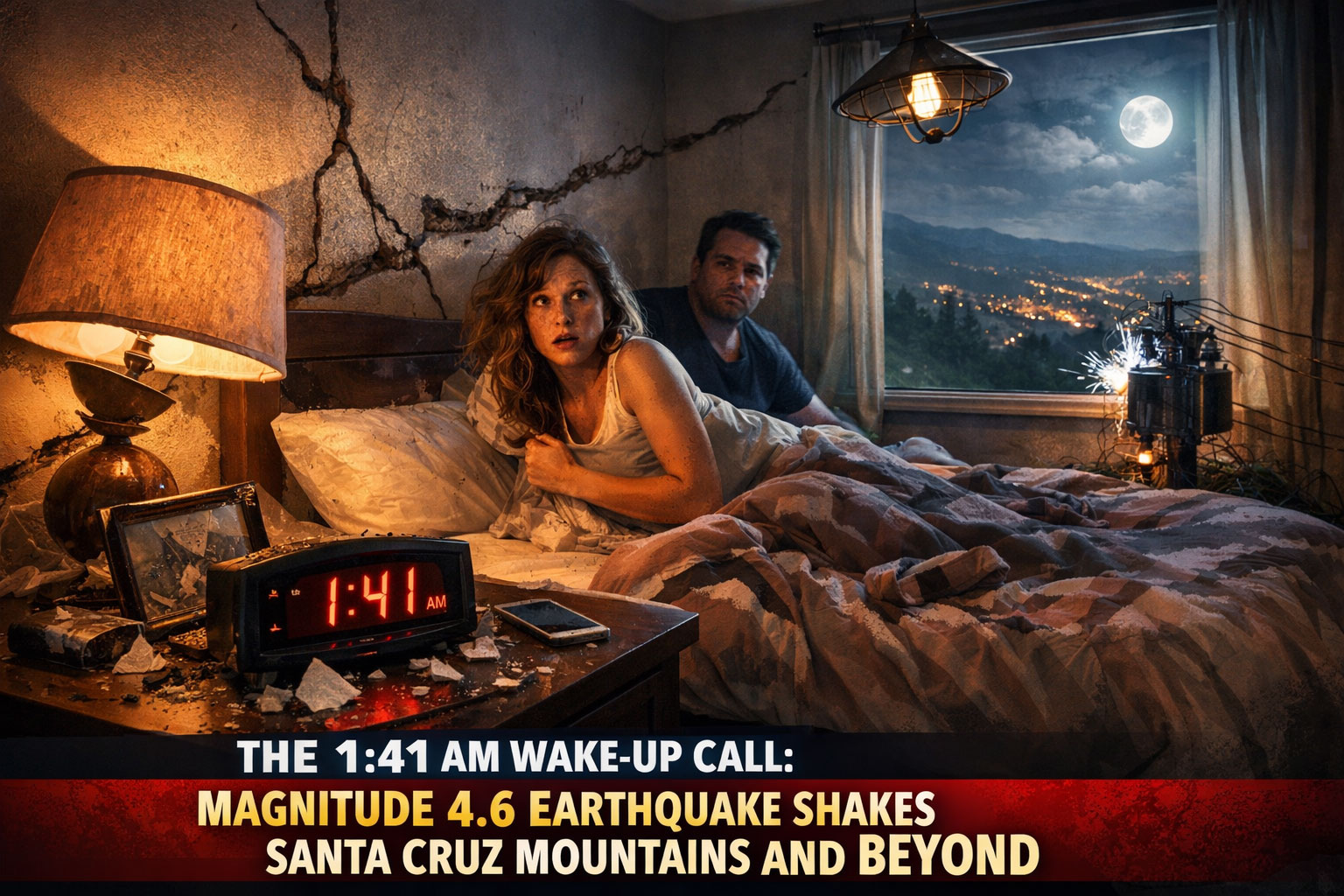
Earthquake news USA: Just when you thought the only thing bumping in the night was your neighbour’s suspiciously loud cat, the Earth decided to drop a bass line. At precisely 1:41 a.m. on Thursday, April 2, 2026, a magnitude 4.6 earthquake reminded Northern California that we live on a very restless giant. Centred near the scenic (and now slightly more jittery) town of Boulder Creek, the temblor sent a literal wake-up call from the Santa Cruz Mountains all the way to the fog-drenched streets of San Francisco.
If you slept through it, congratulations on your elite-level snoring. For the rest of the Bay Area, it was a “grab-the-phone-and-check-Twitter” kind of night.
The Jolt Heard ‘Round the Bay
The USGS (U.S. Geological Survey) initially clocked this seismic party-crasher at a magnitude 4.9. After a few minutes of scientific huddling and data crunching, they downgraded the event to a magnitude 4.6 earthquake. While a 0.3 difference might not sound like much to a layman, in the world of seismology, it’s the difference between “Whoa, did a truck hit the house?” and “Okay, where are the shoes and the flashlight?”
The epicentre sat approximately one mile southeast of Boulder Creek, lurking at a depth of about 6.2 miles. This wasn’t a deep, rolling grumble; it was a shallow, sharp jolt that felt like the planet was trying to shake off a particularly annoying flea.
Where Was the Shaking Felt?
According to the USGS “Did You Feel It?” map, which saw over 26,000 reports flood in within hours, the reach was impressive:
- Boulder Creek & Santa Cruz: “Moderate” to “Strong” shaking. Residents reported items jumping off shelves and a sound like a freight train passing through the living room.
- San Jose & South Bay: A “Light” to “Moderate” swinging sensation. Many were awakened by the ShakeAlert system on their phones about 30 seconds before the rattling began.
- San Francisco & Oakland: “Weak” to “Light” shaking. For many in the city, it was just enough to make the windows rattle and the pets look around in confusion.
- North Bay: Reports trickled in from as far north as Petaluma, proving that seismic waves don’t care about bridge tolls.
No Damage, Just Nerves (and a Few Broken Jars
The best news of the morning? Aside from a few frazzled nerves and a very confused local wildlife population, there were no reports of major damage or injuries.
Cal Fire’s Santa Cruz-San Mateo unit jumped into action immediately, enacting their earthquake protocols. By 2:12 a.m., they gave the “all clear,” confirming that critical infrastructure and buildings remained intact. In Boulder Creek, a local pharmacy reported a few items taking a tumble off the shelves, but for a 4.6 magnitude event, California’s strict building codes once again proved why they are the MVP of the West Coast.
The Science Behind the Shaking
The Santa Cruz Mountains are essentially the tectonic equivalent of a busy intersection. This region sits nestled among complex fault systems associated with the San Andreas Fault. While we often wait for “The Big One,” these mid-range quakes are a frequent reminder that the Pacific and North American plates are constantly jostling for position.
Seismologists consider this 4.6 event the “mainshock.” Earlier in the week, a tiny magnitude 2.0 tremor tickled the same area—a foreshock that most people ignored in favour of Netflix.
The Aftershock Forecast
Don’t put your breakables back on the edge of the shelf just yet. The USGS released an aftershock forecast indicating a 60% chance of a magnitude 3.0 or higher aftershock within the next week.
- Magnitude 3.0+: Likely (expect up to 9 of these).
- Magnitude 4.0+: About a 14% chance.
- Magnitude 5.0+: Less than a 1% chance.
Basically, the Earth is just settling back into its seat after standing up too fast.
The ShakeAlert Hero
One of the most human elements of this earthquake was the digital chorus of phone pings that preceded the shaking. The MyShake app and the ShakeAlert system, powered by UC Berkeley and the USGS, performed flawlessly.
Many residents reported receiving a warning on their smartphones roughly 10 to 30 seconds before the first wave hit. In the world of disaster safety, those seconds are gold. They allow you to:
- Drop to your hands and knees.
- Cover your head and neck.
- Hold On to something sturdy.
Or, if you’re a typical Californian, they give you just enough time to think, “Is this it? No? Okay, let me check Reddit.”
Living in the “Red Zone”: A Survival Refresher
Since the planet clearly wanted our attention this morning, it’s a great time for a quick survival audit. Living in the Bay Area means your “Go Bag” shouldn’t just be a decorative item in your closet.
Quick Tips for the Next Jolt:
- Check Your Shelves: Use museum wax (yes, it’s a real thing) to secure those fancy vases.
- Water is King: Ensure you have at least one gallon of water per person, per day, for at least three days.
- Shoes Under the Bed: The most common earthquake injury? Stepping on broken glass while trying to find the bathroom in the dark. Keep a pair of sturdy shoes and a flashlight right under your bed frame.
- Download the App: If you don’t have MyShake yet, you’re basically raw-dogging reality. Get the alert.
Final Thoughts from Boulder Creek
As the sun rises over the redwoods today, life in Boulder Creek and Santa Cruz returns to its usual, laid-back rhythm. We’ll talk about where we were when it hit, we’ll laugh at our over-dramatic pets, and we’ll go back to complaining about traffic on Highway 17.
But for a few seconds at 1:41 a.m., we were all reminded of the raw, unscripted power beneath our feet. Stay safe, stay prepared, and maybe—just maybe—don’t keep that 50-pound antique clock directly above your headboard.
For real-time updates and more seismic data, visit the USGS Earthquake Hazards Program.
Searching for more local news? Check out our coverage on The Masked Singer Season 14 Winner and the Latest NBA Milestones.
About the Author