

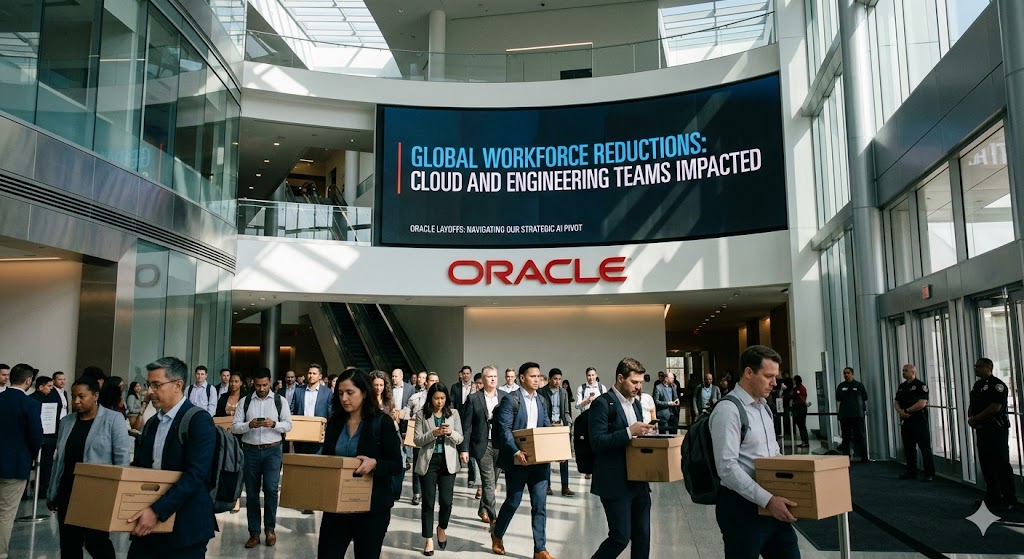

In a move that underscores the brutal financial balancing act facing legacy tech giants in the age of artificial intelligence, Oracle Corporation has initiated a fresh round of global layoffs. The workforce reductions, which began on Tuesday, March 31, 2026, come as Chairman Larry Ellison attempts to steer the database pioneer through a turbulent transition from traditional software services to a dominant force in AI cloud infrastructure.
The cuts arrive at a paradoxical moment for the Texas-headquartered firm: while Oracle is aggressively shedding headcount to “curb costs,” it is simultaneously embarking on the most expensive infrastructure project in the history of the company—the $500 billion “Stargate” data center initiative.
The Anatomy of the Layoffs: Software Engineers and Cloud Staff Hit
While an Oracle spokesperson declined to comment on the exact number of departures, the impact was immediately visible across professional networks. According to internal sources and a surge of LinkedIn activity, the layoffs have primarily targeted software engineers and personnel within Oracle’s Cloud Infrastructure (OCI) division.
Key Details of the Reduction:
- Scope: Global impact across multiple regions and departments.
- Affected Roles: High concentrations in cloud computing business units and software engineering.
- Context: As of May 2025, Oracle reported a workforce of approximately 162,000 full-time employees. Industry analysts suggest today’s cuts could represent a strategic “trimming” to satisfy investor concerns regarding profit margins.
The timing is particularly sensitive. Oracle’s stock has weathered a difficult year, dropping nearly 30% in early 2026 as fears of a broader software sell-off gripped Wall Street. Investors have grown wary of high-valuation tech firms that cannot demonstrate a clear path to AI-driven profitability while maintaining lean operational costs.
The “Stargate” Gamble: Balancing a $500 Billion Bill
The primary driver behind Oracle’s aggressive cost-cutting is its massive capital expenditure (CapEx) requirement. Oracle is currently the primary infrastructure partner for OpenAI, the creators of ChatGPT. Together, they are developing Stargate, a specialized AI data center complex estimated to cost upwards of $500 billion.
However, the road to “Stargate” has been paved with financial hurdles:
- Financing Struggles: Reports surfaced in January 2026 that Oracle was struggling to secure traditional financing for the project due to its unprecedented scale.
- Debt Accrual: In February, the company announced a massive $50 billion debt raise specifically to fund its infrastructure buildout.
- The Investor Promise: During a recent earnings call, Oracle executives assured shareholders that significant data center spending would not erode the bottom line because the company is “very, very good” at internal cost-cutting.
“We are building the future of AI, but the future is expensive,” noted one industry analyst. “To afford the hardware, Larry Ellison is willing to sacrifice the headcount.”
Strategic Analysis: Why Oracle is Doubling Down on Infrastructure
Oracle’s strategy is a high-stakes bet on Investment Banking Services and enterprise-grade AI. By focusing on cloud infrastructure, Oracle is positioning itself as the “landlord” of the AI revolution.
The “New” Oracle Business Model
| Department | Status | Strategic Goal |
|---|---|---|
| Workforce | Downsizing | Maximize operational efficiency and profit margins. |
| Data Centers | Expanding | Secure dominance in the GPU-cloud market for OpenAI and others. |
| Debt Profile | Increasing | Leveraging high-limit financing to outpace competitors like AWS and Azure. |
To maintain this trajectory, Oracle is increasingly reliant on high-level Investment Banking Services to manage its complex debt structure and secure the liquidity needed for its $50 billion infrastructure tranches.
Market Impact: A Software Sell-Off and the AI Fear
The 30% drop in Oracle’s stock price this year is reflective of a wider market trend. While hardware companies like Nvidia have soared, software-heavy firms have faced skepticism. Investors are asking: Can software companies successfully pivot to AI without being crushed by the cost of the hardware needed to run it?
For Oracle, the layoffs are a signal to the market that they are willing to make the hard choices. If you are a business owner seeking a Business Loan or an entrepreneur looking for a Credit Line for Businesses, the lesson from Oracle is clear: liquidity and cost-management are the only shields against market volatility.
The Human Cost of Corporate Evolution
On LinkedIn, the “Open to Work” banners are multiplying for former Oracle engineers. Many affected employees were part of the very teams tasked with building the cloud services that Oracle now hopes will save its future.
“It’s ironic,” posted one former software engineer. “We spent the last year building the tools that supposedly make the company more efficient, and now we’re the ‘inefficiency’ being cut to pay for the servers.”
Conclusion: A Precarious Path Forward
As Oracle trims its global workforce, the company remains at a crossroads. It must successfully navigate the financing of the Stargate project while proving to Wall Street that its cloud services can generate enough revenue to offset its mounting debt.
For now, the strategy is clear: Oracle is shedding its past to fund its future. Whether the $500 billion AI gamble pays off—or leads to further instability—will depend on how effectively the company can execute its infrastructure buildout while keeping its remaining workforce focused on the finish line.
What This Means for You
- For Investors: Keep a close eye on Oracle’s quarterly debt-to-equity ratio as they continue the $50 billion debt raise.
- For Tech Workers: The focus has shifted from general software engineering to specialized AI infrastructure and hardware optimization.
- For Businesses: If your enterprise relies on Oracle Cloud, ensure your service level agreements (SLAs) are protected during this period of internal transition and staffing changes.