
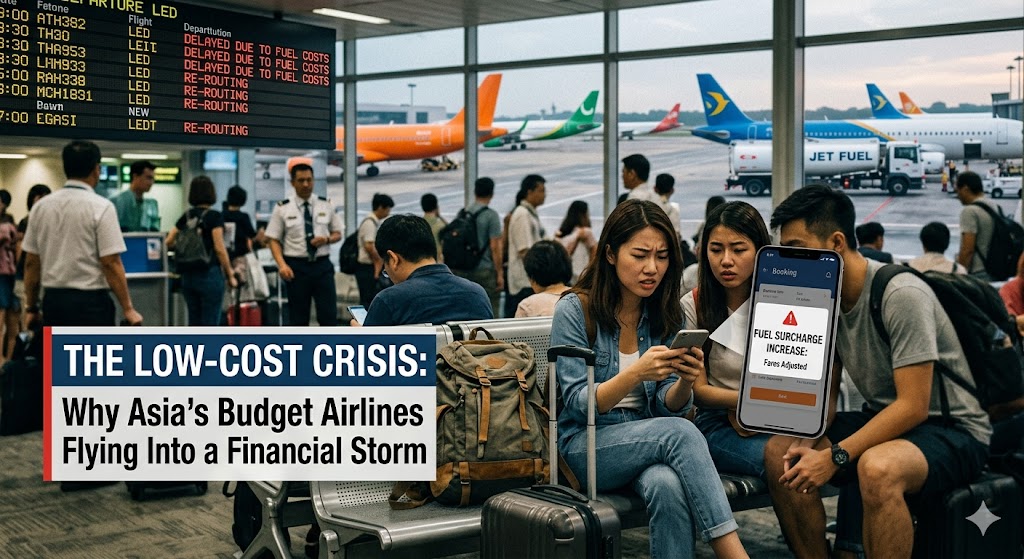

SINGAPORE — For decades, the budget airline model was the unstoppable engine of Asian tourism. Built on the promise of “now everyone can fly,” low-cost carriers (LCCs) thrived by stripping away frills, packing seats, and relying on a world of cheap, abundant jet fuel. But as the sun rises over the 2026 aviation landscape, that engine is beginning to sputter.
The industry is currently facing a “perfect storm” of geopolitical instability, currency devaluation, and a relentless surge in energy costs. According to reports from the Aviation Festival Asia conference in Singapore, the era of the $49 international flight may be reaching its final boarding call.
The Middle East Ripple Effect: Beyond the Horizon
While the conflict in the Middle East may seem geographically removed from the runways of Southeast Asia and India, the operational impact is direct and devastating. For airlines like India’s SpiceJet, the region isn’t just a destination—it’s a vital artery.
“Dubai alone has 77 flights a week from India, and that’s absolutely a huge impact for us from a route and loss of revenue perspective,” said Kamal Hingorani, Chief Customer Officer at SpiceJet.
The crisis has forced airlines to choose between two painful options:
- Costly Detours: Rerouting flights to avoid conflict zones increases flight times, leading to massive spikes in fuel consumption.
- Route Cancellations: Abandoning high-traffic corridors, leading to a direct hit on quarterly earnings.
The Math of Survival: Fuel vs. Fares
The fundamental vulnerability of the budget model is the margin. Unlike full-service carriers (FSC) like Singapore Airlines or Japan Airlines, which can lean on premium cabin revenues to offset costs, LCCs operate on razor-thin profits.
The 2026 Cost Breakdown:
- Fuel Surge: Prices in March 2026 are already 5.4% higher than the previous year.
- April Outlook: Analysts expect another significant jump as monthly contracts reset.
- Currency Pressure: The Indian Rupee’s weakness against the U.S. Dollar (the currency in which jet fuel is priced) has led the Investment Information and Credit Rating Agency of India to downgrade the sector’s outlook to Negative.
Vissoth Nam, CEO of AirAsia Cambodia, summarized the dilemma perfectly: “[We have to] adjust the fares, and at the same time, stimulate the demand. Otherwise, we don’t have travelers.” It is a delicate balancing act—raise prices too high, and the “budget” traveler stays home; keep them too low, and the airline bleeds cash.
A Tale of Two Strategies: Zipair vs. The Field
Not every carrier is feeling the same heat. Zipair Tokyo, the mid-to-long-haul LCC, has emerged as a resilient outlier. By focusing on Trans-Pacific and East Asian routes that bypass Middle Eastern airspace, Zipair has capitalized on seasonal booms like Japan’s famous cherry blossom season.
However, even the “strong” are wary. Yasuhiro Fukada, incoming CEO and co-founder of Zipair, noted that while they currently avoid fuel surcharges to stay competitive, the long-term outlook remains tied to global crude volatility. To combat this, Zipair is aggressively expanding, intending to more than double its fleet to 20 aircraft by 2032.
The Tech Hail Mary: Can Starlink and Software Save the Sector?
With little control over global oil prices, LCCs are turning to radical technological shifts to trim the fat from their operations.
1. The Weight Loss Program
Zipair recently announced a partnership with Starlink to provide free satellite internet. While this sounds like a “frill,” it is actually a cost-cutting measure. High-speed Wi-Fi allows the airline to scrap heavy, expensive in-flight entertainment (IFE) hardware. Removing screens and wiring reduces aircraft weight, which in turn reduces fuel burn.
2. Eliminating the Middleman
SpiceJet has taken a different route by launching SpiceTech, an in-house software subsidiary. By developing their own operational systems, they have eliminated 80% of their outside tech vendors. This move has turned a traditional expense into a revenue stream, as SpiceTech now provides software services to other global airlines.
Conclusion: The End of an Era?
The “Negative” outlook from rating agencies serves as a stark warning. The budget airline industry is no longer just competing on who can offer the cheapest seat; they are competing on who can most effectively integrate technology and navigate a fractured geopolitical map.
For the traveler, the message is clear: The “cheap” in “cheap fares” is becoming increasingly expensive to maintain. As we look toward the remainder of 2026, the budget airlines that survive will be those that stop acting like bus companies and start acting like tech firms.
Executive Insight: “Passing on high fuel surcharges would hurt demand… we may have to absorb some costs.” — Kamal Hingorani, SpiceJet
Would you like me to research the latest fuel price forecasts for the second half of 2026 to see if the pressure on budget airlines is expected to ease?