
Artemis 2 Launch Date: NASA Weather Forecast ‘80% Go’ for April 1 Liftoff
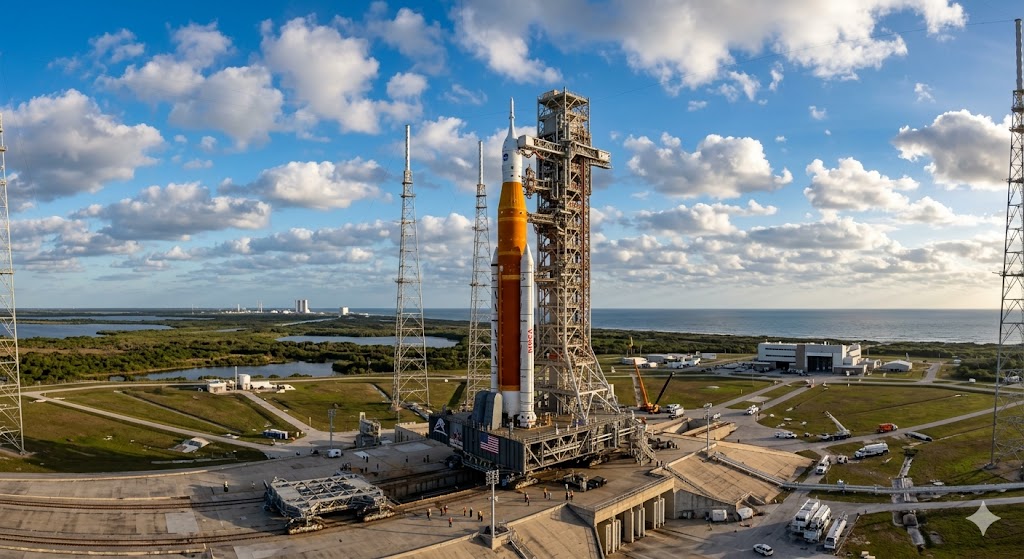
CAPE CANAVERAL, FL — The stage is set at Kennedy Space Center’s Launch Complex 39B for a historic leap into the next era of human exploration. On Sunday, March 29, 2026, NASA officials confirmed that the Artemis II mission is currently “go” for a launch attempt as early as Wednesday, April 1, with meteorologists reporting a promising 80% chance of favorable weather.
This mission, the first crewed flight of the Artemis program, will carry four astronauts on a 10-day journey around the Moon and back, marking the first time humans have left low Earth orbit since the conclusion of the Apollo program in 1972.
The Forecast: Watching the Florida Skies
While the 80% “go” figure is an optimistic start to the launch week, Florida’s volatile coastal weather remains the primary variable. During a countdown status news conference, Shawn Quinn, program manager for Exploration Ground Systems, emphasized that the team is closely monitoring three specific meteorological constraints:
- The Thick Cloud Rule: Designed to prevent “triggered lightning,” this rule prohibits launching through clouds thicker than 4,500 feet that contain freezing temperatures.
- Cumulus Clouds: Distant or local “cotton-like” clouds can indicate atmospheric instability that might interfere with the Space Launch System (SLS) rocket’s ascent.
- Ground Winds: High-velocity winds at the pad can prevent the safe fueling or liftoff of the 322-foot-tall rocket.
“The one thing we are watching is the weather,” Quinn noted. “But right now, we’re forecast to be 80% go on Wednesday afternoon, so that’s good.”
Meet the Artemis II Crew
The mission represents a milestone not just in technology, but in representation. The four-person crew, who arrived at Kennedy Space Center on Friday via T-38 jets, consists of:
| Astronaut | Role | Organization | Historical Milestone |
|---|---|---|---|
| Reid Wiseman | Commander | NASA | Leading the first lunar mission in 50+ years |
| Victor Glover | Pilot | NASA | First person of color to travel to the Moon |
| Christina Koch | Mission Specialist | NASA | First woman to travel to the Moon |
| Jeremy Hansen | Mission Specialist | CSA | First non-American to travel to the Moon |
“I think the nation and the world have been waiting a long time to do this again,” Commander Wiseman told reporters upon arrival. “We’re all fired up to go.”
Mission Profile: A High-Stakes Test Flight
Artemis II is not a lunar landing mission; rather, it is a critical “proving ground” for the Artemis III mission, which aims to put boots back on the lunar surface.
- Launch: The SLS rocket will generate 8.8 million pounds of thrust to propel the Orion spacecraft into orbit.
- Earth Orbit Checkouts: The first 24 hours will be spent in a high Earth orbit. The crew will test life support systems and perform a “proximity operations” demonstration using the rocket’s spent upper stage.
- Lunar Flyby: Orion will perform a Trans-Lunar Injection (TLI) burn, sending the crew on a “free-return” trajectory. They will swing around the far side of the Moon, reaching a distance of roughly 248,655 miles from Earth—surpassing the record set by Apollo 13.
- Splashdown: After a 10-day trek, Orion will re-enter the atmosphere at 25,000 mph before splashing down in the Pacific Ocean.
The Road to April 1
The path to this launch has been a marathon of engineering. Earlier this year, preparations were briefly delayed by a liquid hydrogen leak during a wet dress rehearsal in February. However, NASA Administrator Jared Isaacman and his team have expressed total confidence in the repairs.
“Our teams are working hard to get the rocket ready. The energy and dedication is truly electric,” said Quinn. “Everybody recognizes the historical significance.”
The official two-hour launch window opens at 6:24 p.m. EDT on Wednesday. If weather or technical issues force a scrub, backup windows are available daily through April 6, with another opportunity opening on April 30.
As the countdown clock begins its final tick, the world watches Florida, waiting for the moment the “Moonikin” mascot “Rise” floats in the cabin—signaling that humanity has finally returned to the deep cosmos.
Would you like me to provide a detailed breakdown of the 10-day mission timeline or more info on the SLS rocket’s specifications?