
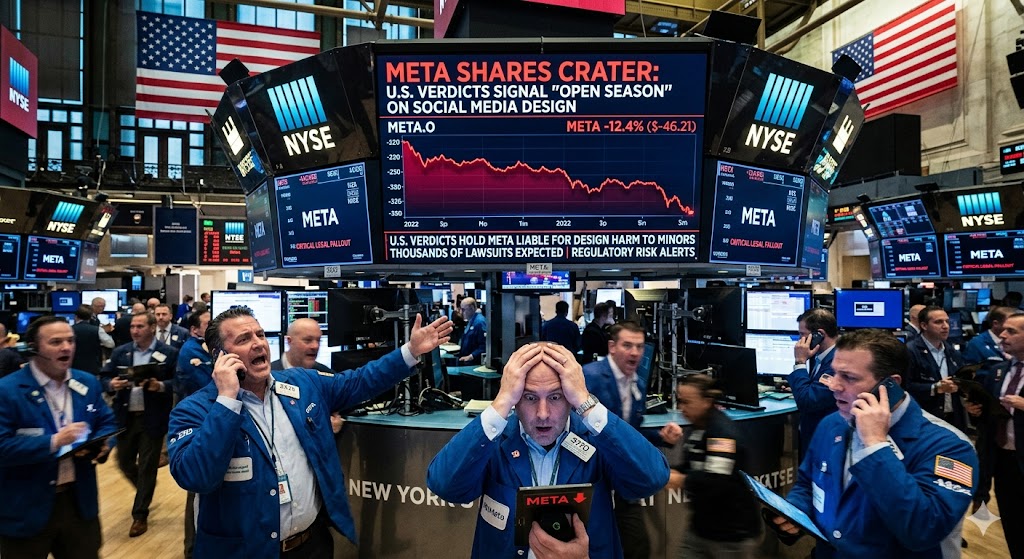
MENLO PARK, CA — The long-standing legal “shield” protecting Silicon Valley has finally cracked, sending Meta Platforms (META.O) into a tailspin that wiped out billions in market value in a single trading session. On Thursday, Meta shares plummeted 7%, hitting 10-month lows, as investors scrambled to price in a seismic shift in American jurisprudence: the transition from holding platforms responsible for what users say to holding them liable for how the platforms are built.
The catalyst for the sell-off was a pair of devastating jury verdicts in New Mexico and Los Angeles. While the combined fines of $381 million represent a fraction of Meta’s annual revenue, the precedent they set—targeting platform “design architecture” rather than “user-generated content”—has effectively bypassed Section 230 of the Communications Decency Act.
Legal experts are calling this the “tobacco moment” for social media.
The Verdicts That Shook Wall Street
The twin legal defeats arrived within 48 hours of each other, creating a “perfect storm” of liability.
1. The Los Angeles “Addiction” Ruling
In a landmark decision in California, a jury found both Meta and Google liable for the severe depression of a young woman, attributing her condition to an alleged “addiction” to Instagram and YouTube. The jury awarded $6 million in damages. While the dollar amount is relatively small for a company of Meta’s scale, the admission that a platform’s design—its algorithms, “infinite scroll” features, and dopamine-triggering notification systems—can be a proximate cause of clinical mental illness is a legal first.
2. The New Mexico “Exploitation” Verdict
Simultaneously, a jury in New Mexico ordered Meta to pay $375 million. The case centered on allegations that Meta misled the public about the safety of its platforms for children, effectively creating an environment that enabled the exploitation of minors. Jurors were reportedly swayed by internal documents suggesting that Meta executives were aware of the risks to young users but prioritized engagement metrics over safety overhauls.
The Death of the Section 230 Defense?
For decades, Section 230 has been the bedrock of the internet economy, providing a “safe harbor” that prevented companies from being sued for the content posted by their users. However, the plaintiffs in these recent trials successfully argued that they weren’t suing Meta for what was posted, but for how Meta’s proprietary code amplified and encouraged harmful behavior.
“These verdicts represent a fundamental shift in the legal playbook,” says Ken Mahoney, CEO of Mahoney Asset Management. “By targeting platform design, lawyers have found a way to sidestep the federal immunity that has long shielded these giants. If the courts continue to hold companies liable for design rather than content, the financial liability becomes uncapped.”
The “Design Defect” strategy treats social media apps like any other physical product. Just as a car manufacturer is liable if a faulty brake design causes an accident, the argument goes, a software company should be liable if its algorithmic “brakes” are intentionally removed to keep users hooked at the cost of their health.
Market Contagion: Big Tech in the Crosshairs
The fallout was not limited to Meta. The entire social media sector felt the tremors as investors realized that the legal immunity they had taken for granted might be evaporating.
| Company | Share Price Movement (Thursday) |
|---|---|
| Meta Platforms (META) | -7.0% |
| Snap Inc. (SNAP) | -12.5% |
| Alphabet (GOOGL) | -2.8% |
Snap Inc. took the hardest hit, slumping over 12%, as its business model is heavily reliant on the younger demographic central to these lawsuits. TikTok, though not publicly traded in the U.S., faces similar litigation, having already settled with the California plaintiff prior to the trial alongside Snap.
The $100 Billion Question: Future Cash Flows and AI
The timing could not be worse for Meta CEO Mark Zuckerberg. The company is currently in the midst of a massive capital expenditure cycle, spending tens of billions of dollars to pivot toward Artificial Intelligence.
“These decisions don’t break the business model today, but they raise the range of outcomes around future cash flows and margin structure,” noted Adam Sarhan, CEO of 50 Park Investments. “Investors are now repricing legal and regulatory risk. If Meta is forced to overhaul its design practices—reducing the ‘stickiness’ of its apps—its advertising business, which thrives on high engagement, could see a permanent decline in margins.”
Meta’s advertising engine relies on keeping users on the platform for as long as possible. If court mandates or the fear of further litigation force Meta to implement “cooldown” periods, disable certain algorithmic feeds, or strictly verify ages, the “sprawling advertising business” mentioned in the Reuters report could face its first structural contraction.
A Deluge of Litigation: 2,400 and Counting
The two verdicts are likely just the tip of the iceberg. Currently, Meta and its peers face more than 2,400 cases centralized before a single judge in California federal court. These “Master Liability” cases involve claims from school districts, state attorneys general, and thousands of families alleging that social media has fueled a national youth mental health crisis.
With the New Mexico and Los Angeles verdicts providing a successful “proof of concept” for plaintiffs’ attorneys, the volume of filings is expected to surge.
“Financially, multiple verdicts could total billions of dollars in damages and legal costs,” warns Mahoney. “But the real cost is the forced change in behavior. If Meta has to spend more on safety and moderation than it does on R&D for AI, the stock becomes a much less attractive growth play.”
The Road Ahead: The Appeals Process
Meta and Google have both signaled their intent to appeal the verdicts, a process that could take years to resolve. Meta’s legal team is expected to argue that the rulings still infringe upon First Amendment rights and that the link between “design” and “harm” is too tenuous to meet the high bar of American tort law.
However, the damage to investor sentiment may already be done. For the first time in the history of the “Magnificent Seven,” a fundamental legal risk has emerged that cannot be solved simply by a new product launch or a share buyback.
As of Thursday’s close, Meta remains under heavy pressure. The “Market Mayhem” isn’t just about a 500-point drop in the Dow or oil hitting $100—it’s about the fundamental re-evaluation of whether the most profitable business models in history are actually legal.
Next Step: Would you like me to generate a series of Facebook posts based on this specific “Meta Lawsuit” news, similar to the Dow Jones posts we created earlier?