Midnight Breakthrough: Senate Passes Critical TSA Funding Bill to Avert Aviation Collapse
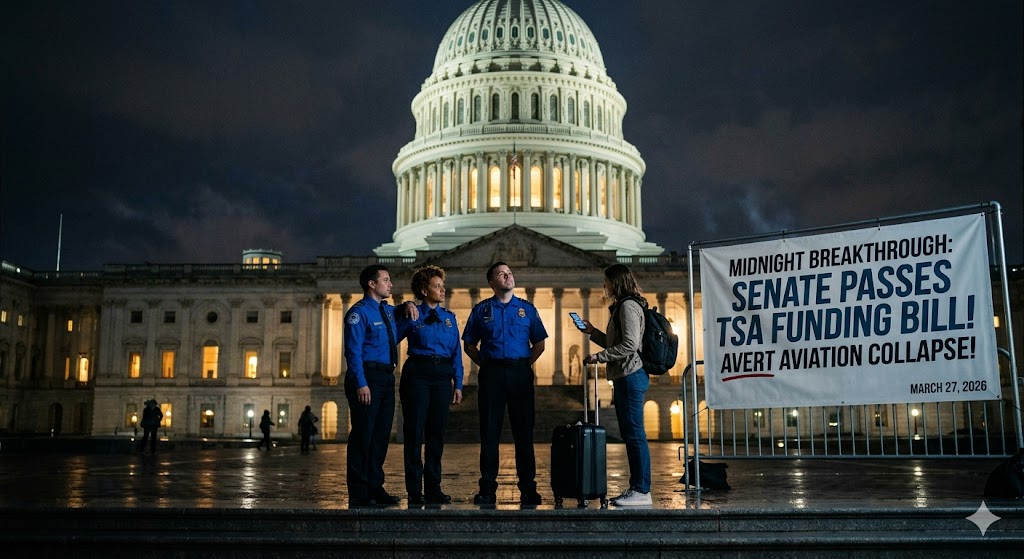
WASHINGTON, D.C. — In a dramatic pre-dawn session that saw the halls of the U.S. Capitol illuminated well past the usual hours of recess, the United States Senate voted early Friday morning to pass a high-stakes funding bill for the Department of Homeland Security (DHS). The measure, which specifically targets the Transportation Security Administration (TSA), aims to provide an immediate infusion of capital to an agency that has been teetering on the edge of a total operational shutdown for over a month.
The 82-17 vote marks a rare moment of bipartisan consensus, driven not by political alignment, but by the undeniable reality of a nation’s transportation infrastructure in terminal freefall. With the bill now hurtling toward the House of Representatives, the question remains: is this legislative “midnight miracle” enough to restore the faith of millions of American travelers who have spent the last several weeks trapped in security lines that resemble humanitarian crises more than airport queues?
The 34-Day Squeeze: How We Got Here
The Department of Homeland Security has been operating under a partial lapse in appropriations for more than five weeks. While “essential” personnel—including TSA screening officers, Federal Air Marshals, and Border Patrol agents—have been required to report for duty, they have been doing so without pay.
By the 30-day mark, the strain became visible. What began as a political standoff in Washington transformed into a logistical nightmare at major hubs like John F. Kennedy International (JFK), Hartsfield-Jackson Atlanta (ATL), and Chicago O’Hare (ORD).
The Human Cost of “Working for Free”
Reports indicate that TSA call-out rates reached a staggering 35% at some Category X airports earlier this week. These weren’t protests or organized “blue flu” strikes; they were the results of economic necessity. Officers who had missed two full paychecks were forced to choose between commuting to a high-stress security job for no pay or staying home to care for children they could no longer afford childcare for, or taking temporary “gig economy” jobs to cover rent.
“We are asking the people who stand between us and global terrorism to work for free while they worry about their electricity being shut off,” said Senator Riley Beggin (D-Mich.) during the floor debate. “It is not just a labor issue; it is a glaring national security vulnerability.”
Inside the Bill: More Than Just a Paycheck
The legislation passed on Friday morning is a comprehensive stopgap measure designed to provide stability through the end of the 2026 fiscal year. While the primary focus is the immediate restoration of backpay for the roughly 60,000 TSA employees, the bill includes several critical provisions:
- Retention Bonuses: An emergency allocation to provide “bridge bonuses” to officers who remained on duty during the shutdown, aimed at preventing a mass exodus of trained personnel to the private sector.
- Infrastructure Maintenance: Funding to repair and update high-tech CT scanners and “Computed Tomography” systems that had fallen into disrepair during the funding lapse.
- The “Spring Break” Surge: Allocation for overtime pay to handle the projected record-breaking travel volume for April 2026.
The Airport “Horror Stories” That Broke the Gridlock
Lawmakers reportedly felt the “heat of the tarmac” as viral social media posts became impossible to ignore. On Thursday, just hours before the Senate vote, images from New York’s JFK Airport showed lines snaking out of Terminal 4, down the sidewalk, and into the parking garages.
Travelers reported wait times of four to six hours, leading to missed international flights and a cascade of cancellations. One traveler’s story went viral after they spent $1,200 on a new ticket because they arrived the recommended three hours early, only to find the line for the “Pre-Check” lane alone was nearly a mile long.
“I arrived four hours early for a flight to London,” said Sarah Larson, a passenger interviewed at JFK. “I didn’t even see the scanners until hour five. The agents were exhausted, people were fainting in line, and there was no water. It felt like a fever dream.”
It was these “travel horror stories” that eventually forced the hands of holdout Senators who had previously insisted on including broader immigration reforms in the DHS package. The realization that the American economy—which relies heavily on the $1.1 trillion travel and tourism industry—was at a breaking point proved to be the ultimate motivator.
The House Gauntlet: What Happens Next?
The victory in the Senate is significant, but it is only half the battle. The bill now moves to the House of Representatives, where a more fractured Republican majority awaits.
House leadership has indicated they will gavel in at noon on Friday to begin considering the Senate’s version. However, hardline factions have already voiced opposition to what they call a “clean” bill that doesn’t address the ongoing crisis at the Southern border.
If the House fails to pass the bill by Sunday at midnight, industry experts warn that “cascading failures” could occur. Airlines have already warned that they may begin preemptively canceling flights if TSA staffing levels do not stabilize by Monday morning.
The “Four-Hour” Question: Is it Safe to Travel?
Despite the Senate’s progress, travel experts are urging caution. Even if the bill is signed by the President by Friday night, it will take days, if not weeks, for the TSA to return to full operational capacity.
“Passing a bill doesn’t instantly put money in an officer’s bank account or fix a broken scanner,” says aviation analyst Theodoric Meyer. “We have a backlog of maintenance and a workforce that is deeply demoralised. If you have a flight this weekend, the advice remains the same: Arrive at least four hours early.“
Tips for Travellers This Weekend:
- Monitor “MyTSA” App: Check crowdsourced wait times in real-time.
- Pack Light: Avoid checked bags if possible to bypass the additional staffing shortages at luggage carousels.
- Check Flight Status: Airlines are adjusting schedules hourly to accommodate the security delays.
Conclusion: A Lesson in Governance
The midnight passage of the TSA funding bill is a reminder of how essential the “invisible” functions of government are to daily American life. For 34 days, the nation watched as a political stalemate threatened to ground the world’s most robust aviation system.
As the sun rises over a still-divided Washington, the bill’s passage offers a glimmer of hope for a return to normalcy. But for the thousands of travelers still standing in line this morning, the “midnight miracle” won’t be real until the lines start moving again.
Follow the latest updates as the House prepares for its vote later today.