Mortgage Rates Near 6-Month High: How Freddie and Fannie’s $200 Billion Bond-Buying Strategy is Saving the Housing Market
The U.S. housing market is currently navigating a perfect storm of geopolitical tension and economic volatility. As of late March 2026, mortgage rates have spiked to a near 6-month high, deal-breaking for many aspiring homeowners and effectively ending the recent “refi wave.” However, a deeper look at the mechanics of the bond market reveals that without the aggressive intervention of Fannie Mae and Freddie Mac, the situation for American borrowers would be significantly worse.
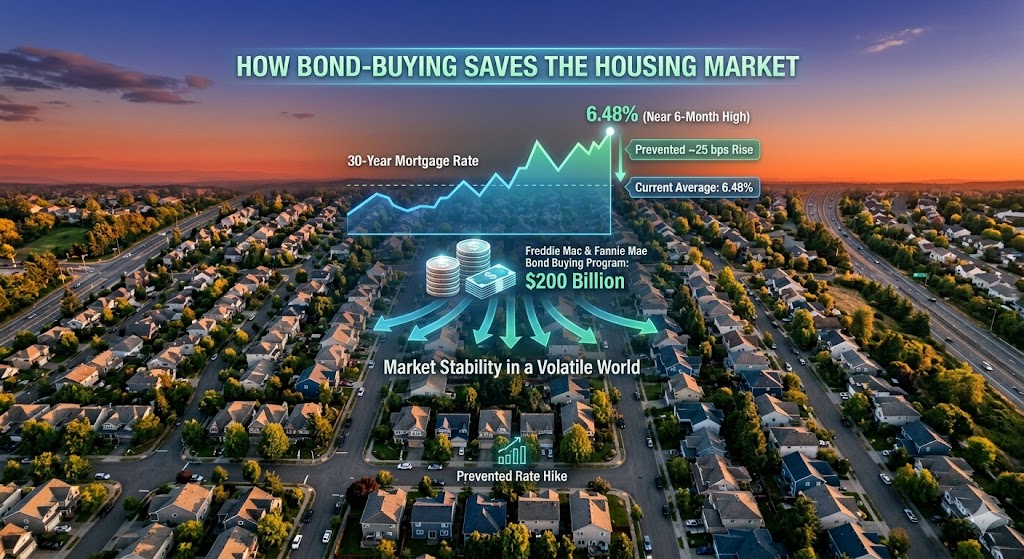
Recent data from Mortgage News Daily pegged the 30-year fixed mortgage rate at 6.48%, a sharp reversal from the sub-6% levels seen earlier this year. This surge is directly linked to the outbreak of the Iran conflict in late February, which sent oil prices soaring and reignited fears of long-term inflation.
The Impact of Geopolitical Turmoil on Home Loans
When the conflict began, financial markets reacted with immediate “risk-off” sentiment. Brent crude oil prices surged toward $120 per barrel following the closure of the Strait of Hormuz, a critical artery for global energy. For the average American, this doesn’t just mean higher costs at the pump; it means higher costs for a mortgage.
Mortgage rates typically track the 10-year Treasury yield. As inflation expectations rise due to energy shocks, investors demand higher yields on government bonds. The 10-year Treasury recently hit a high of 4.44%, up from 3.91% earlier this month. Because mortgages are priced at a “spread” above these yields to account for risk, the upward pressure on home loans has been relentless.
The “Silent Savior”: $200 Billion in Bond Purchases
In January 2026, President Donald Trump announced a major affordability push, directing the Government-Sponsored Enterprises (GSEs)—Fannie Mae and Freddie Mac—to purchase $200 billion in mortgage-backed securities (MBS). While some analysts initially questioned the scale of this intervention in a $10 trillion market, its “cushioning” effect is now becoming clear.
According to industry experts, the GSEs’ consistent buying has prevented mortgage-bond spreads from blowing out further. Scott Buchta, head of fixed-income strategy at Brean Capital, suggests that without this intervention:
- Mortgage-bond spreads would be 20 to 25 basis points higher.
- The average 30-year mortgage rate would likely be sitting at 6.75% or higher today.
By absorbing the supply of mortgage bonds when other private investors are hesitant, Fannie and Freddie are effectively keeping a lid on how much of the Treasury yield spike is passed on to the consumer.
The Death of the Refinance Wave
For months, homeowners had been waiting for rates to drop into the 5% range to lower their monthly payments. That window has now slammed shut.
“What’s key about 6.5% is it essentially shuts off the refi wave,” noted Buchta. “You’ve taken 90% of borrowers out of the refi window.”
When rates hover near 6.5%, the financial incentive to refinance vanishes for the vast majority of people who locked in lower rates during the pandemic or the brief dips of early 2026. This has a secondary effect on the broader economy: when homeowners can’t refinance, they have less discretionary income to spend, potentially slowing economic growth during an already precarious time.
Market Outlook: What to Expect Next
The Federal Housing Finance Agency (FHFA) continues to oversee the GSEs’ buying patterns, which are being “spread out” rather than dumped into the market all at once to maximize stability. However, the path forward remains tied to the Federal Reserve’s next moves.
While the Fed has signaled a desire to cut interest rates later this year, the “war-driven oil shocks” are making that difficult. If inflation remains sticky at the 4.2% level projected by some economists for 2026, the Fed may be forced to keep benchmark rates higher for longer, leaving Fannie and Freddie as the primary defense against skyrocketing housing costs.
| Metric | Current Level (March 2026) | Without GSE Buying (Est.) |
|---|---|---|
| 30-Year Mortgage Rate | 6.48% | 6.75% |
| 10-Year Treasury Yield | 4.39% | 4.39% |
| MBS Spread | ~210 bps | ~235 bps |
As the spring home-buying season approaches, the resilience of the market will depend on whether geopolitical tensions ease or if further federal intervention is required to maintain affordability.
Frequently Asked Questions (FAQ)
Why are mortgage rates rising if the government is buying bonds?
While the $200 billion bond-buying program by Fannie Mae and Freddie Mac provides a “floor” for the market, it cannot entirely override global economic forces. The Iran conflict has driven up oil prices, which fuels inflation. Since mortgage rates are benchmarked against the 10-year Treasury yield, the broad market’s fear of inflation pushes all interest rates higher, even with federal intervention.
What would the 30-year mortgage rate be without Fannie and Freddie’s intervention?
Market analysts estimate that without the current liquidity provided by the GSEs (Government-Sponsored Entities), mortgage-bond spreads would be 20 to 25 basis points higher. This means today’s 6.48% rate would likely be closer to 6.75%.
Is the “refi wave” officially over?
For the vast majority of homeowners, yes. Experts suggest that once rates cross the 6.5% threshold, approximately 90% of eligible borrowers lose the financial incentive to refinance. The brief window in early 2026 where rates dipped below 6% has effectively closed due to the geopolitical volatility in the Middle East.
How does the Iran conflict specifically affect my home loan?
The conflict impacts your loan through inflation expectations. War in the Middle East often disrupts oil supply (specifically via the Strait of Hormuz), leading to higher energy costs. Higher energy costs lead to higher consumer prices (inflation), which causes investors to sell bonds. When bond prices fall, yields (and mortgage rates) rise.
What is the “spring home-buying season” outlook?
The outlook is currently “cautiously pessimistic.” While inventory has improved compared to 2025, the sudden spike in rates has sapped the momentum seen in January and February. Builders like KB Home have already reported a softening in buyer activity since the conflict began.
Reference Links & Sources
For real-time updates and further reading on the 2026 housing market, visit the following primary sources:
- Mortgage News Daily: Current 30-Year Fixed Rates & Market Analysis
- Freddie Mac: Primary Mortgage Market Survey (PMMS) Data
- MarketWatch: Housing Market & Geopolitical Impact Reports
- Federal Housing Finance Agency (FHFA): Updates on GSE Bond Buying & Oversight