
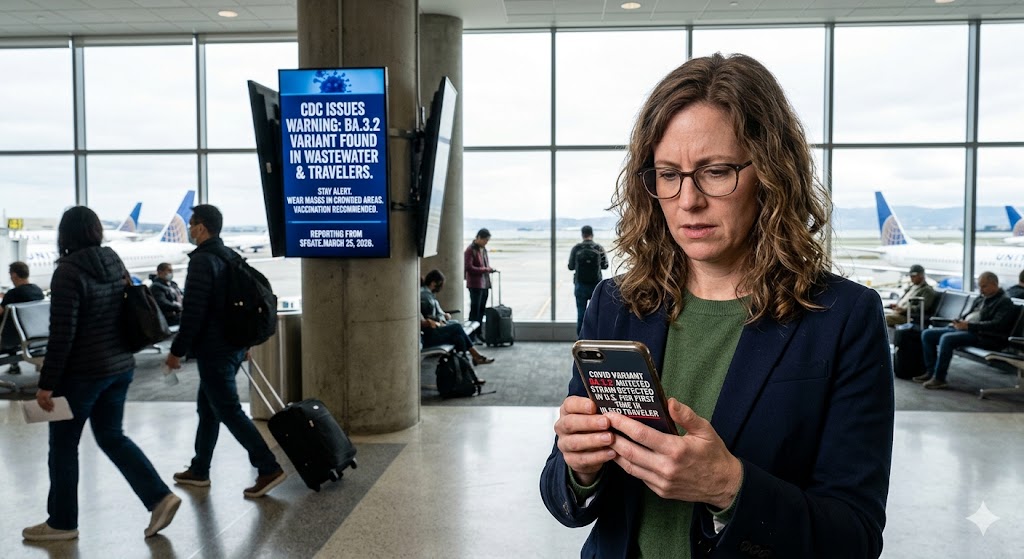
SAN FRANCISCO, CA — COVID variant BA.3.2 updates : Federal health officials and genomic surveillance teams are on high alert following the confirmed discovery of a highly mutated viral strain on American soil. The COVID variant BA.3.2, a sub-lineage that has scientists concerned due to its unique genetic profile, was first identified in a traveller passing through San Francisco International Airport (SFO), marking a significant milestone in the ongoing evolution of the SARS-CoV-2 virus.
The discovery, detailed in a recent Morbidity and Mortality Weekly Report (MMWR) by the Centres for Disease Control and Prevention (CDC), highlights the effectiveness—and the necessity—of the Traveller-Based Genomic Surveillance program. While the initial case was linked to a traveler arriving from the Netherlands, the variant has since been detected in wastewater samples across 25 states, signalling that the strain is no longer confined to international transit hubs.
The Genetic Mystery of BA.3.2
What makes the COVID variant BA.3.2 particularly striking to researchers is its “spike protein” configuration. The spike protein is the part of the virus that acts like a key, allowing it to enter human cells. In this new variant, the protein has undergone significant mutations that may allow it to “hide” from the immune system.
[Image of SARS-CoV-2 spike protein mutations]
“BA.3.2 mutations in the spike protein have the potential to reduce protection from a previous infection or vaccination,” the CDC report stated. This suggests that even individuals who have been recently boosted or previously infected with Omicron sub-variants may have diminished defense against this specific strain.
Dr. William Schaffner, a renowned infectious disease expert at Vanderbilt University Medical Center, described the variant as “substantially different” from the strains that dominated the 2024-2025 winter season.
From SFO to 25 States: The Path of Transmission
The timeline of BA.3.2’s arrival in the United States underscores the speed of global viral transmission:
- June 2025: The variant is first detected in a traveler from the Netherlands at SFO.
- Late 2025: Sparse detections begin appearing in international genomic databases (now found in 23 countries).
- February 11, 2026: The CDC confirms the variant has been detected in five specific individuals and, more alarmingly, in wastewater systems across 25 states.
- March 19, 2026: The formal CDC report is released, classifying BA.3.2 as a variant requiring “continued genomic surveillance.”
The presence of the virus in wastewater in states like California, New York, and Texas suggests that while clinical cases remain low, the virus is circulating under the radar in many communities.
Severity vs. Spread: What the Experts Say
Despite the mutations that allow for “immune escape,” there is a silver lining in early laboratory data. Preliminary tests suggest that the COVID variant BA.3.2 does not infect lung cells as efficiently as the original 2020 strains or the Delta variant.
“We will have to watch this very carefully in the real world,” Dr. Schaffner explained to SFGATE. “If this is a variant that develops the capacity to spread rapidly, it will likely influence the composition of future vaccines.”
Currently, hospitalizations have not seen a dramatic spike associated with this variant, but health officials warn that “viral fitness”—the ability of a virus to survive and reproduce—can change as it moves through a population.
The Future of Vaccination and Surveillance
The emergence of BA.3.2 comes at a time when many Americans have moved past regular testing and masking. However, the CDC emphasizes that the “genomic toolkit” is more robust than ever. By tracking the virus through airport swabs and city sewage, scientists can predict surges before they hit emergency rooms.
If BA.3.2 becomes the dominant strain, the FDA and vaccine manufacturers like Pfizer and Moderna may be forced to adjust the Fall 2026 booster shots to specifically target these new spike protein mutations.
Public Health Recommendations:
- Stay Updated: Ensure you have received the most recent available booster.
- Testing: Use rapid tests if you develop respiratory symptoms after international travel.
- Surveillance: Support local health departments in wastewater monitoring efforts.
As Terminal 3 at SFO continues to see thousands of travelers daily, the story of BA.3.2 serves as a reminder that the world remains interconnected, and the virus remains opportunistic.
Following the discovery of the COVID variant BA.3.2 at SFO and its subsequent spread to 25 states, here are the most frequently asked questions and official reference links to help you stay informed on this evolving public health situation.
🦠 COVID Variant BA.3.2: Frequently Asked Questions
1. What is the COVID variant BA.3.2?
The COVID variant BA.3.2 is a highly mutated sub-lineage of the SARS-CoV-2 virus. It was first detected in the United States in June 2025 from a traveler arriving at San Francisco International Airport (SFO) from the Netherlands. It is notable for significant mutations in its spike protein.
2. Why are scientists concerned about this specific mutation?
The mutations in the spike protein of BA.3.2 may allow the virus to “hide” from immune cells. This means it has the potential for immune escape, potentially reducing the effectiveness of antibodies gained from previous infections or earlier vaccine doses.
[Image of SARS-CoV-2 spike protein mutations]
3. How widely has BA.3.2 spread in the U.S.?
As of February 11, 2026, the CDC has confirmed the variant in five individuals. More significantly, it has been detected in wastewater across 25 states, including California. This indicates that the variant is circulating in the community even if clinical testing isn’t catching every case.
4. Is the BA.3.2 variant more dangerous or “deadlier”?
Currently, there is no evidence that BA.3.2 causes more severe disease. Lab studies suggest it does not infect lung cells as easily as some previous variants. However, infectious disease experts like Dr. William Schaffner warn that we must monitor its “real-world” spread to see if it becomes more transmissible.
5. Will current vaccines work against BA.3.2?
While the mutations might reduce the preventative power of current vaccines against infection, health officials believe existing vaccines still provide strong protection against severe illness, hospitalization, and death. Data from this variant will likely influence the composition of the Fall 2026 COVID-19 booster.
🔗 Official Reference Links
For the most accurate and up-to-date data, please refer to these official health and news sources:
- CDC Morbidity and Mortality Weekly Report (MMWR): The primary source for the March 19, 2025 report on BA.3.2 genomic surveillance.
- CDC Traveler-Based Genomic Surveillance Program: Information on how the SFO traveler was identified and how the U.S. tracks incoming variants.
- SFO Health & Safety Updates: Updates regarding health protocols and testing at San Francisco International Airport.
- Vanderbilt University Medical Center – Infectious Diseases: Expert commentary and research from Dr. William Schaffner on viral evolution.
- SFGATE Health News: Local reporting on the initial SFO detection and California wastewater findings.