

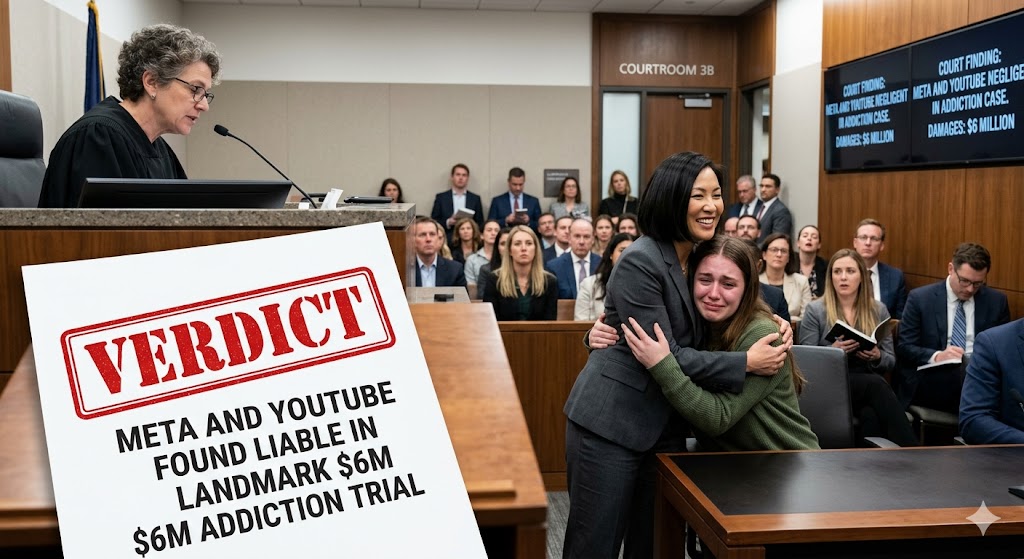

LOS ANGELES, CA — Meta Social Media Addiction Trial Updates, In a decision drawing immediate comparisons to the historic litigation against Big Tobacco, a Los Angeles jury has found social media giants Meta and YouTube liable for the intentional design of addictive platforms that harmed a young user’s mental health.
The verdict, delivered on March 25, 2026, awarded 20-year-old plaintiff “Kaley” $6 million in damages. This “righteous moment,” as described by the plaintiff’s legal team, marks the first time a jury has held tech conglomerates financially accountable for the physiological and psychological impact of social media algorithms on minors.
The Verdict: A Breakdown of Liability and Damages
After a grueling five-week meta social media addiction trial, the jury concluded that Meta (owner of Facebook, Instagram, and WhatsApp) and Google (owner of YouTube) acted with “malice, oppression, or fraud” in how they engineered their platforms to maximize user engagement at the expense of safety.
The Financial Judgment
The $6 million award is split into two equal parts:
- $3 Million in Compensatory Damages: Intended to cover the costs of Kaley’s long-term mental health treatment, loss of educational opportunities, and emotional distress.
- $3 Million in Punitive Damages: A clear message from the jury to the tech industry regarding the “malicious” nature of addictive algorithm design.
Liability Split:
The jury determined that Meta bears the primary responsibility, ordering the company to pay 70% of the total damages ($4.2 million), while Google is responsible for the remaining 30% ($1.8 million).
The Legal Argument: “Big Tech is the New Big Tobacco”
Plaintiff’s attorney Matthew Bergman argued throughout the trial that Meta and YouTube used sophisticated neurobiological triggers to keep children “hooked” to their screens. The prosecution presented internal documents suggesting that the companies were aware of the dopamine-loop effects of “infinite scrolls” and “push notifications” but prioritized ad revenue over child safety.
“This is a Big Tobacco moment for the 21st century,” Bergman stated following the verdict. “Just as the tobacco industry knew nicotine was addictive and targeted youth, these platforms knew their algorithms were eroding the mental health of an entire generation.”
Personal Injury and Product Liability
Legal experts suggest this case shifts social media harm from “content moderation” issues—which are often protected under Section 230—to product liability. The argument centres on the platform’s design being a defective and dangerous product. This distinction is crucial for personal injury lawyers looking to bring similar class action lawsuits across the United States.
Corporate Defenses: The “Complex Issue” Argument
Both Meta and Google have announced their intention to appeal the Los Angeles verdict, maintaining that their platforms are built responsibly.
- Meta’s Position: A spokesperson stated that “Teen mental health is profoundly complex and cannot be linked to a single app.” The company continues to argue that external factors, such as social environment and pre-existing conditions, play a larger role than app usage.
- YouTube’s Position: Google’s legal team attempted to distance the video platform from the “social media” label, claiming YouTube is a “responsibly built streaming platform” focused on content delivery rather than social validation loops.
A Breaking Point: The Global Context
The Los Angeles verdict did not happen in a vacuum. Just 24 hours prior, a jury in New Mexico found Meta liable for endangering children by exposing them to sexual predators and explicit material.
Global Regulatory Pressure:
- Australia: Recently imposed strict age-gating and usage restrictions for children.
- United Kingdom: Currently piloting a program that explores a total ban on social media for those under the age of 16.
- United States: Hundreds of similar cases are currently winding through the court system, and this $6 million win provides a “mechanical necessity” for other plaintiffs to prove that damages are attainable.
Economic and Market Implications
The meta social media addiction trial has immediate repercussions for the financial and tech sectors. Market analysts suggest that if these verdicts hold on appeal, social media companies may need to set aside billions in “litigation reserves,” similar to the mesothelioma attorney settlements of the past.
The Rise of Digital Wellness Tech
As platforms are forced to “de-addict” their interfaces to avoid liability, we expect a surge in:
- Digital Wellness Software: Tools that provide mortgage refinance-style stability to personal screen time.
- Wealth Management Re-allocation: Investors are beginning to move capital away from “high-engagement” social platforms toward “utility-based” tech.
FAQs: Understanding the Social Media Addiction Trial
1. Does this mean I can sue Meta or YouTube if my child is addicted?
While this case sets a precedent, it was a “bellwether” trial. To win, a plaintiff must prove “specific harm” (such as a diagnosed mental health crisis) directly linked to the platform’s design. Consulting a personal injury lawyer experienced in tech litigation is the first step for many families.
2. What is “Agentic AI” and does it help with social media addiction?
Agentic AI refers to autonomous systems that can manage tasks. In the future, these agents could act as “digital guardians,” intercepting addictive loops or blocking harmful content before it reaches a minor, acting as a buffer between the user and the platform’s algorithm.
3. How will this affect social media features like “Reels” or “Shorts”?
If juries continue to find “infinite scrolls” and “auto-play” features to be “maliciously addictive,” platforms may be legally forced to include mandatory “break” screens or disable these features by default for users under 18.
Reference Links & Legal Resources
- CRFB Fiscal Reports on Tech Regulation: Analyzing the economic impact of tech litigation.
- Social Media Victims Law Center: Resources for families affected by platform-induced harm.
- Forrester Research: The Breaking Point Report: Market analysis on the “sentiment boil-over” in Big Tech.
- AARP: Digital Safety for Families: Guidance on protecting younger generations in the digital age.
What’s trending in the USA now?
John Sauer Solicitor General USA and Birth Right Citizenship Case updates 2026
Breaking USA news : Read on this Latest US News Who is John Sauer, who hired him and how he is related to the Birth Right Citizenship Case. You might be also interested to know that the birth right citizenship of America is almost 150 years and this follows the 14th amendment for the US…
How do I buy SpaceX IPO? What is the pre price?
Business News USA: Read in this news article all about the Elon Musk SpaceX IPO latest update 2026 to know more about its share price, prediction results , how to buy SpaceX IPO stock, etc. Are you also one looking for the SpaceX initial public offering date and price for this year? Have a look…
Intel to Buy Apollo’s Stake in Joint Ireland Chip Manufacturing Facility for $14.2 Billion
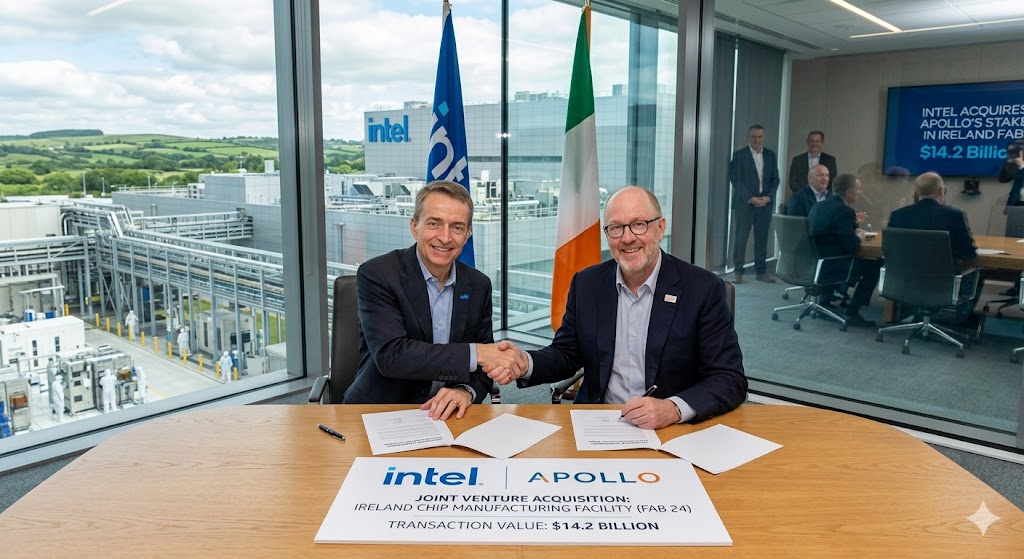
SANTA CLARA, CA – In a massive strategic pivot aimed at consolidating its European manufacturing footprint and refining its balance sheet, Intel Corporation announced on April 1, 2026, that it has reached an agreement to buy back Apollo Global Management’s 49% stake in their joint venture, Fab 34, located in Leixlip, Ireland. The transaction, valued…