NASA Unveils Ambitious $20 Billion Plan for Lunar South Pole Base: A New Era of Space Exploration and Infrastructure
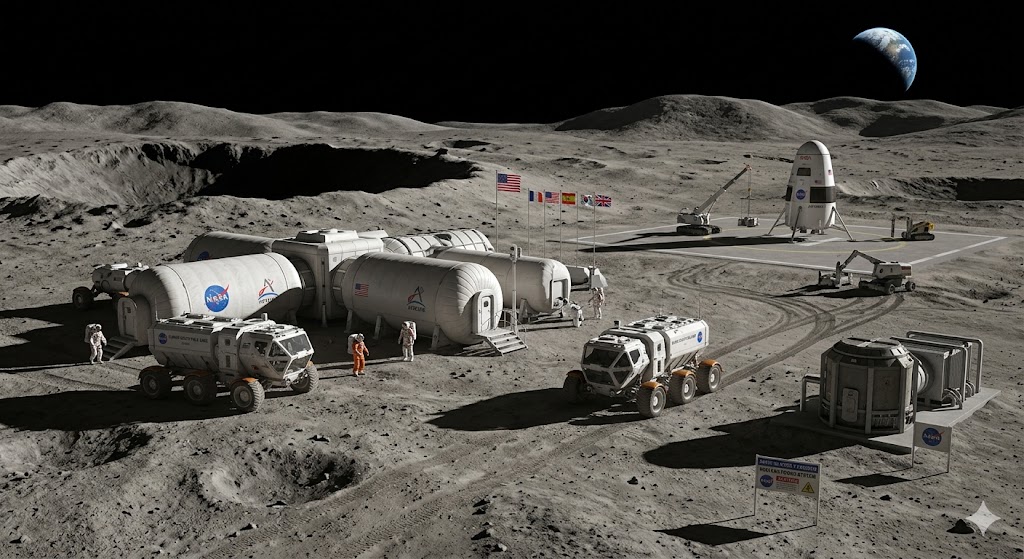
WASHINGTON, D.C. — In a historic move that signals a definitive shift in American space policy, NASA Administrator Jared Isaacman announced on Tuesday a bold, $20 billion roadmap to establish a permanent human outpost on the Moon. This “Ignition” initiative marks the end of the agency’s reliance on the orbital Gateway station in favor of a direct, surface-first approach, aiming to secure a “semi-permanent” presence near the lunar south pole within the next seven years.
The announcement comes at a critical juncture, just days before the highly anticipated launch of Artemis II, a crewed flyby mission that will see four astronauts—including the first woman and person of color to venture into deep space—pave the way for this massive infrastructural undertaking.
The $20 Billion Blueprint: Three Phases to Permanence
The newly unveiled plan is not merely about “flags and footprints,” as Isaacman emphasized, but about establishing a sustainable economic and scientific hub. The $20 billion investment will be distributed across three distinct phases designed to build “muscle memory” through frequent, low-risk missions.
Phase 1: Frequent Delivery and Risk Mitigation
The initial stage of the program focuses on increasing the cadence of lunar missions. Rather than once-a-year launches, NASA intends to leverage at least two commercial launch providers to facilitate crewed landings every six months. This phase will prioritize the delivery of:
- Pressurized Rovers: Advanced mobile units that allow astronauts to traverse vast distances without the constraints of space suits.
- Scientific Instruments: Testing the lunar environment for resource extraction, particularly water ice located in permanently shadowed craters.
- Technology Payloads: Validating landing systems and surface communication networks.
Phase 2: Semi-Habitable Infrastructure
Once the delivery pipeline is secured, NASA will begin the construction of semi-permanent habitats. These structures will use components repurposed from the now-paused Lunar Gateway project. By shifting these resources to the surface, NASA aims to provide immediate shelter and research facilities for rotating crews.
Phase 3: Permanent Surface Outpost
The final stage will see the deployment of “heavy infrastructure” necessary for a continuous human foothold. This includes:
- Nuclear Power Systems: Utilizing Space Reactor-1 Freedom, NASA plans to deploy surface fission reactors to provide reliable, 24/7 electricity, independent of the 14-day lunar night.
- Lunar GPS and Communications: Establishing a “cellphone-like” network and satellite constellations for navigation and data relay back to Earth.
- Construction Robots: Uncrewed machines designed to prepare landing pads and shield habitats using lunar regolith.
Strategic Shift: Commercial Rockets and National Policy
In a significant departure from the original Artemis architecture, the “Ignition” plan prioritizes competitive commercial rockets over the government-owned Space Launch System (SLS) for long-term surface operations. While the SLS will still carry initial crews via the Orion spacecraft, the future of lunar logistics will rely heavily on private partners like SpaceX and Blue Origin.
Isaacman noted that this shift is a direct response to the National Space Policy, which emphasizes American leadership and the need to establish a presence before international competitors, specifically China, aim for their own 2030 landings.
“America will never again give up the Moon,” Isaacman declared. “The clock is running in this great-power competition, and success or failure will be measured in months, not years.”
The Role of Nuclear Energy and Mars Preparation
A cornerstone of the $20 billion plan is the development of nuclear power. Solar power on the Moon is intermittent, making it insufficient for large-scale industrial operations or surviving the freezing lunar night. NASA’s commitment to building a nuclear reactor on the lunar surface serves a dual purpose: it sustains the base and acts as a “technology proving ground” for future flights to Mars.
By the end of 2028, NASA hopes to use the lessons learned from the lunar base to fuel a nuclear-powered spacecraft capable of reaching the Red Planet. The high-energy density of nuclear systems is seen as a “mechanical necessity” for deep-space travel, significantly reducing transit times and radiation exposure for crews.
Financial and Economic Implications
While $20 billion is a staggering figure, industry experts suggest the long-term ROI (Return on Investment) could be monumental. From mortgage refinance opportunities for new aerospace headquarters to the surge in personal injury lawyer demand for specialized space-contractor insurance, the “lunar economy” is expected to ripple through terrestrial markets.
| Component | Estimated Allocation (7 Years) | Key Partners |
|---|---|---|
| Surface Habitats | $6.5 Billion | Lockheed Martin, Northrop Grumman |
| Nuclear Power (Fission) | $4.2 Billion | Westinghouse, BWXT |
| Commercial Landers | $5.8 Billion | SpaceX, Blue Origin |
| Lunar Rovers/Robotics | $3.5 Billion | Intuitive Machines, Astrobotic |
Next Steps for Artemis II
As the agency pivots to this new surface-centric model, all eyes remain on the Kennedy Space Center. The Artemis II mission is currently slated for a launch window starting April 1, 2026. The four-person crew—Reid Wiseman, Victor Glover, Christina Koch, and Jeremy Hansen—is currently in mandatory quarantine.
Their 10-day mission will test the Orion spacecraft’s life support and optical communication systems, providing the critical data needed to begin Phase 1 of the moon base construction. If successful, this mission will be the “ignition” for a permanent human presence on another world.
Would you like me to research the specific high-CPC keywords currently trending for the aerospace and defense sectors to help optimize your social media distribution for this story?