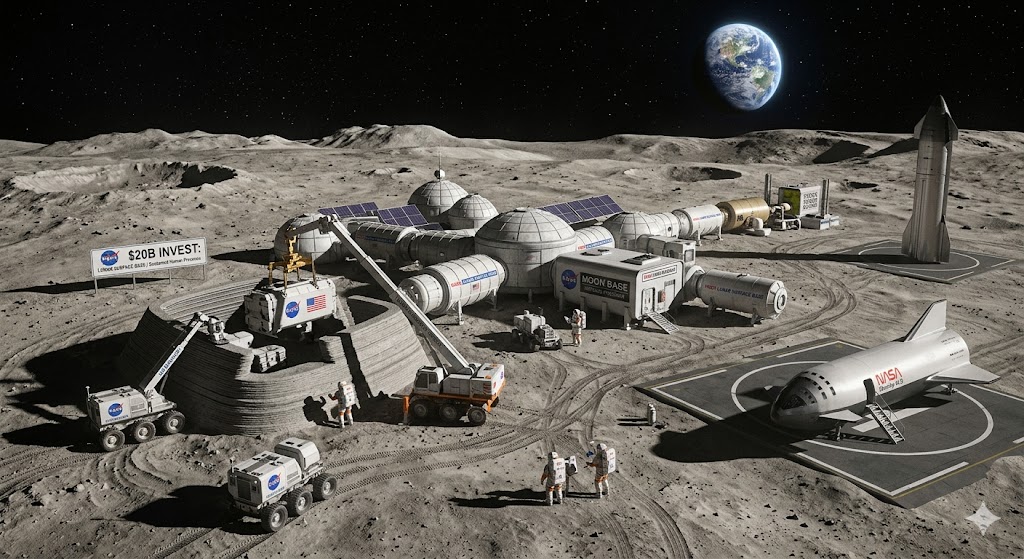
NASA is officially canceling its plans to deploy a space station in lunar orbit, choosing instead to divert those resources toward a $20 billion permanent base on the moon’s surface. The dramatic strategic pivot, announced Tuesday by NASA Administrator Jared Isaacman, marks the most significant architectural shift in the Artemis program since its inception.
Isaacman, the billionaire private astronaut sworn in as NASA’s chief in December, unveiled the plan at a high-stakes event at the agency’s Washington headquarters. The move effectively “pauses” the Lunar Gateway—a planned orbital outpost that has been a cornerstone of international lunar cooperation—to focus on “sustained operations” where the gravity is.
“It should not really surprise anyone that we are focusing on infrastructure that supports sustained operations on the lunar surface,” Isaacman told a room of delegates, contractors, and international partners. “The moon’s surface is where the science is, where the resources are, and frankly, where the competition is.”
Repurposing the Gateway
The Lunar Gateway was intended to be a “pit stop” in space where astronauts would transfer from the Orion capsule to lunar landers. However, Isaacman argued that the orbital station had become a “costly bottleneck.”
Key components of the Gateway, already under construction by contractors like Northrop Grumman and Vantor (formerly Maxar), will now be evaluated for repurposing as surface modules.
“Despite real hardware and schedule challenges, we can repurpose equipment and international partner commitments to support surface objectives,” Isaacman said. “We aren’t throwing away the work; we are changing its destination.”
The $20 Billion “Ignition” Plan
The new initiative, dubbed “Ignition,” aims to establish a functional, habitable outpost at the lunar south pole within the next seven years. The $20 billion investment will be spread across three distinct phases:
- Phase I: Robotic Scouting (2027): A surge in uncrewed robotic vehicles to deliver power grids and communication arrays.
- Phase II: Initial Habitation (2028-2029): Repurposing Gateway modules into a “core” habitat for short-term stays.
- Phase III: Sustained Presence (2030+): Expanding the base into a multi-purpose research facility capable of supporting rotating crews for 6–12 months.
Racing Against Beijing
The move is widely seen as a response to China’s aggressive lunar timeline. With Beijing aiming for a crewed landing by 2030, Isaacman emphasized that the U.S. could not afford a “leisurely” approach.
The strategy also streamlines the Artemis launch cadence. Artemis III, previously a landing mission, has been re-designated as a high-Earth orbit test flight for 2027 to “wring out” the lander and new spacesuits. This clears the path for Artemis IV to attempt the first surface stay of the new era in early 2028.
Frequently Asked Questions (FAQs)
1. Is the Lunar Gateway gone forever? Not necessarily. Isaacman used the word “pause,” but the $20 billion shift suggests that an orbital station is no longer a priority for the 2020s. Its core modules (PPE and HALO) are being redesigned for surface use or potential long-term orbital storage.
2. How will this affect international partners like the ESA or JAXA? Isaacman noted that “international partner commitments” would be honored by shifting their contributions to the surface. For example, the European i-HAB module could be modified into a surface laboratory.
3. Why did NASA change its mind now? The new administration and Isaacman believe the “Lunar Orbit Rendezvous” via a station was too complex and slow. By landing directly on the surface, NASA hopes to establish a presence faster and more efficiently.
4. What happens to the SLS and Orion? They remain the primary transport system. However, Isaacman is standardizing the SLS configuration to a “Block 1” style to increase launch frequency to once every 10 months.
References and Further Reading
- NASA’s Official Artemis Program Updates
- Reuters: NASA Strategy Shift under Isaacman
- SpacePolicyOnline: Artemis Course Correction
Would you like me to generate a breakdown of how this $20 billion budget is allocated between private contractors?
NASA Administrator Jared Isaacman on Building a Moon Base
This video provides a direct look at Administrator Isaacman’s vision for the 2027 construction start and his “mission-first” approach to the lunar surface.
http://googleusercontent.com/youtube_content/0
About the Author