Deep Learning Market Revolution: Global Industry Projected to Skyrocket to $406 Billion by 2032
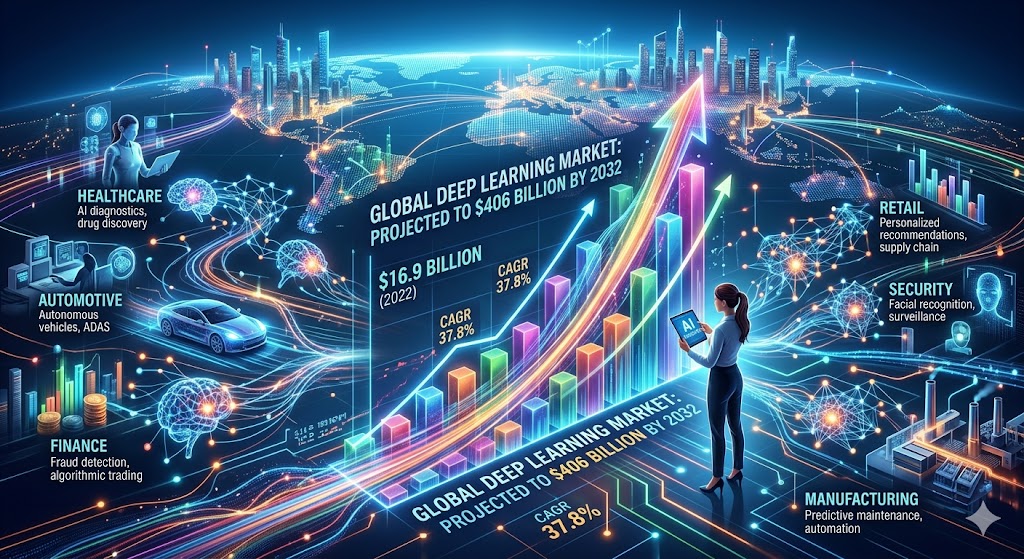
WILMINGTON, DE — March 24, 2026 — The global deep learning landscape is on the verge of an unprecedented explosion. According to a comprehensive new industry report released today by Allied Analytics LLP, the deep learning market—valued at a modest $16.9 billion in 2022—is forecasted to reach a staggering $406 billion by 2032.
This meteoric rise represents a Compound Annual Growth Rate (CAGR) of 37.8%, signaling a fundamental shift in how global industries process data, automate labor, and interact with customers. As we move further into 2026, deep learning is no longer just a buzzword; it is the central nervous system of the modern digital economy.
The Engine of Intelligence: Why Deep Learning is Dominating
Deep learning, a specialized subset of Artificial Intelligence (AI), utilizes multi-layered neural networks to mimic the way the human brain processes information. Unlike traditional algorithms, deep learning models can sift through massive volumes of unstructured data—such as raw video footage, medical scans, and complex human speech—to identify patterns that were previously invisible to machines.
The current market surge is being fueled by three “perfect storm” factors:
- Exponential Data Growth: The proliferation of IoT devices and digital platforms has created a sea of “Big Data” that only deep learning can effectively navigate.
- Hardware Breakthroughs: Specialized AI chips and high-performance GPUs (Graphics Processing Units) from leaders like NVIDIA and AMD have slashed the time required to train complex models.
- Cloud Accessibility: Cloud-based AI platforms have democratized access, allowing even mid-sized firms to rent world-class computational power without massive upfront costs.
Market Dynamics: Drivers and Barriers
Key Drivers
- Automation at Scale: From autonomous vehicles navigating city streets to fraud detection systems protecting global banks, deep learning is removing human error from high-stakes processes.
- Personalization: Retail and E-commerce giants are using deep learning recommendation engines to predict consumer needs before they are even articulated.
- The Edge Computing Leap: The integration of deep learning with “Edge” devices—smartphones and industrial sensors—allows for real-time decision-making without needing a constant connection to a central server.
Critical Challenges
Despite the optimism, the report identifies significant hurdles. The high cost of implementation and a chronic shortage of skilled data scientists remain the primary barriers for smaller enterprises. Furthermore, as AI systems become more pervasive, data privacy and ethical regulations are becoming top-of-mind for governments in Europe and North America, potentially slowing deployment in sensitive sectors like Law and Healthcare.
Industry Vertical Outlook: Who is Winning?
The report breaks down the market across several high-impact sectors:
- Image Recognition: This segment held the largest market share in 2022. Its dominance is driven by the surge in facial recognition for security, medical imaging for early cancer detection, and optical character recognition (OCR) in the legal sector.
- Automotive: With the race for Level 5 autonomy heating up in 2026, deep learning is the primary technology enabling vehicles to interpret 3D environments in real-time.
- Healthcare: AI-driven drug discovery and personalized treatment plans are transforming patient outcomes, moving the sector toward a “predictive” rather than “reactive” model.
Regional Powerhouse: North America Leads the Charge
Geographically, North America remains the dominant player, generating the highest revenue in the sector as of 2022. This is largely due to the concentration of tech giants like Google, Microsoft, and IBM, alongside a robust infrastructure for high-performance computing. However, the Asia-Pacific region is expected to show the fastest growth over the next decade as manufacturing hubs in China and India aggressively automate their supply chains.
Frequently Asked Questions (FAQs)
Q: What is the difference between Machine Learning and Deep Learning?
A: Machine Learning is a broad category of AI that uses algorithms to parse data. Deep Learning is a specific type of Machine Learning that uses “neural networks” with many layers (hence “deep”) to learn from data in an unsupervised manner, making it much more powerful for complex tasks like voice and image recognition.
Q: Which companies are leading the Deep Learning market?
A: Key players include NVIDIA, Google, Microsoft, IBM, Intel, AMD, Amazon Web Services (AWS), Samsung, and Qualcomm. These companies are currently competing through massive R&D investments and strategic acquisitions of AI startups.
Q: How is deep learning affecting jobs?
A: While deep learning automates many routine and data-heavy tasks, it is also creating a massive demand for new roles, including AI ethicists, prompt engineers, and neural network architects.
Reference Links & Official Resources
- Allied Market Research: Deep Learning Market Forecast 2032 – Full Report
- NVIDIA AI: Advances in Deep Learning Hardware
- MIT Technology Review: The Future of Neural Networks
Would you like me to generate a summary of the “Top 5 Deep Learning Startups” to watch in the Asia-Pacific region for 2026?