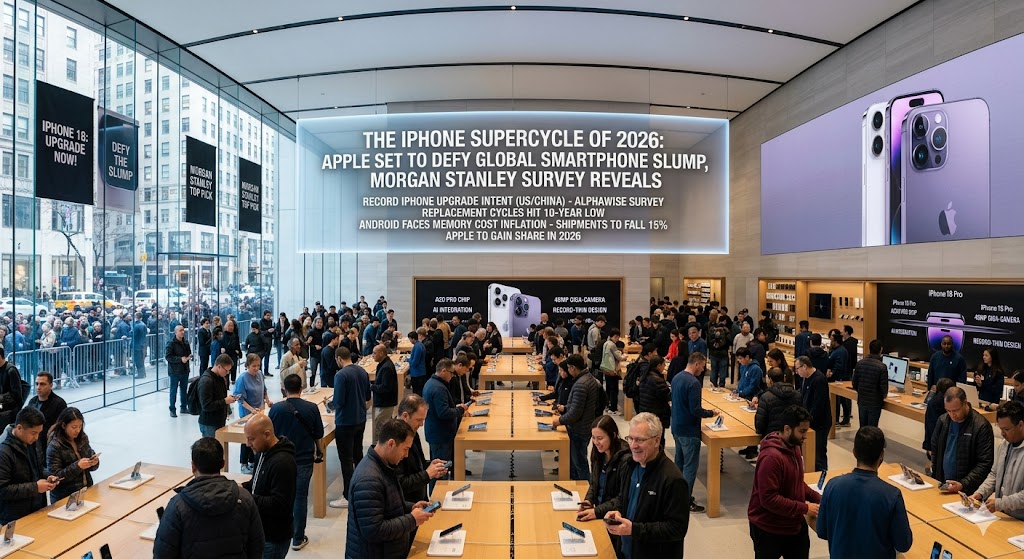
The iPhone Supercycle of 2026: Apple Set to Defy Global Smartphone Slump, Morgan Stanley Survey Reveals
USA Breaking News: In a year that is shaping up to be one of the most volatile in the history of personal technology, a major new global smartphone survey from Morgan Stanley has delivered a striking verdict: Apple is preparing to capture the lion’s share of the market, even as the broader industry faces a double-digit decline.
The AlphaWise survey, analysed by Morgan Stanley’s Erik Woodring, points to a “record-breaking” intent among consumers to upgrade to new iPhones in 2026. However, while the outlook for Cupertino is golden, the same cannot be said for its rivals. Woodring warns that the positive results for Apple “at first blush” actually mask a “tougher year ahead” for the global smartphone market as a whole.
A Record-Breaking Upgrade Cycle
According to the survey data, upgrade intent over the next 12 months in the United States and China—Apple’s two most critical markets—has hit “all-time highs.”
This surge in demand implies that the typical smartphone replacement cycle will accelerate to a 10-year low. Consumers who have been holding onto their devices for three or four years are finally ready to pull the trigger, driven by a “perfect storm” of factors:
- Broad Upgrade Eligibility: A massive portion of the current iPhone “install base” is using models that are now significantly aged, making the jump to a new device more compelling.
- Advanced Features: The 2026 lineup is expected to introduce “new and advanced features,” likely centered around hardware-integrated AI and breakthrough camera technology.
- Superior Build Quality: The perceived longevity and resale value of Apple devices continue to act as a primary driver for brand loyalty.
The Android Crisis: “Memory Inflation” and Price Hikes
While Apple appears insulated, the Android ecosystem is staring down a “perfect storm” of a different kind. Morgan Stanley highlights a looming crisis: unprecedented memory cost inflation.
Due to supply chain bottlenecks and a surge in demand for high-end chips for AI servers, the cost of DRAM and NAND memory has skyrocketed. For Android vendors—who operate on much thinner margins than Apple—these costs must be passed on to the consumer.
The bank predicts that:
- Price Dampening: Rising device prices will “significantly dampen” demand for mid-range and budget Android phones.
- Loyalty Erosion: Because Android users are historically more price-sensitive and show lower brand loyalty than iPhone users, they are more likely to delay a purchase or switch platforms entirely.
- The Switching Surge: iPhone switching rates are projected to reach a 5-year high in 2026, as frustrated Android users seek the perceived stability and value retention of the Apple ecosystem.
Revised Market Forecasts: A 13% Global Drop
As a direct result of these findings, Morgan Stanley has made a drastic cut to its 2026 global smartphone shipment forecast. The bank now expects total shipments to hit 1.1 billion units, down from its previous estimate of 1.3 billion. This represents a 13% year-on-year decline for the industry.
However, the pain is not distributed equally:
- Android Shipments: Expected to plummet 15% year-over-year.
- Apple Shipments: Expected to remain remarkably resilient, with only a 2% decline.
The Takeaway for Investors
For AAPL shareholders, the Morgan Stanley report is a strong endorsement of the company’s “walled garden” strategy. By controlling its own silicon and maintaining premium pricing, Apple is better positioned to weather the inflationary pressures that are currently crippling its competitors.
As Erik Woodring summarizes, Apple is currently “the only major global smartphone vendor expected to gain share in 2026.”
Frequently Asked Questions (FAQs)
Q: Why is the upgrade intent so high for iPhone right now?
A: It’s a combination of “pent-up demand” from users who skipped the last two cycles and the introduction of new features that make older phones feel obsolete. Additionally, Apple’s trade-in programs have become more aggressive, lowering the “barrier to entry” for a new model.
Q: What is “memory cost inflation” and why does it hurt Android more?
A: Android phones often compete on “specs” like high RAM. As the cost of those components rises, manufacturers must either raise prices or lower quality. Apple controls its own hardware/software integration so tightly that it can often achieve better performance with less “raw” memory, making them less vulnerable to these specific price hikes.
Q: Does this mean the 2026 iPhone will be more expensive?
A: While Apple isn’t immune to inflation, Morgan Stanley suggests they have the “pricing power” to maintain their margins without the same drastic demand drop that a budget-focused brand would see.
Reference Links & Further Research
- Investing.com: Morgan Stanley Smartphone Survey – Full Data
- Apple Investor Relations: Quarterly Earnings and Install Base Updates
- Morgan Stanley Research: [Erik Woodring – Tech & Hardware Analysis 2026]
Would you like me to analyze how this “record intent” might impact Apple’s stock price ($AAPL) heading into the Q3 earnings call?