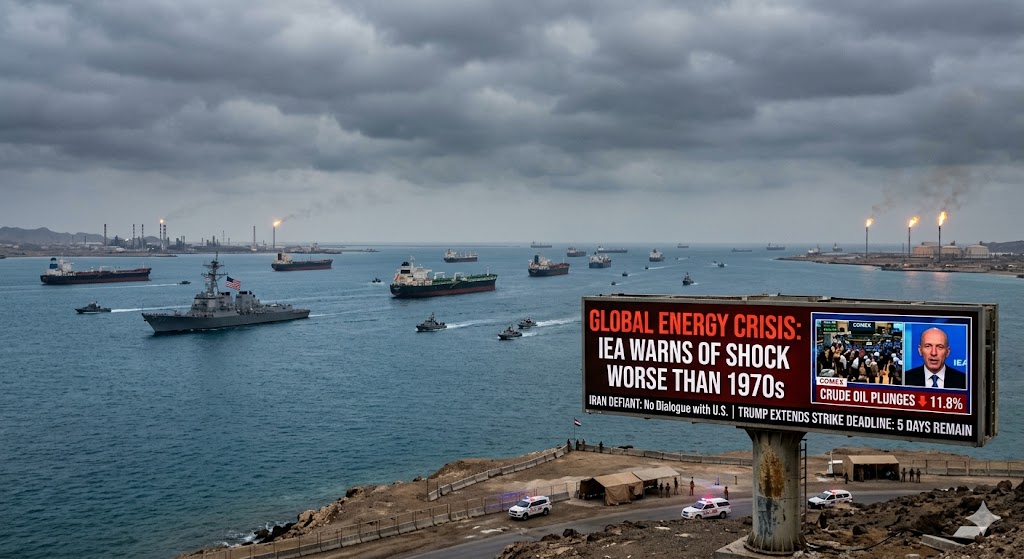
Global Energy Crisis: Iran Remains Defiant as IEA Warns of Shock Worse than 1970s; Trump Extends Strike Deadline
WASHINGTON/TEHRAN — The world stands at a precarious geopolitical crossroads this Monday as the International Energy Agency (IEA) issued a haunting warning: the current global energy crisis has officially surpassed the scale and volatility of the 1970s oil shocks. Against this backdrop of economic peril, President Donald Trump has temporarily walked back a looming military threat against Iran, granting a five-day reprieve to “productive conversations,” even as Tehran denies any such dialogue exists.
The whiplash in rhetoric has sent global markets into a frenzy, with oil prices plummeting from record highs in a matter of hours, while analysts warn that the reprieve may be nothing more than the “eye of the storm.”
The Five-Day Reprieve: Trump’s Calculated Pivot
Late Sunday night, the global economy was bracing for a catastrophic military escalation. President Trump had previously set a “hard deadline” for tonight, threatening to launch targeted kinetic strikes against Iranian energy infrastructure—including refineries and storage facilities—if Tehran did not immediately facilitate the “full and unconditional” reopening of the Strait of Hormuz.
The Strait, a narrow waterway through which roughly 20% of the world’s liquid petroleum gas and oil consumption flows, has been the primary theater of the 2026 Iran Conflict.
However, in a surprise Truth Social announcement Monday morning, the President pivoted.
“Had very good and productive conversations with representatives regarding the Iran situation,” the President posted. “Because of this progress, I am postponing any military strikes on energy sites for FIVE DAYS. We want a deal, but the Strait must open. Time is short!”
The announcement immediately deflated the “war premium” that had seen Brent Crude hovering near $130 per barrel earlier this month. Investors, desperate for any sign of de-escalation, sparked a massive sell-off in energy futures and safe-haven assets like gold.
Tehran’s Defiance: “No Dialogue”
The optimism radiating from the White House was met with a cold, sharp rebuke from the Islamic Republic. Hours after Trump’s post, Iran’s Foreign Ministry issued a statement via state-affiliated media channels, flatly contradicting the American narrative.
“There has been no dialogue, direct or indirect, between Tehran and Washington,” the Ministry spokesperson stated. “The American President’s claims are a desperate fabrication designed to manipulate global energy prices and buy time for the further implementation of his failed military plans.”
Tehran’s rhetoric remains militarily aggressive. The Iranian Revolutionary Guard Corps (IRGC) reaffirmed its vow to retaliate against any American or allied aggression by striking “every energy target across the Middle East,” a threat that encompasses facilities in Saudi Arabia, the UAE, and Qatar.
The IEA’s Dire Warning: A Crisis Beyond 1973
While the political theater plays out, the International Energy Agency (IEA) released a sobering report today suggesting that the ” reprieve” does little to mend the structural damage done to the global energy grid.
The IEA Executive Director stated that the 2026 crisis is “deeper, broader, and more complex” than the 1973 OPEC embargo. Unlike the 1970s, the modern world is more interconnected, and the current disruption affects not just crude oil, but natural gas and the refined products necessary for electricity and food production.
Key Comparisons: 1970s vs. 2026
| Feature | 1970s Oil Shocks | 2026 Energy Crisis |
|---|---|---|
| Primary Trigger | OPEC Embargo (Yom Kippur War) | Blockade of Hormuz / U.S.-Iran Conflict |
| Market Scope | Primarily Crude Oil | Oil, LNG, and Refined Distillates |
| Supply Chain | Regional Disruption | Global Just-in-Time Fragility |
| Inflationary Impact | High (Stagflation) | Record High (Supply-Chain Driven) |
The IEA warns that even with a five-day delay in strikes, the “energy poverty” currently sweeping through Europe and parts of Asia could become a permanent fixture of the 2026 economic landscape if the Strait remains a contested zone.
Market Reaction: Oil Plunges, Bullion Follows
The immediate impact of the “Trump Reprieve” was felt on the trading floors of London, New York, and Mumbai.
- Crude Oil: Brent Crude, which had been pricing in a “strike scenario,” saw a sharp decline of nearly 12% in early trading, as the immediate threat of fireballed refineries was removed from the five-day horizon.
- Gold and Silver: As the “fear factor” subsided, precious metals faced a “bullion bloodbath.” Gold, which hit record highs in late January, continued its slide, losing over 30% from its peak as liquidity returned to the dollar.
- Equity Markets: Airline and transportation stocks saw a modest “relief rally,” though gains were capped by the IEA’s grim long-term outlook.
Frequently Asked Questions (FAQs)
Why did President Trump postpone the strikes?
The President cited “productive conversations,” suggesting that back-channel diplomacy (possibly involving intermediaries like Switzerland or Oman) may be yielding results. Analysts also suggest the five-day window allows the U.S. to further position naval assets in the Persian Gulf.
What happens if the Strait of Hormuz doesn’t reopen in five days?
If the deadline passes without a resolution, the “strike threat” returns to the table. The President has indicated that Iranian energy infrastructure—the backbone of their economy—would be the primary target.
Is the energy crisis over?
No. According to the IEA, the current crisis is a long-term structural issue. Even if the war ends tomorrow, the damage to supply chains and the “risk premium” associated with Middle Eastern oil will take months, if not years, to normalize.
How does Iran’s denial affect the situation?
Tehran’s denial of talks suggests either a major internal power struggle within the Iranian government or that the “conversations” Trump mentioned are with third parties rather than the Iranian leadership itself. It keeps the “war footing” high and the diplomatic path uncertain.
Conclusion: The Looming Deadline
As the sun sets on Monday, March 23, the world enters a tense five-day waiting game. The “productive conversations” touted by Washington and the “defiant denials” from Tehran create a confusing, high-stakes fog of war. One thing, however, is clear: with the IEA warning of an economic shock worse than any in the last 50 years, the clock is ticking not just for the pilots and sailors in the Gulf, but for every consumer on the planet.
Reference Links:
- IEA Official Energy Security Updates
- U.S. State Department – Iran Policy Page
- Live Oil & Commodity Tracking via CNBC
Next Step: Would you like me to monitor the IRGC’s social media channels and state news for any movement of their naval “swarm” boats during this five-day window?