Gold and Silver Markets Shaken: Trump Postpones Iran Energy Strikes, Precious Metals Volatility Eases
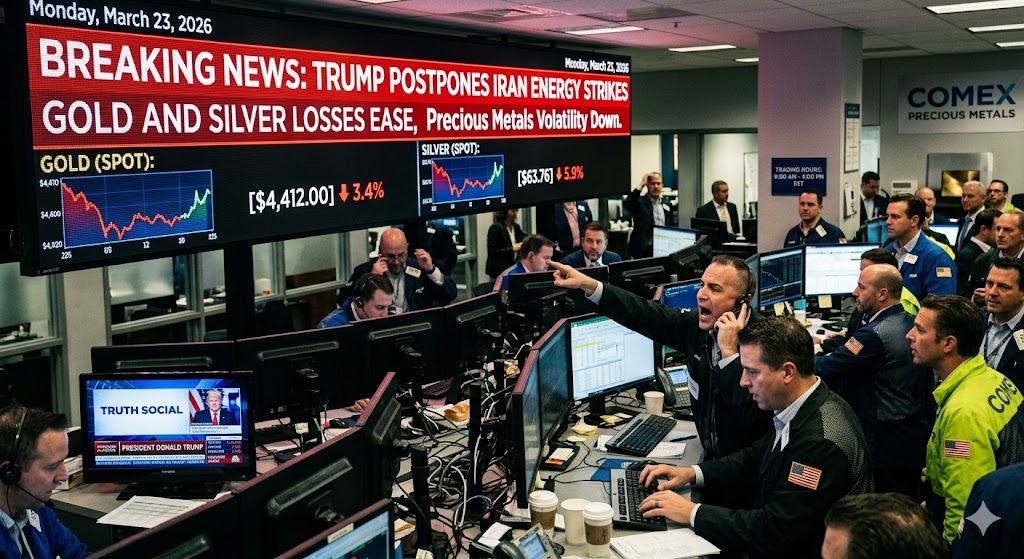
BREAKING USA NEWS : Precious metals markets experienced a “whipsaw” Monday as investors reacted to a sudden shift in U.S. foreign policy. After suffering through its worst week in fifteen years, Gold (XAU=) resumed its slide in early morning trade before paring significant losses following a strategic announcement from the White House regarding the ongoing conflict in the Middle East.
The “Truth” That Moved the Markets
The primary catalyst for Monday’s market volatility was a Truth Social post from U.S. President Donald Trump. In a move that signaled a dramatic de-escalation of regional tensions, the President announced that the United States would postpone planned strikes on Iranian energy infrastructure.
According to the President, the decision followed “good and productive” talks between Washington and Tehran. This news provided a much-needed sigh of relief for global markets that had been pricing in a massive disruption to global energy supplies and a potential widening of the war.
Precious Metals: A Morning of Extremes
The initial reaction on Monday was a continuation of the “panic selling” seen throughout March. Investors, fearing renewed inflation and adjusting to the potential for peace, retreated from traditional “safe-haven” assets.
Gold’s Rollercoaster
- Early Morning Lows: Spot gold plummeted more than 5% early Monday, touching a low of $4,262.50.
- The Recovery: Following the de-escalation news, the yellow metal recovered to trade at $4,412 by late morning in London (7:40 a.m. ET).
- Context: This follows a brutal week where gold lost nearly 10%—its worst performance since September 2011. Since hitting an all-time record high of $5,594.92/oz in late January, spot gold has now shed approximately 25% of its value.
Silver and PGMs Plunge
The “white metals” did not escape the carnage. Spot silver hit a year-to-date low of $63.76, down 5.9% on the day. To put this in perspective, silver was trading near $117 as recently as February 28, just as the Iran conflict ignited. Other metals, including Platinum and Palladium, also saw sharp sell-offs as the “war premium” began to evaporate from the commodity sector.
Key Market Statistics: March 23, 2026
| Metal | Current Spot Price | Intraday Change | 2026 Peak |
|---|---|---|---|
| Gold | $4,412.00 | -3.4% (Recovered from -5%) | $5,594.92 |
| Silver | $63.76 | -5.9% | $117.00 |
| Platinum | $1,085.00 | -4.2% | $1,420.00 |
| Gold Futures | $4,392.00 | -4.0% (Recovered from -10%) | $5,610.00 |
Why the Sudden Sell-Off?
Market analysts point to three primary factors driving the current volatility:
- De-escalation Premium: Much of the surge in gold and silver over the last month was a “risk premium” based on the threat of a full-scale energy war with Iran. With strikes postponed, that premium is exiting the market.
- Inflation Fears: Despite the de-escalation, renewed domestic inflation fears in the U.S. are pushing some investors toward cash and short-term Treasuries rather than non-yielding bullion.
- Technical Correction: After hitting the $5,500 level in January, gold was technically “overbought.” The current correction is viewed by some as a necessary reset to long-term valuation norms.
Frequently Asked Questions (FAQs)
Why did Gold prices fall despite the news of “productive talks”?
While peace is good for the global economy, gold often thrives on uncertainty. When President Trump signaled a postponement of strikes, the “fear factor” that drives safe-haven buying decreased, leading to a sell-off. However, the price recovered from its daily lows as investors stabilized their positions.
Is Silver still a good investment at $63?
Silver has been hit harder than gold, losing nearly half its value since late February. While it is currently at a year-to-date low, some industrial buyers see this as a value entry point, though volatility remains extremely high.
How has the Iran conflict specifically impacted these prices?
The conflict began in late February, sending silver to $117 and gold to record territories. Any news suggesting a military strike on “energy infrastructure” usually sends prices up; conversely, “postponing” such strikes sends prices down.
Will the markets remain closed if volatility continues?
There are no current plans to suspend trading, though “circuit breakers” on major exchanges may trigger if futures drop more than 10% in a single session.