
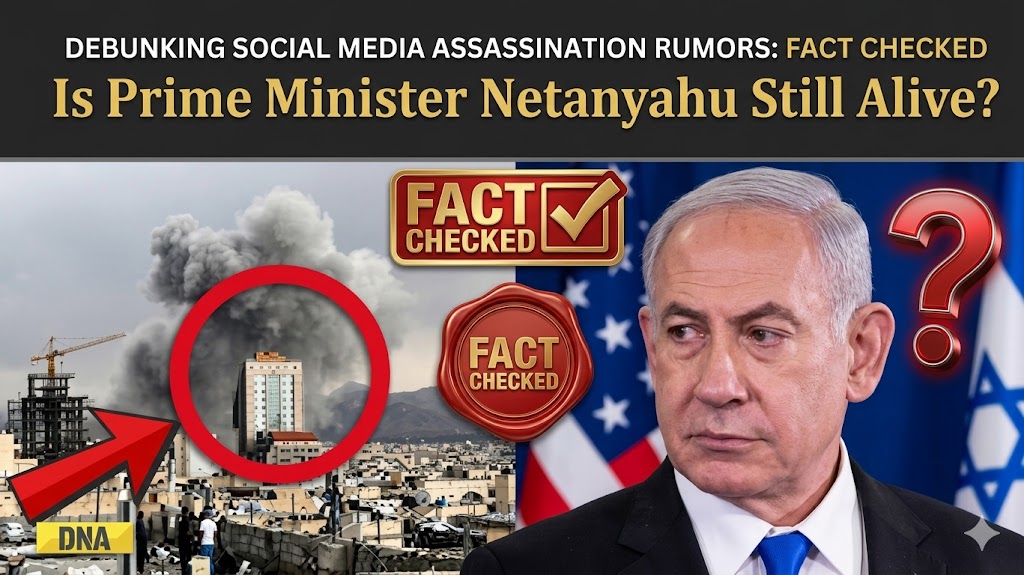
Is Netanyahu Alive? Latest Update: Israel Rejects Assassination Rumors Amid IRGC Vows to Kill Prime Minister
The Middle East has reached a perilous inflection point as the conflict between Israel, the United States, and Iran transitions from a shadow war into a direct, high-intensity confrontation. On Sunday, March 15, 2026, Tehran issued its most provocative threat to date, with the Islamic Revolutionary Guard Corps (IRGC) publicly vowing to assassinate Israeli Prime Minister Benjamin Netanyahu.
This escalation comes on the heels of devastating military exchanges over the weekend, including a massive U.S. strike on Iran’s primary oil terminal at Kharg Island and targeted Israeli strikes against senior Iranian leadership. As the “Operation Epic Fury” continues to unfold in the Mediterranean and the Persian Gulf, the global energy market and regional stability hang in a delicate balance.
Tehran’s Ultimatum: The IRGC Targets Netanyahu
In a statement released via the state-run IRNA news agency, the IRGC utilized incendiary language, labeling Prime Minister Netanyahu a “child-killer” and promising to “pursue and kill” the Israeli leader. The threat is seen by geopolitical analysts as a direct response to the systematic dismantling of Iran’s command and control structure by the Israel Defense Forces (IDF) over the past 48 hours.
The rhetoric reflects a desperate shift in Tehran’s strategy. Having lost significant military assets in recent weeks, the Iranian leadership is now pivoting toward high-profile asymmetric threats. However, Israeli officials remained undeterred. “We are operating on all fronts to ensure the security of our citizens,” an IDF spokesperson stated following a missile barrage aimed at central Israel early Sunday morning.
Weekend of Attrition: IDF Eliminates Iranian Intelligence Chiefs
The Israeli military confirmed a major blow to the Iranian state apparatus this weekend. According to the IDF, special operations have successfully “eliminated” two senior officials of the “Khatam al-Anbiya” Emergency Command. These individuals were reportedly responsible for coordinating Iran’s regional proxy networks and intelligence gathering against Israeli targets.
Furthermore, on Saturday night, the IDF conducted a series of precision airstrikes targeting:
- Iranian Space Agency Research Center: A facility Western intelligence believes is a front for long-range ballistic missile development.
- Aerial Defense Production Factory: A move designed to strip Iran of its ability to intercept future Israeli sorties.
Operation Epic Fury: U.S. Strikes Kharg Island
The involvement of the United States reached a new peak on Friday, March 13, when U.S. Navy assets—supported by the USS Abraham Lincoln (CVN 72) carrier strike group—struck Kharg Island. As Iran’s most critical oil export terminal, the destruction of infrastructure on the island is a direct hit to Tehran’s economic lifeline.
The U.S. Department of Defense framed the strike as a “defensive necessity” following Iranian-backed attacks on shipping lanes in the Strait of Hormuz. Images provided by the U.S. Navy showed EA-18G Growler electronic attack aircraft launching from the Mediterranean, signaling a massive logistical capability to strike Iranian interests from multiple directions.
Despite the heavy losses, Iran’s Foreign Minister Abbas Araghchi maintained a dual-track approach on Sunday, stating that while the country is “ready to retaliate,” it also remains “ready to cooperate with regional neighbors” to prevent a total collapse of the Gulf’s security architecture.
The Economic Ripples: Oil and the Gulf Region
The strike on Kharg Island has sent shockwaves through the global oil markets. With the Gulf region serving as the world’s most significant energy corridor, the threat of a prolonged U.S.-Israel-Iran war has pushed Brent Crude prices toward record highs.
Regional neighbors, including Saudi Arabia and the UAE, have expressed “grave concern” over the widening impact of the war. The shift from proxy battles in Lebanon and Yemen to direct strikes on Iranian soil suggests that the “red lines” of the past decade have been permanently erased.
Summary of Recent Military Developments (March 13–15, 2026)
| Date | Event | Location | Actor |
|---|---|---|---|
| March 13 | Strike on Kharg Island Oil Terminal | Persian Gulf | U.S. Navy |
| March 14 | Strike on Space Agency & Defense Factory | Tehran Suburbs | Israel (IDF) |
| March 15 | Assassination threat against Netanyahu | Tehran | IRGC / IRNA |
| March 15 | Missile barrage on Central Israel | Tel Aviv Region | Iran / Proxies |
Insurance Coverage and War Loss: FAQs for Impacted Individuals
As the conflict widens, many are questioning the legal and financial ramifications for those caught in the crossfire—specifically regarding the loss of life and property under war conditions.
1. Does standard life insurance cover deaths resulting from an act of war?
Generally, most individual life insurance policies do not have a “war exclusion” clause for civilians, meaning they will pay out if a policyholder is killed in a conflict zone. However, policies for active-duty military personnel often have specific stipulations. Always check for a “War and Military Service Exclusion” in your policy’s fine print.
2. Can I claim property damage caused by missile strikes or military action?
Most standard homeowners and commercial property insurance policies explicitly exclude damage caused by war, insurrection, or nuclear radiation. In these cases, claims are typically denied unless the policyholder has purchased a specific “War Risk” rider, which is common in maritime and aviation industries but rare for residential properties.
3. What is “War Risk Insurance”?
This is a specialized type of insurance that covers damage due to acts of war, including invasion, insurrection, and hijacking. It is frequently used by shipping companies operating in the Gulf. Following the Kharg Island strike, premiums for War Risk Insurance in the Persian Gulf have surged by over 400%.
4. Is there government compensation for victims of war?
In many countries, including Israel and Iran, the national government provides specific victim compensation funds for civilians killed or injured in terrorist attacks or acts of state-sanctioned war. These are separate from private insurance and are intended to cover medical bills and funeral costs.
5. How are “Lost Lives” documented for insurance during active combat?
In active war zones, official death certificates may be delayed. Insurance companies often accept “Statements of Death” from military authorities or the Red Cross/Red Crescent to initiate the claims process during a crisis.
Reference Links
- CNBC Finance: Impact of Kharg Island Strike on Global Oil Prices
- IDF Official: Operational Update on Khatam al-Anbiya Strikes
- U.S. Navy News: USS Abraham Lincoln Mission Highlights
- Al Jazeera: Regional Reactions to IRGC Threat Against Netanyahu
