






US Strikes Kharg Island Military Assets: Trump Warns Iran Over “Crown Jewel” Oil Hub
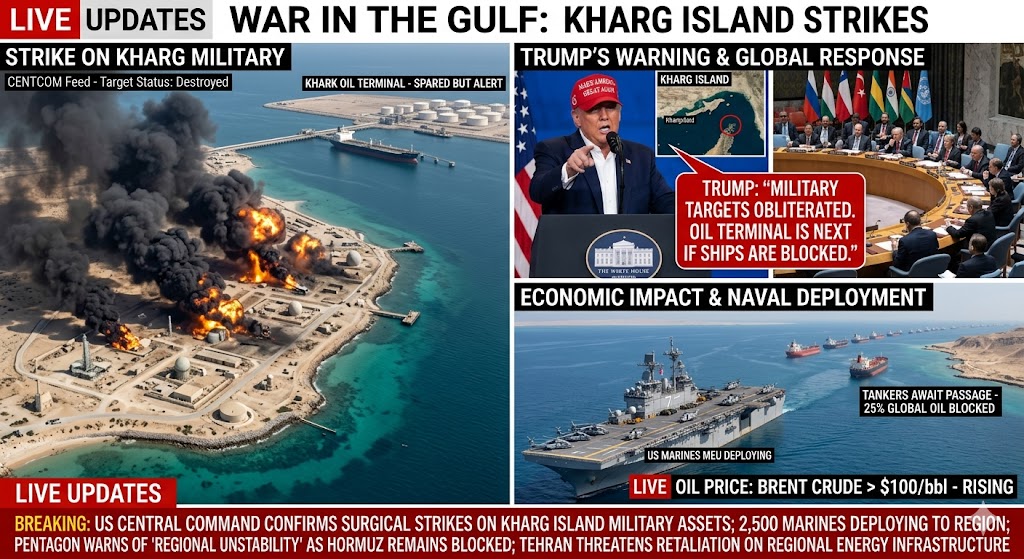
MARCH 14, 2026 — In a major escalation of the two-week-old conflict in West Asia, U.S. forces launched a massive aerial bombardment on Kharg Island, Iran’s most critical oil export hub. President Donald Trump announced Saturday that the United States Central Command (CENTCOM) had “totally obliterated” every military target on the island, describing the facility as the “crown jewel” of the Iranian economy.
The strikes represent a high-stakes “escalate to de-escalate” strategy by the Trump administration, aimed at forcing Tehran to reopen the Strait of Hormuz, which remains effectively shut to international maritime traffic.
Key Updates: A Region on the Brink
- Surgical Strikes on Military Assets: President Trump clarified on Truth Social that while military installations were destroyed, the island’s oil infrastructure—which handles roughly 90% of Iran’s crude exports—was deliberately spared “for reasons of decency.” However, he warned that this decision would be immediately reconsidered if Tehran continues to block global shipping.
- Iranian Retaliation Threats: Tehran has dismissed claims of significant damage to its export capabilities, while state media reported that Iranian leadership is prepared to strike regional oil facilities in neighboring Gulf states if their energy assets are targeted next.
- The “Yuan” Gambit: In a significant shift for global energy markets, a senior Iranian official told CNN that Tehran is considering a limited reopening of the Strait of Hormuz—but only for tankers trading in Chinese yuan, a move seen as an attempt to bypass the U.S. dollar and strengthen ties with Beijing.
- Marines Deploying: The Pentagon is rushing a Marine Expeditionary Unit (MEU) to the region. Approximately 2,500 Marines and sailors are expected to join the USS Tripoli and other naval assets to provide “rapid response” capabilities as tensions peak.
Economic Impact: Oil Prices and Global Markets
The conflict has sent shockwaves through the global economy. On Friday, Brent crude settled above $100 a barrel, with some analysts warning that a “forever war” scenario could see prices spike between $120 and $140.
| Economic Indicator | Status | Impact |
|---|---|---|
| Global Oil Price | Rising | Brent Crude surpassed $100/bbl on March 13. |
| US Gas Prices | Increasing | National average has climbed to $3.63 per gallon. |
| Strait of Hormuz | Blocked | 20% of the world’s oil supply is currently trapped. |
| Currency Markets | Volatile | Shift toward Yuan trade threatens Petrodollar dominance. |
The effective closure of the Strait of Hormuz has not only impacted energy but also the global fertilizer trade. Prices for urea have jumped from $485 to $665 per ton, threatening agricultural yields in countries like India and Brazil that rely on Middle Eastern exports.
The Strategic Importance of Kharg Island
Located 25 km off the Iranian coast, Kharg Island is the lifeblood of the Iranian regime. Its deep-water jetties allow supertankers to load millions of barrels of oil daily. By striking the military defenses of the island without yet destroying the storage tanks, the U.S. is signaling its ability to “turn off the lights” on Iran’s economy at any moment.
“Iran has NO ability to defend anything that we want to attack,” Trump posted, emphasizing that the U.S. military is currently at its most “lethal and powerful” state.
What’s Next?
The deployment of 2,500 Marines suggests the U.S. is preparing for a range of contingencies, including potential amphibious operations or increased naval escorts for tankers. Meanwhile, the international community is watching the “Yuan” proposal closely, as it could mark the most significant challenge to the U.S. dollar’s role in energy in decades.
FAQs: US Strikes on Kharg Island and Iran War Updates (March 2026)
The recent escalation between the United States and Iran has raised urgent questions regarding global energy security and military stability. Below are the most frequent queries regarding the strikes on Kharg Island.
1. What exactly was hit on Kharg Island?
According to President Donald Trump and CENTCOM, the strikes targeted and “obliterated” military assets on the island. These include air defense systems, radar installations, and coastal missile batteries used to monitor and target ships in the Strait of Hormuz. Crucially, both the U.S. and Iranian sources confirm that the oil export terminals and storage infrastructure remain intact—for now.
2. Why is Kharg Island called Iran’s “Crown Jewel”?
Kharg Island is the lifeblood of the Iranian economy. It handles approximately 90% to 95% of Iran’s crude oil exports. Any destruction of its deep-water jetties would effectively end Iran’s ability to participate in the global oil market, crippling its primary source of national revenue.
3. Will gas prices go up after the Kharg Island strike?
Yes. Brent crude prices have already surged past $100 per barrel following the attack. Market analysts warn that if the conflict continues to threaten the Strait of Hormuz—through which 25% of the world’s oil flows—prices could reach $150 per barrel within weeks, leading to significant hikes at the gas pump globally.
4. What is the “Yuan” proposal for the Strait of Hormuz?
In a strategic move to bypass U.S. sanctions and the “petrodollar,” Tehran has suggested it may allow tankers to pass through the Strait of Hormuz if the cargo is traded in Chinese yuan (CNY). This is seen as a way for Iran to maintain its alliance with China while challenging U.S. financial dominance.
5. Are U.S. ground troops being deployed?
The Pentagon has ordered a Marine Expeditionary Unit (MEU) consisting of 2,500 Marines and sailors to the region aboard the USS Tripoli. While officials state this is a “rapid response” deployment for embassy security and maritime defense, it marks a significant buildup of U.S. “boots on the ground” capabilities in the Persian Gulf.
Reference Links & Live Coverage
For continuous updates on the evolving situation in the Middle East, please refer to the following verified news sources:
- The Hindu (Live Digest): U.S. bombs targets on Iran’s oil export hub Kharg Island
- Al Jazeera (Live Blog): Iran war updates: Israel strikes Tehran; Trump warns of oil facility hits
- Hindustan Times: Why Kharg Island is crucial to Iran’s oil network
- Gulf News: Global oil prices hinge on security of Kharg Island