
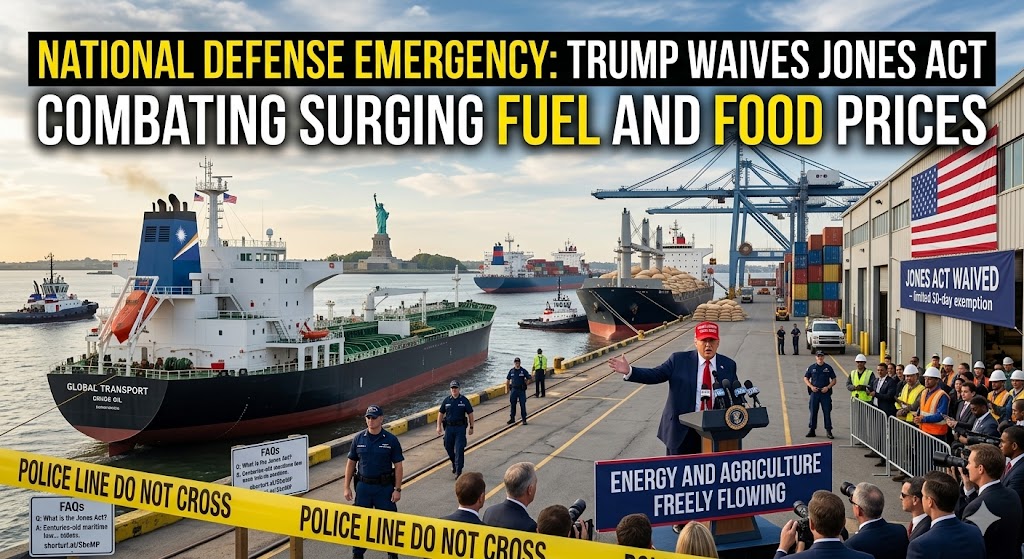
National Defense Emergency: Trump to Waive Jones Act to Combat Surging Fuel and Food Prices
WASHINGTON, D.C. — In a dramatic bid to stabilize a domestic economy reeling from the “Gulf Oil Shock,” President Donald Trump is moving to suspend the Merchant Marine Act of 1920, commonly known as the Jones Act. The move, confirmed by White House Press Secretary Karoline Leavitt on Thursday evening, marks a significant escalation in the administration’s efforts to tame spiraling energy and agricultural costs as the war in Iran enters a volatile new phase.
The proposed 30-day waiver would lift the century-old requirement that all goods transported between U.S. ports be carried on ships that are U.S.-built, U.S.-owned, and U.S.-crewed. By opening domestic shipping lanes to cheaper, more plentiful foreign-flagged tankers, the White House aims to break the logistical bottleneck preventing Gulf Coast energy and fertilizer from reaching the Northeast and the West Coast.
“In the Interest of National Defense”
The administration’s decision comes as national average gasoline prices threaten to breach historic highs, fueled by the closure of the Strait of Hormuz and the ongoing air campaign against Iranian infrastructure.
“In the interest of national defense, the White House is considering waiving the Jones Act for a limited period of time to ensure vital energy products and agricultural necessities are flowing freely to U.S. ports,” Karoline Leavitt said in a statement. “This action has not been finalized, but the President is committed to using every tool at his disposal to protect American families from the radical spike in costs caused by foreign instability.”
While the waiver is officially being framed as a “defense” measure, the economic implications are immediate. Gasoline futures pared gains almost instantly following the announcement, as markets priced in a more efficient supply chain.
The Logistics of the Waiver: Who Wins?
The Jones Act has long been a point of contention between domestic shipbuilders and energy economists. Because there are very few U.S.-compliant tankers currently in operation, the Northeast U.S. often finds it cheaper to import gasoline from Europe than to ship it from Texas.
The 30-day exemption is expected to cover:
- Crude Oil & Gasoline: Allowing foreign tankers to move fuel from the Gulf Coast to the densely populated Eastern Seaboard.
- Liquefied Natural Gas (LNG): Crucial for power generation in New England, which lacks sufficient pipeline capacity.
- Fertilizer: A critical “agricultural necessity” as American farmers prepare for the spring planting season amid global shortages.
“It absolutely facilitates the free flow of gasoline,” said David Goldwyn, president of Goldwyn Global Strategies. “The Northeast continues to import whatever gasoline they can’t get from the Colonial Pipeline. This waiver allows us to use the global fleet to move our own American resources where they are needed most.”
A Multi-Pronged Economic Offensive
The Jones Act waiver is just one piece of a broader “Economic Defense” strategy deployed by the Trump administration this week. The White House is currently managing:
- The SPR Release: The administration announced the release of 172 million barrels from the Strategic Petroleum Reserve on Wednesday.
- Global Coordination: A total of 400 million barrels are being released in coordination with international allies to offset the loss of Iranian and Gulf exports.
- The “Bahamas Bridge”: California, facing extreme fuel shortages, has already begun turning to unconventional shipments from the Bahamas to bypass domestic logistical hurdles.
The Political Fallout: Shipbuilders vs. Motorists
The move is not without its detractors. Domestic maritime unions and U.S. shipbuilders have historically lobbied hard against Jones Act waivers, arguing that they undermine national security by degrading the American merchant marine fleet.
However, with J.P. Morgan Chase & Co. estimating that a waiver could save East Coast motorists roughly 10 cents a gallon at the pump, the administration appears to be prioritizing the immediate “pocketbook pain” of voters over the long-term protectionist policies of the shipping industry.
| Commodity | Current Market Pressure | Expected Impact of Waiver |
|---|---|---|
| Crude Oil | $93.94 (Up 7.5%) | Improved refinery access on East Coast |
| Gasoline | Surging in Northeast/CA | Est. 10-cent reduction per gallon |
| Fertilizer | Supply chain bottlenecks | Stabilized food production costs |
Conclusion: A 30-Day Race Against Time
The proposed waiver is intended to be a “short, sharp shock” to the logistical system. By limiting the exemption to 30 days, the administration hopes to flood the market with supply without permanently damaging the domestic shipping industry.
As the war in the Middle East continues to dictate global energy prices, the White House is betting that a temporary pivot to global shipping will provide the relief American consumers desperately need before the “oil shock” turns into a full-scale economic recession.
To help you stay ahead of the curve, here is a breakdown of the most frequently asked questions regarding the White House’s proposed 30-day Jones Act waiver.
Jones Act Waiver: Frequently Asked Questions (FAQ)
Q: What exactly is the Jones Act?
A: Formally known as the Merchant Marine Act of 1920, it is a federal law requiring that all goods transported by water between U.S. ports be carried on ships that are U.S.-built, U.S.-owned, and U.S.-crewed.
Q: Why is President Trump waiving it now?
A: The war in Iran has caused crude oil to surge past $100 a barrel and the national gas average to jump 60 cents in just weeks. Because there are very few U.S.-flagged tankers available, the Northeast often has to import fuel from overseas rather than from the Gulf Coast. A waiver allows cheaper, more plentiful foreign tankers to move American fuel and food where it’s needed most.
Q: How will this affect my wallet?
A: Analysts suggest the waiver could lower gas prices on the East Coast by roughly 10 cents per gallon. It also aims to stabilize the cost of fertilizer, which is critical for preventing a secondary spike in food prices during the spring planting season.
Q: How long will the waiver last?
A: The White House has signaled a 30-day exemption period. Under current law, non-Department of Defense waivers are typically limited to 10 days but can be extended up to 45 days in cases of national emergency.
Q: Does this hurt American jobs?
A: Critics, including maritime unions and domestic shipbuilders, argue that waiving the act undermines the U.S. merchant marine fleet. However, the White House has stated that in a state of “national defense” emergency, the priority is the immediate flow of energy to avoid a domestic economic collapse.
Quick Resource Guide
| Resource Type | Link/Location | Use Case |
|---|---|---|
| Official Statement | White House Press Office | Confirming official administration policy. |
| Real-Time Gas Prices | AAA Gas Prices | Tracking the impact of the waiver at the pump. |
| Market Data | WSJ Energy Section | Monitoring Brent and WTI crude fluctuations. |
Key Takeaway
The Jones Act waiver is a rare, emergency lever being pulled to “blunt” the impact of the Iran war on the American consumer. By bypassing protectionist shipping rules, the administration is betting that global logistics can save the domestic economy from an unmanageable oil shock.