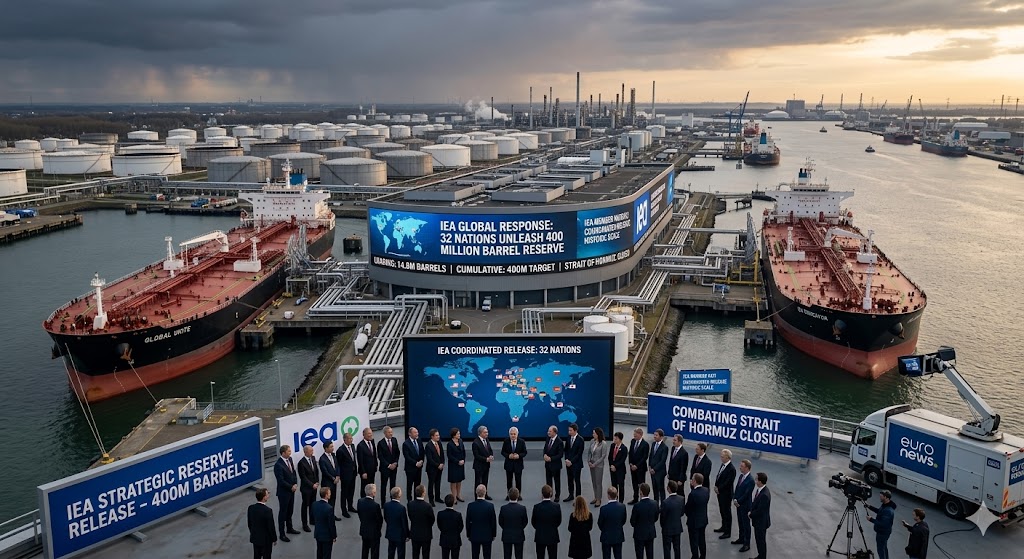
IEA Global Response: 32 Nations Unleash Historic 400 Million Barrel Oil Reserve to Combat Strait of Hormuz Closure
WASHINGTON D.C. / TEHRAN — In a historic and unprecedented attempt to prevent a total collapse of the global economy, the International Energy Agency (IEA) announced on Wednesday that its 32 member countries will release 400 million barrels of oil from their strategic reserves. The coordinated action—the largest in the agency’s 52-year history—comes as the Strait of Hormuz remains effectively closed due to the rapidly expanding war in the Middle East.
The decision, announced by IEA Executive Director Fatih Birol, underscores the desperation of world leaders to shore up energy supplies as a fifth of the world’s oil transit is choked off by a cycle of U.S.-Israeli strikes and Iranian retaliatory attacks.
The Strait of Hormuz: A Global Chokepoint Under Fire
The catalyst for the IEA’s emergency intervention was a series of maritime strikes that occurred within hours of each other on Wednesday morning. The United Kingdom Maritime Trade Operations (UKMTO) reported that three commercial vessels were struck by unidentified projectiles in or near the Strait.
Iran has appeared to take direct responsibility for the escalation. Alireza Tangsiri, the commander of the Navy of the Islamic Revolutionary Guards Corps (IRGC), issued a chilling ultimatum on social media, stating that “any vessel that intends to pass must obtain permission” from the Iranian regime. Shortly after, the Mayuree Naree, a Thai-flagged cargo ship, was struck, signaling that neutral vessels are no longer safe in the waterway.
In response, the U.S. Central Command (CENTCOM) issued a stark warning to civilian shipping:
“Civilian ports used for military purposes lose protected status and become legitimate military targets… Iran is using these ports to conduct military operations that threaten international shipping.”
Trump vs. Tehran: Contradictory Signals and “Unconditional Surrender”
In Washington, President Trump offered a conflicting assessment of the conflict’s duration. Speaking to Axios, the President claimed the war would end “soon” because there was “practically nothing left to target” following days of intense bombardment.
However, his administration simultaneously maintained that only the “unconditional surrender” of Tehran would cease hostilities. Analysts point out that despite the deaths of approximately 1,300 Iranians in recent strikes, the regime has shown no signs of capitulation. Instead, missiles and drones from Iran have targeted Saudi Arabia, Kuwait, Qatar, and the United Arab Emirates, forcing regional air defenses into constant engagement.
The Human and Economic Toll
The human cost of the expanding war is mounting with terrifying speed.
- Casualties: More than 1,800 people have been killed across the region.
- Lebanon: Israeli strikes on Hezbollah strongholds have killed at least 570 people and displaced over 750,000.
- American Losses: The Pentagon confirmed that Iranian strikes have killed seven U.S. service members and wounded 140 others, eight of them severely.
For the global consumer, the “Strait of Hormuz tax” is already being felt at the pump. In the United States, gas prices rose for the 11th consecutive day to a national average of $3.58 a gallon.
A Shadow Leader: The Silence of Mojtaba Khamenei
Adding to the regional instability is the mystery surrounding Iran’s new leadership. Mojtaba Khamenei, who succeeded his father as Supreme Leader following a lethal strike earlier this week, has remained entirely invisible.
Iranian officials suggest two possible reasons for his silence:
- Security: Any broadcast could reveal his location to U.S. or Israeli intelligence.
- Injury: Reports suggest he may have been wounded during the opening wave of coalition strikes on Monday.
Frequently Asked Questions (FAQs)
Q: What is the IEA and why is this release significant?
A: The International Energy Agency was created after the 1973 oil crisis. The release of 400 million barrels is double the previous record and is intended to prevent a global recession by artificially lowering prices while the Strait of Hormuz is blocked.
Q: How does the closure of the Strait of Hormuz affect me?
A: Because 20% of global oil passes through this narrow waterway, any disruption leads to immediate spikes in gas prices and shipping costs for consumer goods.
Q: Is the U.S. currently at war with Iran?
A: While not a formally declared war by Congress, the U.S. and Israel are engaged in high-intensity kinetic operations against Iranian infrastructure and mine-laying vessels.
Reference Links
- IEA Official Statement: iea.org/news/emergency-release
- U.S. Central Command Updates: centcom.mil/media
- AAA National Gas Prices: gasprices.aaa.com
- UK Maritime Trade Operations: ukmto.org
Next Step: Would you like me to track the Brent Crude oil price and provide an update on how the market is reacting to the IEA’s 400-million-barrel announcement?