Van Allen Probe A: NASA Satellite’s Fiery Return as Solar Maximum Accelerates Re-entry
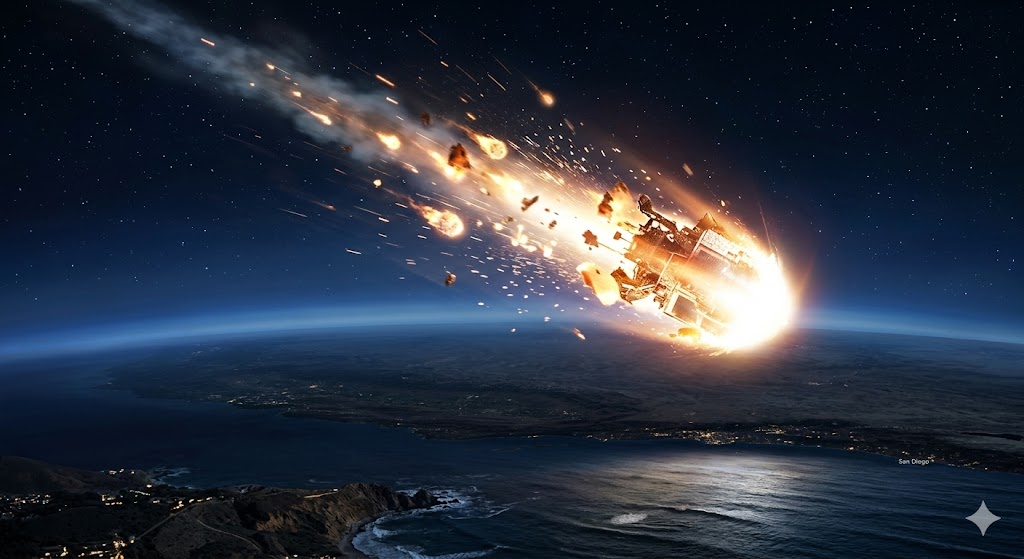
In a dramatic conclusion to a mission that redefined our understanding of the space surrounding our planet, a 1,323-pound NASA satellite is expected to plunge through Earth’s atmosphere tonight. The Van Allen Probe A, which spent years navigating the treacherous radiation belts encircling Earth, has become the latest victim of an unexpectedly fierce solar cycle that has dragged it back toward the surface nearly a decade ahead of original projections.
NASA officials confirmed that the spacecraft is slated for re-entry on Tuesday, March 10, into Wednesday, March 11, with a primary target window centered around 7:45 p.m. ET. However, the agency cautioned that atmospheric physics remains an inexact science, providing a 24-hour buffer for the fiery descent.
The Mission: Journey Into the Heart of the Belts
Launched in August 2012, the Van Allen Probes (originally the Radiation Belt Storm Probes) were designed for a grueling task: survive and study the Van Allen radiation belts. These two donut-shaped regions of high-energy particles are held in place by Earth’s magnetic field, acting as a shield against cosmic radiation while simultaneously posing a severe threat to orbiting satellites and astronauts.
Initially planned as a two-year sprint, the twin probes—Probe A and Probe B—proved to be legendary endurance runners. They operated for nearly seven years, providing the first-ever high-resolution data on how the belts shrink and swell in response to solar storms.
“These probes exceeded every expectation we had,” a NASA spokesperson noted. “Even though the mission officially ended in 2019, the data they collected is still being used today to protect our modern GPS and communication infrastructure.”
The Solar Maximum Factor: Why Now?
The most startling aspect of the Van Allen Probe A’s return is the timing. When the mission concluded in 2019, orbital mechanics calculated a re-entry date in 2034. However, the Sun had other plans.
In 2024, scientists confirmed the Sun had reached its solar maximum—the peak of its 11-year cycle. This cycle has proven to be far more active than predicted, characterized by frequent solar flares and coronal mass ejections. These events heat Earth’s upper atmosphere, causing it to expand. For a decommissioned satellite like Probe A, this meant increased atmospheric drag, effectively “braking” the spacecraft and pulling it down years earlier than expected.
Risk Assessment: Should We Be Worried?
While the idea of a 1,300-pound object falling from the sky sounds harrowing, NASA and the U.S. Space Force have emphasized that the threat to human life is negligible.
- Atmospheric Incineration: Most of the satellite is expected to burn up due to the extreme heat of friction as it enters the atmosphere at several thousand miles per hour.
- Surviving Components: NASA warns that high-density components, such as fuel tanks or specialized sensors, may survive the heat and reach the surface.
- The Odds: NASA has calculated the risk of harm to anyone on Earth as 1 in 4,200. To put that in perspective, the vast majority of the Earth’s surface is uninhabited ocean or wilderness.
What Happens Next?
The U.S. Space Force continues to track the descent via its Space Track network. As for its twin, Van Allen Probe B, it remains in a slightly different orbit and is currently projected to remain aloft until 2030 or later.
As Probe A prepares for its final “shooting star” performance, it leaves behind a legacy of scientific discovery that remains vital as humanity prepares for the Artemis III manned moon missions, where understanding radiation will be the difference between life and death for astronauts.
Frequently Asked Questions (FAQ)
Q: Where exactly will the satellite land? A: Because re-entry occurs at orbital speeds, it is impossible to predict the exact landing spot until minutes before it happens. Most re-entries occur over the ocean.
Q: Can I see it from the ground? A: If the re-entry occurs over a populated area during night hours, it will appear as a very bright, slow-moving fireball, often breaking into several smaller streaks.
Q: Why couldn’t NASA just move it to a higher orbit? A: The mission ended in 2019 when the satellites ran out of fuel. Without propellant, the spacecraft cannot be maneuvered.
Q: Is there hazardous material on board? A: No. The Van Allen Probes did not carry nuclear power sources or hazardous chemicals that would survive re-entry in dangerous quantities.
Reference Links
- NASA’s Van Allen Probes Mission Page – Historical data and mission archives.
- Space-Track.org – Real-time satellite tracking provided by the U.S. Space Force.
- NOAA Space Weather Prediction Center – Updates on the current solar cycle and atmospheric drag.
- NASA Artemis Program Updates – Information on how radiation belt data impacts future moon landings.