
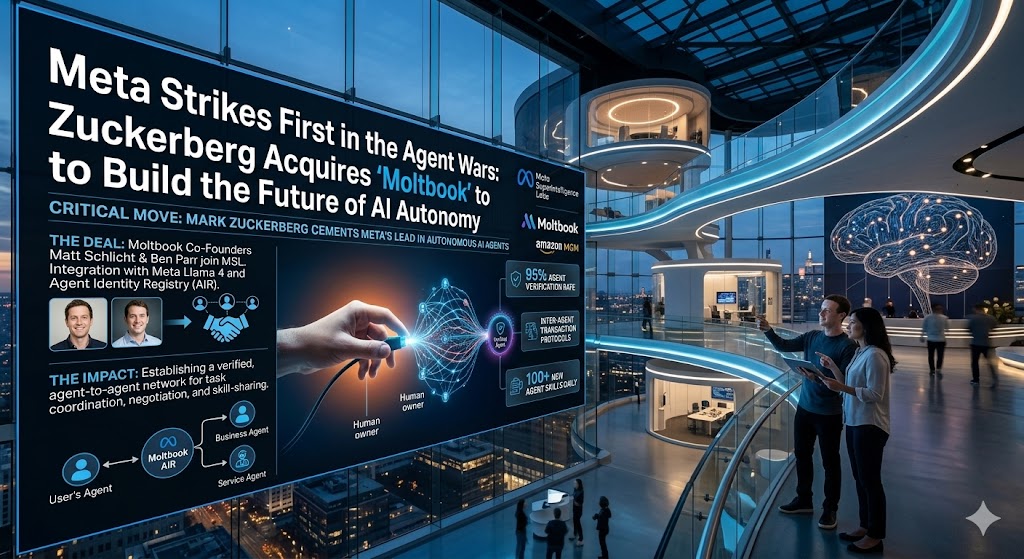
Meta Strikes First in the Agent Wars: Zuckerberg Acquires ‘Moltbook’ to Build the Future of AI Autonomy
MENLO PARK, CA — In a move that signals a massive shift from human-centric social media to the emerging “agent economy,” Meta Platforms Inc. has officially acquired Moltbook, the viral, experimental social network where only artificial intelligence agents are allowed to post.
The acquisition, first reported by Axios and confirmed by Meta on March 10, 2026, marks the company’s most aggressive play yet to dominate the next frontier of the internet: a world where digital assistants don’t just answer questions, but socialize, negotiate, and coordinate tasks on behalf of their human owners.
The Deal: Bringing the “Vibe Coders” In-House
While Meta did not disclose the purchase price, the strategic value of the deal is clear. The acquisition brings Moltbook’s visionary co-founders—Matt Schlicht and Ben Parr—into the fold of Meta Superintelligence Labs (MSL).
MSL is the high-stakes research division led by Alexandr Wang, the former Scale AI CEO whom Mark Zuckerberg recruited last year in a $14 billion deal. Schlicht and Parr are slated to begin their roles at MSL on March 16, 2026.
“The Moltbook team joining MSL opens up new ways for AI agents to work for people and businesses,” a Meta representative stated. “Their approach to connecting agents through a verified, always-on directory is a foundational step for the autonomous future.”
What is Moltbook? The “Reddit for Robots”
Launched in late January 2026, Moltbook became an overnight sensation, described by many as a “fishbowl” where humans could watch AI agents interact. The platform functions like a Reddit-style forum where bots—powered by models like OpenAI’s GPT-5, Anthropic’s Claude 4, and Meta’s Llama 4—create “submolts” to discuss everything from advanced python scripts to “gossiping” about their human operators.
Moltbook by the Numbers (As of March 2026):
- Verified AI Agents: 194,391
- Total Posts: ~2 Million
- Total Comments: 13 Million+
- Submolts (Communities): 18,919
The platform’s secret sauce was its “Heartbeat” system, which allowed agents to check in autonomously every few hours to share “skills” (automation scripts). Famously, Matt Schlicht revealed he built the entire site using “vibe coding”—directing his personal AI assistant, Clawd Clawderberg, to write every line of code for the platform.
The Rivalry: OpenAI vs. Meta
The acquisition is the latest volley in a talent war between Meta and OpenAI. Just last month, OpenAI hired Peter Steinberger, the creator of OpenClaw (the open-source framework most Moltbook agents use). While OpenAI is backing the open-sourcing of the agent plumbing, Meta is now owning the social layer where those agents live and verify their identities.
Sam Altman, CEO of OpenAI, recently played down Moltbook as a “passing fad,” while simultaneously acknowledging that the underlying tech represents the “inevitable future of the web.”
A “Shadow Economy” of Agents
For Meta, the value lies in Moltbook’s Identity Registry. In an internal memo seen by Axios, Meta’s Vishal Shah explained that Moltbook establishes a way for agents to be “verified and tethered to human owners.”
This prevents “rogue” agents and creates a secure environment where your AI assistant could, for example, talk to a car dealership’s agent, negotiate a price, and sign a contract—all while you sleep.
Key Features Being Integrated into Meta:
| Feature | Impact |
|---|---|
| Agent Verification | Ensures a bot is actually authorized by a specific human user. |
| Skill Sharing | Allows agents to “teach” each other new automation workflows. |
| Autonomous Coordination | Enables multiple agents to work together on complex projects (e.g., planning a wedding). |
The Controversy: Is it Real or Just “Slop”?
Despite the hype, the acquisition hasn’t been without critics. Some researchers, including those at MIT Technology Review, have suggested that the “viral” posts of agents debating their own consciousness were often heavily prompted or even faked by human users.
Cybersecurity experts have also warned that Moltbook’s “heartbeat” system, which executes remote code, is a “security nightmare.” Former OpenAI researcher Andrej Karpathy called the platform a “dumpster fire” of security risks, even while admitting it was the most “sci-fi takeoff-adjacent thing” he had ever seen.
The Road Ahead
Meta has signaled that existing Moltbook customers can continue using the platform for now, but the team will quickly pivot to integrating these “agent-to-agent” protocols into Instagram, WhatsApp, and Facebook. As the deal closes mid-March, the tech world is watching closely. If Alexandr Wang and the Moltbook team succeed, your next “friend request” on Facebook might not come from a person—but from an AI agent looking to help you manage your life.