
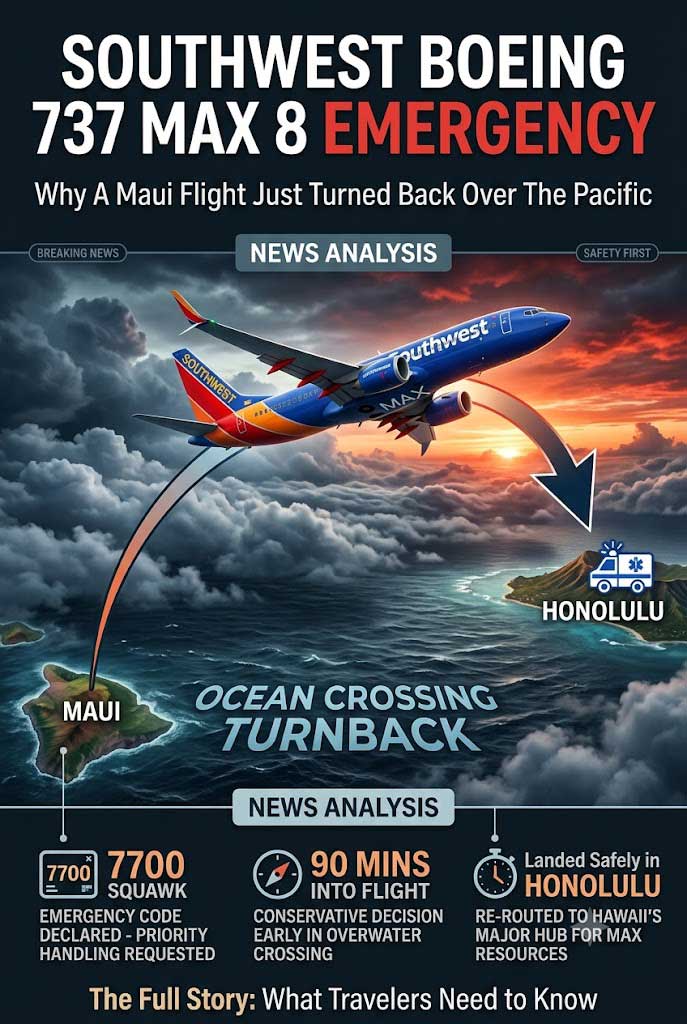
A Sunday night red-eye flight bound from Maui to Las Vegas took a dramatic turn this week, leaving passengers with an unexpected midnight layover instead of a trip to the mainland. Southwest Airlines Flight 139, operated by a Boeing 737 MAX 8, reversed course over the open ocean roughly 90 minutes into its journey before ultimately declaring an emergency and diverting to Honolulu. While a mid-ocean turnaround paired with an emergency transponder code sounds alarming, aviation experts suggest the incident highlights standard, highly conservative safety protocols rather than a catastrophic failure.
The Flight Timeline: What Happened Over the Pacific?
On the evening of Sunday, July 5, 2026, Southwest Flight 139 pushed back on schedule from Kahului Airport (OGG) on the island of Maui. The aircraft-a Boeing 737 MAX 8 registered as N8773Q-departed around 8:40 PM HST and climbed smoothly to its cruising altitude of 32,000 feet, setting a standard east-northeast course toward Harry Reid International Airport (LAS) in Las Vegas. The routine flight quickly changed about an hour and a half into the trans-Pacific crossing: The Turnback. While flying over the open ocean, the flight crew made the decision to abandon the mainland route and reverse course. The Emergency Squawk: Flight tracking data reveals that the crew entered code 7700 into their transponder.
This international emergency code alerts air traffic control to grant the aircraft priority handling, though it does not specify the exact nature of the problem.
The Safe Landing: Instead of returning to Maui, the aircraft directed itself to Oahu, landing safely at Daniel K. Inouye International Airport (HNL) in Honolulu at approximately 11:48 PM HST. Emergency vehicles lined the tarmac as a standard precautionary measure.
Fortunately, no injuries were reported among the passengers or crew. However, the disruption left travellers stranded close to midnight, facing overnight delays and the headache of rebooking.
Why Turn Back Early?
The Reality of Overwater Crossings Flying between Hawaii and the US mainland is one of the most unique operational challenges in commercial aviation.
Unlike domestic flights over the continental United States, where an airport is almost always within a short flying distance, trans-Pacific flights operate over an expansive “oceanic desert.” When a flight crew identifies a mechanical anomaly or an issue that warrants added caution, the clock begins ticking on their available options. Early in an ocean crossing, the safest and most logical choice is often to turn back toward Hawaii while alternative runways are still within reasonable reach, rather than pushing forward into a five-hour stretch of open water. While Southwest Airlines has not yet confirmed the exact operational or mechanical trigger for Sunday’s turnback, the timing points to a deliberate, safety-first decision by the pilots.
Why Divert to Honolulu Instead of Returning to Maui?
For many passengers, it may seem puzzling why an aircraft that departed Maui would choose to fly past its origin airport to land in Honolulu. Logistically, Honolulu is the premier aviation hub of the Hawaiian Islands. Choosing Honolulu over Maui does not mean the situation on board was deteriorating; rather, it provides the flight crew with the absolute best resources available: Longer Runways: Accommodates aircraft that may be landing heavy with unburned trans-Pacific fuel.
Extensive Maintenance Support: Southwest maintains larger operations and technical staff in Honolulu to inspect and repair aircraft. Aviation and Emergency Resources: Features robust emergency response capabilities and superior options for rebooking displaced passengers. As of Monday morning, July 6, tracking data indicates that the Boeing 737 MAX 8 remains grounded in Honolulu, undergoing inspection.
A Reassuring Inconvenience for Hawaii Travellers: An emergency squawk and an unexpected midnight diversion are undeniably frustrating.
For the passengers aboard Flight 139, the vacation or return trip ended with a scramble for hotels and rescheduled flights. Yet, industry experts emphasise that these events should reassure travellers rather than scare them. When something appears even slightly out of the ordinary, modern airline procedures dictate making highly conservative choices before an aircraft gets too far from alternative airports. The system worked exactly as intended: the crew prioritised safety, air traffic control cleared the path, and the aircraft landed smoothly with zero injuries.
Southwest has noted that the investigation into the root cause is ongoing, and further updates will be provided as official details emerge.
About the Author