
Class I FDA Egg Recall: Nearly 19 Million Eggs Escalated to Highest Danger Level Following Multistate Salmonella Outbreak

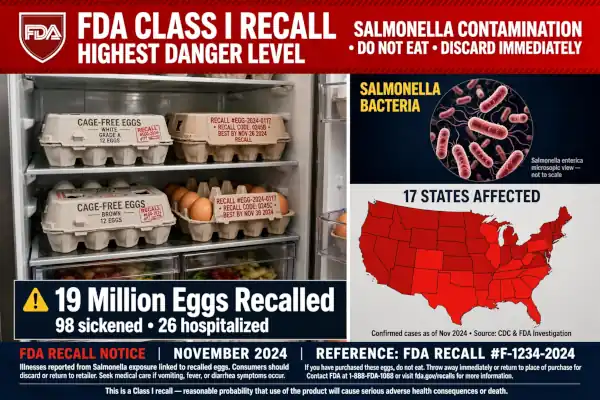
A major public health emergency has intensified across the southern and southwestern United States as federal health regulators escalated an ongoing egg recall to Class I—the U.S. Food and Drug Administration’s (FDA) highest risk designation. The recall involves nearly 19 million shell eggs produced by Texas-based agricultural producer Midwest Poultry Services, L.P., following a multistate outbreak of Salmonella Enteritidis that has sickened nearly 100 people across 17 states.
With millions of egg cartons sold through nationwide grocery chains like Kroger and regional retailers like Brookshire’s, public health officials are issuing urgent advisories to consumers, commercial kitchens, and food service providers. Because recalled cartons carry sell-by and best-by dates extending through August 17, 2026, millions of contaminated eggs may still sit in residential refrigerators and commercial storage units.
The Escalation to Class I: What the Designation Means
The FDA formally reclassified the voluntary recall initiated by Midwest Poultry Services on July 22 into a Class I recall on August 12.
Under the FDA’s regulatory framework, a Class I recall is reserved exclusively for the most severe situations where there is a reasonable probability that the use of, or exposure to, a violative product will cause serious adverse health consequences or death.
While the initial voluntary withdrawal began in mid-summer, the escalation to Class I reflects conclusive epidemiological tracking, whole-genome sequencing (WGS) laboratory matches, and a rising hospitalization count that established a direct link between the farm facilities and sickened consumers nationwide.
FDA RECALL CLASSIFICATIONS BREAKDOWN:
• Class I: Highest risk; exposure carries reasonable probability of severe illness or death.
• Class II: Moderate risk; exposure may cause temporary or medically reversible health issues.
• Class III: Lowest risk; product violates laws/labeling but is unlikely to cause adverse health effects.
Outbreak Scope and Geographic Spread
The Salmonella Enteritidis outbreak tied to this investigation has impacted patients from late 2025 through mid-2026. Health agencies, working in tandem with the Centers for Disease Control and Prevention (CDC) and state health departments, have documented:
-
Total Confirmed Illnesses: 98 laboratory-confirmed infections
-
Hospitalizations: 26 patients (a 26.5% hospitalization rate)
-
Reported Fatalities: 0 deaths reported to date
-
Affected States (17): Arizona, California, Colorado, Georgia, Illinois, Louisiana, Michigan, Missouri, Mississippi, North Carolina, New Mexico, Nevada, New York, Oklahoma, South Carolina, Texas, and West Virginia.
Epidemiological traceback data revealed that among 44 sick individuals who provided detailed food-history records to investigators, 40 individuals (91%) reported consuming eggs in the days leading up to the onset of symptoms. Texas has reported the largest concentration of clinical infections, mirroring the primary retail footprint of the packing plants.
Production Footprint, Brands, and Retail Channels
The recall encompasses 1,589,577 dozen eggs—representing approximately 19,074,924 individual eggs—originating from Midwest Poultry Services facilities in Texas. The eggs were packaged and distributed between June 6 and July 3, 2026, reaching major distribution networks across six primary southern and southwestern states:
-
Primary Retail Distribution: Arkansas, Louisiana, Mississippi, New Mexico, Oklahoma, and Texas.
-
Secondary Logistics: Wholesale and food-service channels spanning secondary supply corridors across the broader South.
The recalled product lines include both white shell and brown cage-free eggs packed across varied packaging formats, from standard half-dozen and dozen cartons to bulk commercial flats.
Impacted Brand Names
The eggs were packaged under several recognized proprietary and store brands:
-
Country Morning
-
Cal-Maine Sunups
-
Brookshire’s
-
Simple Truth (Organic/Cage-Free Lines)
-
Kroger
How Consumers Can Identify Affected Egg Cartons
Consumers and restaurant staff should immediately inspect egg packaging currently held in cold storage. Recalled cartons can be definitively identified using three specific markings printed on the side panel or carton lid:
| Label Element | Recalled Cartons Identification |
| Plant / Facility Code | P-1950 or 0840962 |
| Julian Pack Date Range | 157 through 184 (corresponds to June 6 through July 3) |
| Sell-By / Best-By Dates | July 20, 2026 through August 17, 2026 |
| Egg Types | White Shell & Brown Cage-Free (6-count, 12-count, 18-count, bulk) |
Any carton bearing either plant code (
P-1950 or 0840962) paired with a Julian date between 157 and 184 falls squarely under the Class I warning and should not be used.Laboratory Traceback and Environmental Testing
The FDA’s decision to assign its most severe classification followed comprehensive on-site environmental testing and molecular analysis. Environmental and swab samples collected at Midwest Poultry Services’ Texas poultry houses and packing stations yielded positive cultures for Salmonella.
Third-party reference laboratories conducted Whole Genome Sequencing (WGS) on the isolates. The genomic profile of the environmental bacteria collected from the laying facilities matched the specific clinical strain isolated from hospitalized patients across the multistate surveillance grid.
Federal regulators noted that while Midwest Poultry Services represents a primary common supplier identified in traceback efforts, the facility may not account for 100% of cases nationwide. Epidemiological surveillance remains active to evaluate whether secondary egg suppliers or shared logistics networks also contributed to the outbreak cluster.
Understanding Salmonella: Risks and Clinical Manifestations
Salmonella Enteritidis is one of the most common and hazardous foodborne pathogens. It can colonize the reproductive tract of hens, contaminating the interior of intact, normal-appearing eggs before the shell forms, as well as accumulating on outer shell surfaces during handling.
Symptoms of Infection (Salmonellosis)
Symptoms typically develop within 12 to 72 hours after consuming contaminated food and include:
-
Severe abdominal cramps and stomach pain
-
Watery or bloody diarrhea
-
Fever and chills
-
Nausea and persistent vomiting
-
Headaches and fatigue
The acute illness generally lasts between 4 and 7 days, and most healthy adults recover with supportive fluids. However, in vulnerable populations—including infants, adults aged 65 and older, pregnant women, and individuals with immunocompromising conditions—the infection can enter the bloodstream (bacteremia), causing severe arterial infections, endocarditis, or septic shock requiring intravenous antibiotic therapy and urgent hospitalization.
Guidance for Consumers, Retailers, and Food Service
The FDA, CDC, and state health departments urge immediate corrective action to prevent further cross-contamination and illness:
-
Do Not Consume: Do not eat, cook, bake with, or serve recalled eggs. Cooking to standard temperatures does not fully mitigate risks associated with heavily contaminated batches or raw-handling cross-contamination.
-
Discard or Return: Dispose of recalled eggs immediately in a secured trash receptacle so animals cannot access them, or return the carton to the grocery store of purchase for a complete refund.
-
Handle Loose Eggs with Caution: If you store eggs in reusable plastic refrigerator bins or ceramic holders without original cartons and cannot verify their source, discard them immediately.
-
Sanitize Surfaces and Equipment: Thoroughly wash and sanitize any surfaces that came into contact with recalled cartons or shells, including refrigerator shelving, countertop prep areas, mixing bowls, egg slicers, and utensils, using hot soapy water followed by a diluted bleach or food-safe sanitizing solution.
-
Seek Medical Care: Anyone who has consumed eggs recently and experiences high fever (over 102°F), persistent vomiting, severe dehydration, or bloody diarrhea should consult a medical professional immediately.
Retailers and commercial dining establishments are required to pull any remaining stock matching the plant codes and date stamps from shelves, backrooms, and prep lines, ensuring affected product does not enter the commercial food supply. Investigations and supply-chain monitoring remain active across all affected states.