
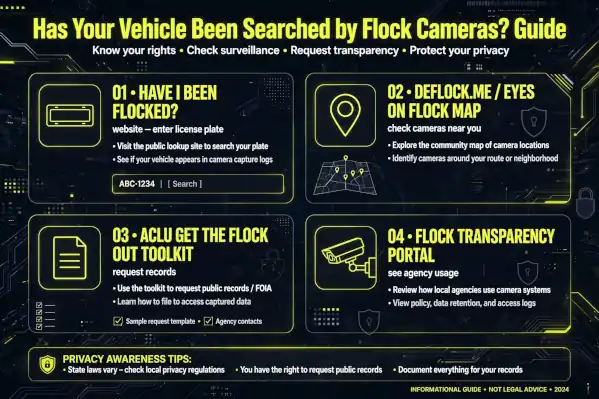

USA: Flock surveillance cameras now monitor thousands of American neighbourhoods, recording billions of vehicle license plate reads each month. If you suspect law enforcement accessed your travel history, new public audit tools let you verify whether officers queried your license plate number across regional automated license plate reader (ALPR) networks.
Automated license plate readers take high-speed photographs of moving traffic, logging registration numbers, vehicle makes, models, and bumper decals into searchable law enforcement databases. While local police agencies deploy these systems for stolen car tracking and active warrant investigations, widespread data sharing between municipal departments and private homeowner associations creates significant constitutional and data privacy concerns.
How to Check If Police Searched Your Vehicle
Drivers can check whether law enforcement queried their vehicle registration through independent transparency portals like HaveIBeenFlocked. The platform aggregates official audit records released via state Freedom of Information Act (FOIA) disclosures, allowing motorists to review historical database lookups for their plates.
-
Enter your exact state-issued license plate number into the portal search bar.
-
Review returned audit logs to view the timestamps of completed agency searches.
-
Identify the specific police department or sheriff’s office that conducted the query.
-
Read the logged investigative reason or case number attached to the database lookup.
These search results show active queries performed by investigators rather than passive roadside camera detections. A record appears only when an officer manually types your plate number into the Flock Safety search interface.
Understanding Flock Safety ALPR Data Collection
Flock Safety operates stationary and mobile solar-powered cameras across public streets, highway intersections, and residential subdivisions. The systems record vehicle movements 24 hours a day, indexing visual traits alongside exact GPS coordinates.
| Data Metric | Flock Safety Standards | Privacy Implication |
| Data Retention Window | Typically 30 days rolling cycle | Unrestricted lookbacks on uncharged drivers |
| Search Capabilities | Plate, color, make, missing plates, decals | Allows broad pattern-of-life queries |
| Network Sharing | Inter-agency and HOA cross-access | Out-of-state jurisdictions can track travel |
| Public Transparency | Agency-level public transparency portals | Audit trails depend on FOIA enforcement |
Law enforcement agencies frequently link private neighbourhood cameras to municipal networks through “hotlists,” which immediately alert patrol cruisers when designated target vehicles pass stationary sensors.
Why Cities Are Reviewing Camera Surveillance
Municipal leaders and civil liberties advocates increasingly challenge mass ALPR surveillance over officer misconduct and unauthorised access. Cities like New Bedford recently paused their camera networks after internal investigations revealed potential officer misuse of the license plate lookup system.
-
Unauthorised Personal Queries: Officers accessing family, dating partner, or neighbour travel logs without open investigative cases.
-
Interstate Data Sharing: Sharing location telemetry with external state jurisdictions without local judicial warrants.
-
Improper Database Retention: Failure to automatically purge logs of innocent motorists after statutory retention limits expire.
Legal Options If Your Privacy Was Violated
Drivers whose license plate logs were improperly accessed without reasonable suspicion have several legal remedies under state records laws and civil rights statutes.
-
Submit Formal Records Requests: File a municipal FOIA or public records request with your local police department demanding complete internal audit logs for your vehicle.
-
File an Internal Affairs Complaint: If audit records demonstrate unauthorized lookups by specific badge numbers, report the breach to the department’s oversight board.
-
Consult a Civil Rights Attorney: Consult specialised attorneys to assess potential Fourth Amendment claims or state statutory privacy violations.
Community Actions for Neighbourhood Surveillance Oversight
Residents can attend town hall meetings to advocate for strict municipal ordinances regulating ALPR deployment. Effective local policies require mandatory search justifications, quarterly public audits, and strict prohibitions on sharing surveillance records with private entities.
Frequently Asked Questions
Does HaveIBeenFlocked show every time my car drove past a camera?
No. The database does not display every passive drive-by captured on roadside sensors. It specifically indexes investigative audit logs, revealing when law enforcement officers manually searched your plate number across historical database records.
How long do police departments store Flock camera footage?
Most law enforcement agreements require automated deletion of passive footage after 30 days unless the vehicle links directly to an active felony case, AMBER alert, or criminal investigation.
Can out-of-state agencies search my local vehicle travel records?
Yes. Police departments often enable nationwide inter-agency data-sharing networks within the Flock ecosystem, allowing outside departments to query local road traffic databases unless explicitly barred by municipal policy.
Verifying your vehicle’s digital footprint helps protect your privacy rights as automated surveillance expands across public roadways. For deeper discussions on privacy rights, auto data security, and driver protections, visit Driver Rights Forum Discussions and read the background on Automated License Plate Readers on Wikipedia. To explore vehicle ownership resources, visit the Online Auto Insurance Portal or search local vehicle compliance tools using the Insurance Search Directory.