
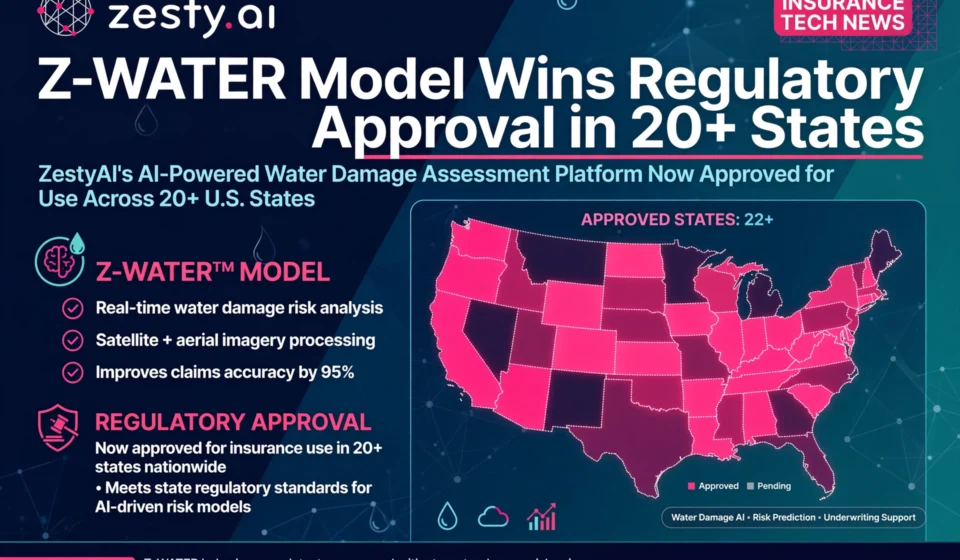

Property insurance underwriting is undergoing a decisive shift as state insurance commissioners embrace granular, artificial intelligence-powered risk modelling. Insurance carriers in over 20 US states can now integrate ZestyAI’s proprietary Z-WATER™ predictive risk model directly into their rate and rule filings to underwrite non-weather water damage.
The Escalating Burden of Non-Weather Water Damage Claims
Non-weather water claims represent the fourth most expensive peril facing property and casualty (P&C) carriers today. Catastrophic weather events often capture national headlines, yet interior plumbing failures, aging appliance leaks, and concealed pipe ruptures quietly drain balance sheets.
Every year, these internal failures generate over 1,000,000 homeowner insurance claims across the United States. Together, they create an annual financial loss exceeding $15 billion for property insurers.
Inflationary pressures, rising labour rates, and surging material replacement costs have driven the average cost per water claim up by 80%. This surge forces underwriters to rethink how they evaluate residential property risk.
Annual Industry Losses:       >$15 Billion
Yearly US Claim Volume:       >1 Million Claims
Average Claim Cost Increase:  +80%
Market Ranking:               4th Most Expensive P&C Peril
Understanding the Limitations of Legacy Underwriting
Traditional residential property underwriting has long depended on broad geographical territories, ZIP codes, and standard property age metrics. These generalised indicators fail to capture the real structural differences between two neighbouring houses built in the same subdivision.
Two homes constructed in the same year often experience completely different maintenance histories. A renovated home with modern copper piping and updated permit filings carries far less loss probability than an adjacent property harbouring degraded cast-iron infrastructure.
Legacy models obscure these critical nuances. As a result, low-risk homeowners subsidise high-risk properties, while carriers face adverse selection and unpredictable loss ratios.
How Machine Learning Unlocks Precise Property Segmentation
Z-WATER closes this underwriting gap by evaluating risk at the single-property parcel level rather than using regional aggregates. The platform combines high-resolution aerial imagery, computer vision algorithms, building permit histories, and micro-climate patterns into a single predictive score.
According to technical validation studies, this multi-layered framework provides 18 times sharper risk segmentation than traditional underwriting formulas. Carriers can pinpoint structural vulnerability before issuing a policy, enabling fair, transparent pricing models.
| Evaluation Metric | Legacy Territory-Based Underwriting | ZestyAI Z-WATER Predictive AI Platform |
| Risk Resolution | Broad ZIP code & county averages | Parcel-level single-property analysis |
| Primary Data Inputs | Property build year & territory class | Aerial computer vision, permits, infrastructure |
| Segmentation Precision | Baseline geographic grouping | 18x sharper risk discrimination |
| Plumbing Risk Detection | Assumed uniform decay curve | Assessed maintenance, upgrades, & permits |
| Regulatory Filing Status | Standard legacy rate structures | Approved for rate/rule filings in 20+ US states |
Key Jurisdictions Expanding AI Regulatory Clearance
State insurance departments require rigorous actuarial transparency before approving machine-learning models for consumer rate filings. Regulators ensure that predictive algorithms remain sound, non-discriminatory, and fully explainable.
Recent state approvals clearing Z-WATER for live carrier rate and rule filings include:
-
Nevada Division of Insurance: Enabling improved loss mitigation across rapidly growing residential corridors.
-
Oregon Division of Financial Regulation: Supporting localized property assessment in complex climate profiles.
-
Ohio Department of Insurance: Allowing Midwest carriers to modernize aging housing stock underwriting.
-
South Carolina Department of Insurance: Enhancing inland non-weather underwriting precision.
-
Oklahoma Insurance Department: Giving regional underwriters clearer visibility into interior plumbing risks.
“Non-weather water losses place real pressure on carriers’ books, but they’re also highly preventable when you understand where the risks actually lie,” noted Bryan Rehor, Senior Director of Regulatory and Government Affairs at ZestyAI. “The growing regulatory acceptance of Z-WATER reflects a broader shift toward models that can identify meaningful differences in risk from one home to the next while providing the transparency regulators expect.”
Frequently Asked Questions
-
What is non-weather water damage in property insurance?Non-weather water damage refers to structural and personal property losses caused by internal failures—such as burst supply lines, appliance malfunctions, sewer backups, and failed water heaters—rather than external flood or storm events.
-
How do state regulators evaluate AI underwriting models?State insurance commissioners require detailed actuarial data proving that AI models are statistically predictive, actuarially sound, and free from unfair bias before approving them for rate and rule filings.
-
Can individual homeowners lower their insurance risk score?Yes. Properties that undergo permitted plumbing upgrades, install automatic shutoff valves, and maintain their internal infrastructure show lower risk profiles in parcel-level predictive platforms.
The widespread regulatory clearance of Z-WATER marks a significant milestone in predictive property analytics. By moving past blunt geographic assumptions, carriers can protect underwriting profitability while offering property owners pricing that reflects their actual risk profile.
Industry professionals, underwriters, and property owners can explore the regulatory framework surrounding Property Insurance Modeling on Wikipedia, track job openings across insurance technology via USA Latest Job Alert, and join the conversation on modern InsurTech adoption at the NT Live News Community Forums.