
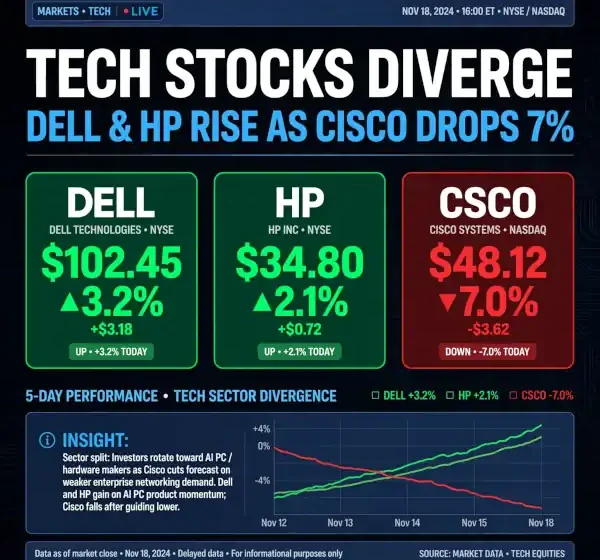
Tech Stocks Diverge: Dell stock & HP Rise as Cisco Systems Drops 7%

Global enterprise hardware tech stock analysis reveals a sharp divergence across Wall Street trading desks on Thursday morning, driven by booming artificial intelligence infrastructure demand and quarterly corporate earnings updates. Shares of Dell Technologies (NYSE: DELL) surged 4% in premarket trading while HP Inc. (NYSE: HPQ) climbed 6% following a massive quarterly revenue beat from enterprise peer Lenovo. Conversely, networking titan Cisco Systems (NASDAQ: CSCO) slipped 7% despite beating overall top and bottom-line consensus estimates.
Lenovo Revenue Explosion Signals Surging AI Server Demand
A blowout first-quarter earnings report overnight from Hong Kong-listed Lenovo Group Limited (HKSE: 992) provided a powerful tailwind for western enterprise hardware manufacturers. Lenovo reported a record 43% year-over-year revenue surge to $26.9 billion, far exceeding Wall Street analyst projections of $22.3 billion. The company’s Infrastructure Solutions Group (ISG)—which produces high-density enterprise servers and data center gear—nearly doubled its revenue, surging 98% year-over-year to $8.5 billion.
Institutional investors interpret Lenovo’s record hardware orders as definitive proof that enterprise AI deployment momentum is overshadowing broader component cost inflation. Demand for high-performance enterprise AI servers, liquid-cooling rack architecture, and next-generation compute nodes continues to outpace available market supply. This massive spending wave directly benefits legacy hardware vendors like Dell and HP as enterprise clients accelerate multi-cloud data center upgrades.
-
Surging Server Sales: Lenovo’s server division revenue jumped 98% year-over-year, confirming massive global hardware demand.
-
AI Pipeline Expansion: The company’s global AI server pipeline expanded to $54 billion, up 157% from the previous quarter.
-
Margin Resilience: Operating margins in enterprise infrastructure reached a record 9.1% despite higher DRAM and memory costs.
Why Cisco Sinks 7% Despite Beating Q4 Revenue Estimates
Cisco Systems found itself on the opposite side of the premarket market split. The networking giant posted fiscal fourth-quarter revenue of $17.3 billion—up 18% year-over-year—and non-GAAP earnings per share of $1.22, topping consensus expectations across both key metrics. Hyperscaler AI infrastructure orders surged 4.5 times year-over-year to $9.3 billion for the full fiscal year.
| Company Benchmark | Premarket Move | Q4 Revenue / YoY Growth | Key Growth Catalyst | Market Sentiment |
| Dell Technologies (DELL) | +4.0% | $25.7B / +6.3% | Enterprise AI server backlog growth | Strongly Bullish |
| HP Inc. (HPQ) | +6.0% | $13.5B / +3.1% | Commercial PC refresh & AI PCs | Strongly Bullish |
| Lenovo Group (0992.HK) | +20.2% | $26.9B / +43.0% | Server sales nearly doubled ($8.5B) | Extremely Bullish |
| Cisco Systems (CSCO) | -7.0% | $17.3B / +18.0% | Cautious gross margins & flat services | Moderately Bearish |
Despite stellar headline figures, investors focused heavily on Cisco’s narrowing gross margins and stagnant services revenue. Non-GAAP gross margins fell 210 basis points year-over-year to 66.3% due to higher memory component costs and a shift toward lower-margin hardware delivery. Furthermore, high expectations set by cloud networking peer Arista Networks (NYSE: ANET) created a high hurdle that Cisco’s flat $3.8 billion services segment failed to overcome.
Enterprise Hardware Stocks: Investment Outlook and Risk Factors
Analyzing institutional portfolio reallocation reveals that capital is flowing toward hardware providers with direct, unhedged exposure to enterprise server expansion. Portfolio managers evaluating AI infrastructure server demand are prioritizing companies capable of translating backlogs into near-term margin expansion.
Hardware Sector Metrics:
• Lenovo Q1 AI Revenue Share:        35% of total group revenue ($9.3B)
• Cisco Fiscal 2026 AI Orders:      $9.3 Billion (4.5x YoY expansion)
• Cisco Q4 Non-GAAP Gross Margin:  66.3% (-210 bps YoY component drag)
However, hardware investors must remain cautious regarding elevated memory pricing and supply chain bottlenecks. While raw server demand remains robust, elevated component costs could compress profit margins for hardware assemblers if enterprise price increases spark customer pushback in late 2026.
Frequently Asked Questions
Why did Dell and HP stock rise before market open?
Dell and HP stock climbed premarket following Lenovo’s record-breaking Q1 financial results. Lenovo reported a 43% revenue surge and a near-doubling of server sales, proving to Wall Street that enterprise demand for server hardware and AI PCs remains exceptionally strong.
Why is Cisco stock dropping if earnings beat expectations?
Cisco stock fell despite beating revenue and profit estimates because investors grew concerned over compressed gross margins. Higher memory costs, a shift toward hardware product mix, and flat year-over-year services revenue led traders to lock in recent profits.
How does AI infrastructure demand affect legacy technology stocks?
Enterprise artificial intelligence workloads require specialized high-performance servers, optical networking, and high-density rack infrastructure. This technology transition provides major multi-year revenue upgrades for legacy hardware providers that adapt their product lines to support high-power compute requirements.
Investor Resources and Market Community Discussions
Staying informed on enterprise tech stock earnings previews and institutional portfolio reallocations requires continuous tracking across verified financial hubs:
-
Search live stock ticker movements via Google Search Market Trends.
-
Participate in tech stock trading debates on the NT Live News Community Forums.
-
Review historical enterprise corporate structures on the Dell Technologies Wikipedia Page and Cisco Systems Wikipedia Page.
Investors navigating the current hardware stock divergence should closely monitor upcoming quarterly earnings releases from pure-play server manufacturers and storage vendors. Balancing exposure between high-growth AI infrastructure builders and stable networking providers remains an effective strategy for managing portfolio volatility in a shifting macroeconomic climate.