
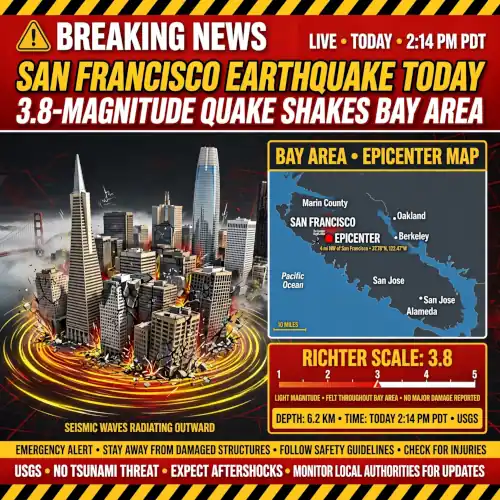
San Francisco Earthquake Today: 3.8-Magnitude Quake Shakes Bay Area

USGS Seismic Report, Epicenter Details, and Initial Magnitude Revisions
The United States Geological Survey initially registered the seismic event as a 4.1-magnitude earthquake before revising the intensity downward to a magnitude 3.8 after processing real-time sensor data across Northern California monitoring stations. The epicenter originated at a shallow depth near the Hayward fault zone, a major tectonic boundary running directly beneath densely populated East Bay urban centers.
Data collected by the USGS automated prompt system indicated that light to weak shaking was felt across a 20-mile radius, extending from downtown San Francisco eastward through Oakland and southward toward Hayward and Fremont. Seismic waves registered across regional seismometers, triggering automated early warning notifications on mobile devices across the Bay Area.
Event Time:          8:30 a.m. Pacific Time (August 13, 2026)
Revised Magnitude:   3.8 M (Initially reported as 4.1 M)
Epicenter Location:  2 miles North of San Leandro, CA
Depth:               Shallow (~5-6 km)
Primary Fault Zone:  Hayward Fault Region
Shake Intensity:     Level III to IV (Weak to Light Shaking)
Geophysicists at the USGS noted that shallow earthquakes typically produce sharper, more pronounced surface jolts near the epicenter compared to deeper seismic events of similar magnitude. Residents directly above the fault line described hearing a loud booming noise immediately preceding the ground movement.
-
Epicenter Proximity: Located near the border of San Leandro and East Oakland, placing thousands of homes within the immediate shake zone.
-
Perceived Intensity: Classified as Modified Mercalli Intensity IV, causing light rattling of dishes, windows, and doors without structural damage.
-
Geographic Spread: Shaking reports poured into the USGS “Did You Feel It?” platform from San Francisco, Berkeley, San Jose, and San Mateo.
BART Transit Delays, Morning Commute Impact, and Emergency Inspections
The morning commute across the Bay Area ground to a temporary standstill as regional transit authorities executed mandatory safety protocols. Bay Area Rapid Transit (BART) immediately held all active passenger trains at stations across the network while system operators initiated systemwide track inspections.
BART maintenance crews dispatched inspection teams to examine track alignments, aerial structures, and underground tunnel segments for potential structural displacement or track misalignment. Once initial inspections cleared core corridors, trains resumed service at reduced speeds before returning to normal schedules later in the morning.
| Location / System | Operational Status | Reported Impact | Inspection Outcome |
| BART Transit System | Temporarily Held / Delayed | Trains held at stations; systemwide speed restrictions | No structural damage or track anomalies found |
| Oakland International Airport | Fully Operational | Brief ground hold during initial seismic check | Runway and terminal facilities cleared safely |
| San Francisco-Oakland Bay Bridge | Open / Normal Traffic | Minor traffic slowing during initial shaking | Caltrans visual bridge inspection confirmed safe |
| East Bay Utility Networks | Uninterrupted Service | Zero reported gas leak or power outages | Municipal infrastructure functioning normally |
No major injuries or significant structural damage were reported by emergency responders in Oakland, San Leandro, or San Francisco following the event. Municipal emergency services reminded residents that light earthquakes serve as critical operational tests for regional infrastructure resilience.
Local Resident Reactions and the Ever-Present Hayward Fault Threat
For long-time East Bay residents, the morning shock served as an abrupt reminder of Northern California’s underlying geological realities. Political analyst and longtime journalist Carla Marinucci, who lives near the epicenter in Oakland, was drinking her morning tea when the temblor struck. She described feeling a massive jolt that felt like a heavy commercial truck slamming directly into her residence.
Within seconds of the initial tremor, neighborhood group chats and social media channels lit up with messages as neighbors checked in on one another. Living directly along the Hayward fault zone means managing a constant state of earthquake readiness for a long-anticipated major seismic event.
“If you live near the Hayward fault, you always have to be prepared for what they describe as a major quake happening any day. We’re overdue,” Marinucci noted. “In California, we learn to live with this stuff, but it still makes you sweat a little.”
Seismologists have long classified the Hayward fault as one of the most hazardous fault lines in North America due to its dense urban population density. The USGS estimates a significant probability of a major magnitude 6.7 or greater earthquake along the Hayward fault over the coming decades, making routine emergency preparation essential for all Bay Area households.
Frequently Asked Questions
How many aftershocks occurred after the San Francisco Bay Area earthquake today?
Residents across the East Bay felt at least one notable aftershock within 30 minutes of the primary 3.8-magnitude quake. Minor aftershocks represent routine adjustments along the fault plane where the initial fault slip occurred.
Why was the initial magnitude reported as 4.1 before changing to 3.8?
Automated seismic algorithms quickly calculate preliminary magnitudes using initial wave arrivals. Human seismologists at the USGS subsequently analyze comprehensive sensor data across multiple monitoring stations to refine and finalize the exact magnitude reading.
What should I do immediately during an earthquake in California?
When shaking begins, remember to Drop, Cover, and Hold On. Drop down onto your hands and knees, take cover under a sturdy desk or table, and hold on until the shaking stops completely. Stay away from windows, heavy bookcases, and unanchored furniture.
Earthquake Tracking Resources and Community Discussion Channels
Monitoring real-time seismic maps, official USGS advisories, and neighbourhood emergency preparedness networks helps keep families safe when unexpected earthquakes occur across California:
-
Search live seismic maps and real-time report logs on Google Search Earthquake Tracking.
-
Join regional safety discussions and local updates on the NT Live News Community Forums.
-
Review technical fault data and geological studies on the USGS Wikipedia Reference Page and Hayward Fault Zone Wikipedia Entry.
Staying prepared throughout earthquake country requires maintaining updated emergency supply kits, securing heavy household furniture to wall studs, and keeping emergency communication channels active. Reviewing family evacuation plans and registering for local mobile emergency alerts ensures that households across the San Francisco Bay Area remain resilient whenever seismic activity strikes.