
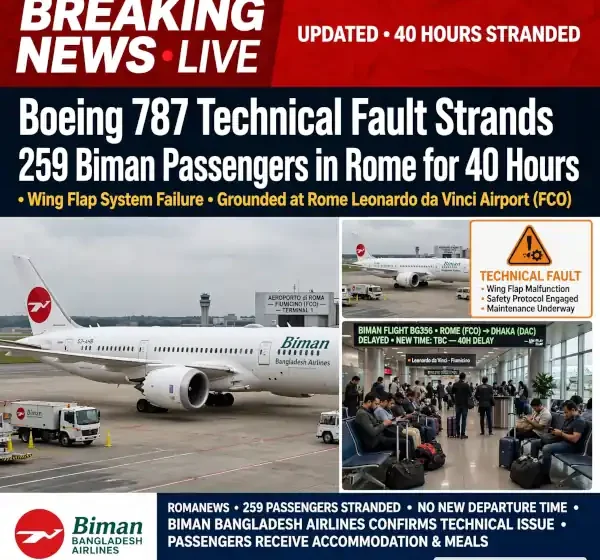
Boeing 787 Technical Fault Strands 259 Biman Passengers in Rome for 40 Hours

ROME / DHAKA — What was supposed to be a routine transcontinental journey from North America to South Asia transformed into an exhausting, multi-day nightmare for hundreds of international travellers. A state-of-the-art Boeing 787-9 Dreamliner operated by Biman Bangladesh Airlines suffered a major technical malfunction during a scheduled transit stop in Italy, stranding 259 passengers at Rome’s Leonardo da Vinci–Fiumicino Airport (FCO) for nearly 40 hours.
The disruption to Flight BG306—running from Toronto Pearson International Airport to Dhaka’s Hazrat Shahjalal International Airport via Rome—triggered severe humanitarian and administrative challenges inside the Italian transit terminal. Due to strict Schengen border regulations, more than 170 passengers holding Bangladeshi passports were barred from leaving the airport to check into local hotels. Trapped inside airport lounges and transit corridors for almost two days, travellers endured soaring temperatures, restricted access to basic supplies, and medical distress before the aircraft was finally declared fit to fly.
A Routine Stop Turns Into a Tense Onboard Standoff
The ordeal began on the evening of Thursday, August 6, 2026, when Flight BG306 departed Toronto Pearson International Airport bound for the Bangladeshi capital. The flagship route was operated by one of Biman’s long-haul widebody jetliners, a Boeing 787-9 Dreamliner registered under tail number S2-AJY.
After approximately eight hours of smooth flying across the Atlantic, the Dreamliner landed at Rome Fiumicino Airport at approximately 07:20 local time on Friday morning for a routine refuelling and crew change stopover. However, during ground inspections prior to the second leg of the flight to Dhaka, maintenance technicians detected a critical mechanical fault within the aircraft’s systems.
Rather than deboarding immediately, passengers were kept onboard the parked Boeing 787 for nearly eight hours while flight crew and local ground engineers attempted to diagnose and rectify the issue. As the aircraft sat on the tarmac with auxiliary power systems struggling, the cabin’s climate control system degraded rapidly. Passengers reported sweltering interior conditions, stuffy air, and growing anxiety as hours ticked by with minimal communication from the cockpit or cabin crew.
Only after local maintenance personnel realised the fault could not be resolved on the spot did airline staff begin disembarking the 259 weary passengers into the international transit area of Rome Fiumicino.
The Visa Divide: Hotel Comfort vs. Terminal Confinement
Once inside the airport terminal, a secondary administrative crisis immediately unfolded, dividing the stranded passengers along lines of nationality and passport power.
Biman Bangladesh Airlines representatives stated that the carrier was fully prepared to procure hotel accommodations, catered meals, and ground transportation for all impacted customers. However, Italian immigration authorities enforced strict European Union entry laws. Passengers holding Canadian, United States, or European passports—as well as those carrying valid Schengen visas—were permitted to clear border control and transfer to nearby hotels arranged by the airline.
Conversely, at least 174 passengers travelling on Bangladeshi passports without transit or Schengen visas were legally prohibited from crossing the immigration threshold into Italian territory.
Unable to enter the country, these 170-plus travellers were forced to remain confined inside the transit zone of Fiumicino Airport. While a portion of the group was accommodated inside the airport’s Prima Vista lounge, the facility quickly reached capacity. Dozens of passengers were left with no choice but to sleep on hard terminal chairs, benches, or makeshift bedding on the floor.
Humanitarian Strain: Vulnerable Travellers Left in Distress
As the delay stretched past the 24-hour mark, conditions inside the transit area deteriorated significantly. The passenger manifest included dozens of elderly individuals returning from visits with family in Canada, young families travelling with infants, and individuals with chronic medical conditions.
Because checked baggage remained locked in the cargo hold of the grounded Boeing 787-9, many travellers lost access to vital prescription medications, including daily cardiovascular drugs and insulin. Families ran out of specialised baby formula, diapers, and infant nutrition, while language barriers between airport staff and non-English- or non-Italian-speaking travellers exacerbated confusion.
Passengers voiced intense frustration over what they described as a breakdown in emergency logistics and communication. Several travellers reported feeling unwell, experiencing spikes in blood pressure and exhaustion due to the lack of sleep and nutrition.
“We were treated like castaways in an international terminal,” recounted one stranded passenger, describing the emotional toll of watching fellow travellers depart for hotels while those with Bangladeshi passports were forced to remain behind under security supervision.
Flying in Parts and Engineers From Dhaka
While passengers struggled in the terminal, the technical situation surrounding the Boeing 787-9 Dreamliner proved far more complex than initially anticipated.
Biman’s onboard flight engineers, working alongside local Italian line maintenance contractors at Fiumicino, determined that fixing the undisclosed technical fault required specialised replacement components and advanced diagnostic tooling that were unavailable in Rome. With the aircraft officially designated as Aircraft on Ground (AOG), the national flag carrier was forced to mount an emergency airlift operation from its primary hub in Dhaka.
Biman dispatched a specialised engineering team accompanied by heavy spare parts aboard another scheduled flight—BG305—which departed Dhaka on Saturday, August 8. The relief flight arrived in Rome late Saturday afternoon local time.
Upon touchdown, the Dhaka-based engineering team worked through the evening alongside local technicians, performing complex component replacements and executing rigorous system recalibrations. Following a series of exhaustive safety inspections and pre-flight checks, Italian aviation authorities and Biman’s engineering oversight team officially declared aircraft S2-AJY airworthy late Saturday night.
The Journey Resumes: 39 Hours Behind Schedule
With the Boeing 787-9 finally cleared for service, airline staff gathered the exhausted passengers from the transit lounge and terminal gates. Boarding for the final leg of Flight BG306 commenced late Saturday evening, and the aircraft pushed back from Rome Fiumicino Airport at approximately 23:00 local time—roughly 39 hours after its original scheduled departure window.
The Dreamliner made its long-awaited final approach into Dhaka’s Hazrat Shahjalal International Airport on Sunday, August 9, landing at approximately 12:30 p.m. local time. Relief swept through the arrivals terminal as families were reunited with loved ones who had spent nearly two days navigating an unexpected operational crisis.
The grounding of S2-AJY also sent minor shockwaves through Biman’s international schedule. Because the same Boeing 787-9 was slated to immediately turn around and operate the return service from Dhaka back to Toronto via Rome (Flight BG305), Biman was forced to reschedule that outbound flight by over 24 hours, stranding hundreds of additional passengers at Dhaka airport.
Systemic Vulnerabilities in International Aviation
The 40-hour ordeal at Rome Fiumicino highlights ongoing vulnerabilities in long-haul international air travel, particularly when technical breakdowns occur at non-hub transit airports.
Aviation industry analysts point out that while the Boeing 787 Dreamliner is widely regarded as one of the world’s most advanced commercial aircraft, complex fly-by-wire, electronic, and climate systems require highly specialised parts and certified engineers. When an AOG incident occurs far from an airline’s main maintenance base, sourcing qualified labour and compatible spare parts can paralyse operations for days.
Furthermore, the Incident underscores the stark geopolitical inequities facing global travellers during major flight disruptions. While international air passenger rights frameworks—such as the European Union’s EU261 regulation—mandate duty of care, meals, and hotel accommodations during long delays, local immigration laws routinely override airline obligations. When transit stops occur in countries requiring strict entry visas, passengers from developing nations often face institutional confinement inside terminals during mechanical emergencies, leaving airlines struggling to deliver basic humanitarian support.
Biman Bangladesh Airlines expressed deep regret over the severe disruption, reiterating that passenger safety and mechanical integrity remain the carrier’s highest operational priorities. Meanwhile, consumer advocacy groups and affected passengers are calling for formal reviews into duty-of-care protocols at international transit hubs to ensure that essential medical care, adequate resting facilities, and emergency supplies are guaranteed to all stranded travellers—regardless of the passport they carry.
Summary Table: Flight BG306 Disruption Key Facts
| Parameter | Details |
| Airline & Flight | Biman Bangladesh Airlines — Flight BG306 |
| Aircraft Model & Registration | Boeing 787-9 Dreamliner (S2-AJY) |
| Route | Toronto (YYZ) $\rightarrow$ Rome (FCO) $\rightarrow$ Dhaka (DAC) |
| Total Passenger Count | 259 Passengers |
| Initial Landing in Rome | Friday, Aug 7, 2026 @ 07:20 Local Time |
| Stranded Passengers in Terminal | ~174 (Bangladeshi passport holders lacking Schengen visas) |
| Resolution Strategy | Spare parts & 2 engineers flown from Dhaka on Flight BG305 |
| Final Departure from Rome | Saturday, Aug 8, 2026 @ ~23:00 Local Time |
| Arrival in Dhaka | Sunday, Aug 9, 2026 @ 12:30 PM Local Time (~39 hrs late) |