
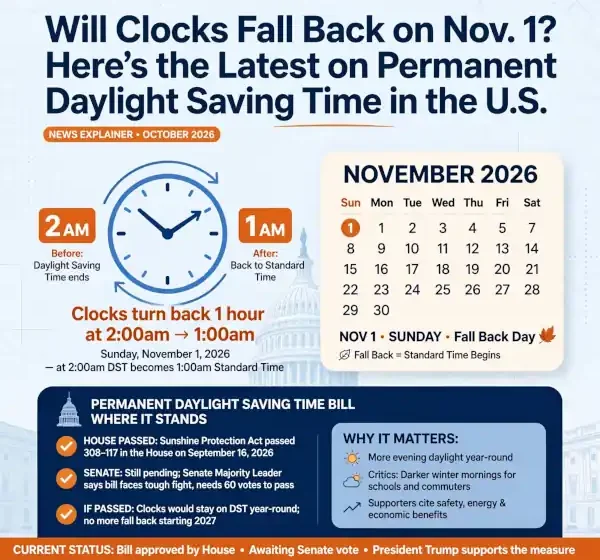
Will Clocks Fall Back on Nov. 1? Here’s the Latest on Permanent Daylight Saving Time in the U.S.

What’s trending in America Today: As November approaches, millions of Americans are asking if they will need to set their clocks back by one hour on Sunday, November 1, 2026. The short answer is yes, most Americans will still “fall back” on Nov. 1, unless the U.S. Senate passes the pending Sunshine Protection Act and the President signs it before that deadline.
Legislative Snapshot: Where the Law Stands Right Now
While the U.S. House of Representatives previously approved the Sunshine Protection Act of 2025 (H.R. 139) to make Daylight Saving Time permanent, federal law has not changed yet.
| Milestone | Current Status | Key Takeaways |
| U.S. House of Representatives | Passed | Approved 308–117 to end biannual clock changes. |
| U.S. Senate | Pending | Must pass the bill before year-round DST can be enacted. |
| Presidential Action | Pending | White House supports ending time shifts once passed by Congress. |
| Current Federal Law | In Effect | The Uniform Time Act mandates setting clocks back 1 hour on Nov. 1, 2026, at 2:00 AM local time. |
What Happens on November 1, 2026?
-
48 States & U.S. Territories: Clocks will turn back 1 hour at 2:00 AM local time on Sunday, Nov. 1.
-
Exceptions: Arizona (except the Navajo Nation) and Hawaii, along with Puerto Rico, Guam, American Samoa, and the U.S. Virgin Islands, do not observe Daylight Saving Time and will remain on Standard Time year-round.
Public Health & Safety: Permanent DST vs. Permanent Standard Time
While nearly 75% of the public wants to end biannual clock changes, health professionals and lawmakers disagree on which time should become permanent.
Permanent Daylight Saving Time (More Evening Light)
-
Economic Boost: Extra evening daylight encourages shopping, outdoor recreation, and dining.
-
Evening Commute Safety: Better visibility during rush hour reduces evening traffic accidents and street crime.
-
Mental Well-being: Prolonged afternoon sun helps combat Seasonal Affective Disorder (SAD).
Permanent Standard Time (More Morning Light)
-
Circadian Health: Medical groups like the American Academy of Sleep Medicine (AASM) prefer Permanent Standard Time because morning light aligns better with human sleep cycles.
-
Dark Morning Hazards: Under year-round DST, northern states would experience winter sunrises as late as 8:30 AM–9:00 AM, forcing children to head to school in pitch darkness.
Summary & Discussion
Unless the Senate takes swift legislative action prior to November 1, 2026, clocks across 48 states will turn back one hour as scheduled.
Community Question: Would you prefer Permanent Daylight Saving Time (more evening sunlight) or Permanent Standard Time (more morning sunlight)? Share your thoughts and let your network know what to expect on Nov. 1!