
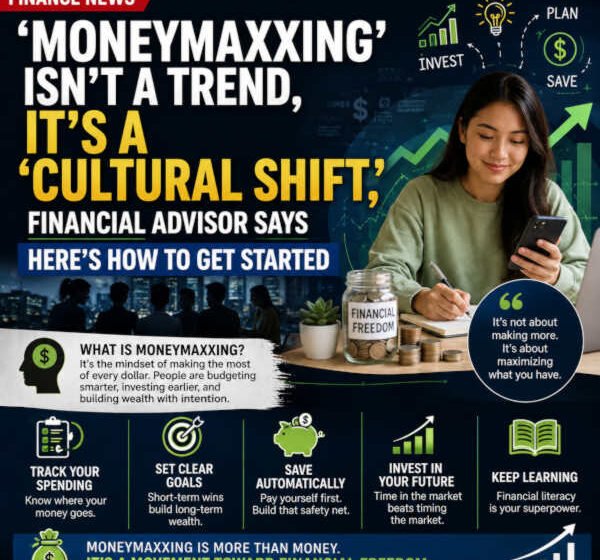
‘Moneymaxxing’ Isn’t a Trend, It’s a ‘Cultural Shift,’ Financial Advisor Says | Here’s How to Get Started

USA FINANCE News Today: A breaking update on finance today in America. As consumers across the nation seek pragmatic strategies to fortify their personal balance sheets amidst an ongoing affordability crunch, a fresh movement is capturing widespread attention across digital platforms. For once, the internet’s viral financial trend doesn’t encourage buying anything.
Dubbed “Moneymaxxing,” this intentional financial framework encourages individuals to systematically optimize their daily spending, trim recurring overhead, redeem credit card reward points (a sub-movement known as pointsmaxxing), and redirect reclaimed capital into high-yield savings vehicles.
Unlike short-lived viral fads, financial planners and behavioural economists emphasise that moneymaxxing represents a fundamental pivot in consumer mindset: transforming traditional, restrictive frugality into a proactive, high-leverage lifestyle centred on long-term wealth building.
What Is ‘Moneymaxxing’ and Where Did It Originate?
Moneymaxxing is the financial spin-off of social media’s broader “maxxing” phenomenon, a behavioural trend focused on hyper-optimising specific lifestyle pillars. Recent iterations include vacationmaxxing (maximising paid time off for optimal travel), sleepmaxxing (restructuring routines for optimal recovery), and fibermaxxing (deliberately optimising dietary fibre intake).
However, while previous internet trends often promoted consumerism or aesthetic spending, moneymaxxing flips the script.
“Moneymaxxing is now about getting the absolute most out of your money by being proactive, resourceful, and creative to achieve a life of abundance,” explains Winnie Sun, co-founder and managing director of Irvine, California-based Sun Group Wealth Partners. “It’s a cultural shift that is not about living with less, but rather seeking more for yourself.”
Financial psychologist Brad Klontz, managing principal of YMW Advisors, frames the movement as a welcome evolution in consumer psychology. “It’s frugality made cool again — I love it,” says Klontz. “It’s certainly better than ‘credit-card maxxing,’ which is what consumers have been doing for far too long.”
               TRADITIONAL BUDGETING                      MONEYMAXXING
     ┌──────────────────────────────────────┐   ┌──────────────────────────────────────┐
     │ • Focuses on deprivation & restriction│   │ • Focuses on value optimization      │
     │ • Passive spending tracking          │   │ • Automated high-yield yield capture │
     │ • Reactive debt payments             │   │ • Gamified rewards ("Pointsmaxxing") │
     │ • Short-term survival mindset        │   │ • AI-assisted expense audit          │
     └──────────────────────────────────────┘   └──────────────────────────────────────┘
The Macroeconomic Drivers Behind the Movement
The rapid adoption of moneymaxxing is directly linked to compounding macroeconomic pressures facing American households. Rising cost-of-living indices, elevated interest rates, and stubborn service inflation have left households searching for systematic ways to stretch their take-home pay.
1. Surging Consumer Debt
According to quarterly credit industry research from TransUnion, credit card balances increased 4.4% year-over-year to a record collective $1.14 trillion. The average balance per consumer now stands at $6,610, marking a 2.1% increase over the previous year. Elevated interest rates mean that carrying these balances incurs significant finance charges, making debt reduction an urgent financial priority.
2. Delayed Financial Independence Among Young Adults
Younger generations face particularly steep hurdles to independence. Data from Northwestern Mutual’s 2026 Planning and Progress Study reveals that over half of Millennials and 72% of Gen Zers still rely on their parents for financial assistance. On average, young adults today do not expect to achieve complete financial independence until age 37.
Against this economic backdrop, moneymaxxing serves as a self-empowerment framework designed to reclaim financial control.
Why Behavioural Experts Say Moneymaxxing Has Staying Power
Unlike seasonal spending bans or extreme “no-buy” months that often lead to rebound spending, moneymaxxing focuses on sustainable, incremental habit formation.
Jack Howard, head of money wellness and a behavioural finance expert at Ally Bank, notes that the movement’s focus on long-term systems gives it lasting power. “Instead of jumping from one money trend to the next in search of a quick fix, moneymaxxing focuses on creating everyday habits to create long-term financial success,” Howard emphasises.
| Core Moneymaxxing Strategy | Tactical Execution | Primary Behavioural Outcome |
| Cash Flow Audit | Reviewing 90 days of transactions to isolate non-essential recurring leaks. | Uncovers hidden subscription costs and friction spending. |
| Automated Yield Capture | Directing excess cash reserves automatically into High-Yield Savings Accounts (HYSAs). | Converts idle capital into compounding interest income. |
| Pointsmaxxing | Aligning routine category spending with high-earning credit reward structures. | Funds travel and everyday expenses using earned points rather than cash. |
| AI Budget Integration | Deploying machine-learning tools to identify cash-flow anomalies. | Reduces administrative friction in budget maintenance. |
How to Get Started Moneymaxxing: A 4-Step Action Plan
Adopting a moneymaxxing strategy does not require an overhaul of your lifestyle overnight. Financial advisors recommend taking a structured, step-by-step approach to optimise your cash flow.
Step 1: Conduct a Thorough Cash Flow Audit
Begin by examining income and outgoing expenditures over the preceding three to six months. Categorize baseline fixed overhead (housing, utilities, transportation) versus discretionary variables (dining out, entertainment, streaming subscriptions).
The goal of this audit is not to eliminate enjoyment, but rather to identify spending patterns that no longer align with your long-term goals. Look specifically for “subscription creep”—recurring monthly fees for services you no longer utilize regularly.
Step 2: Automate Key Financial Transactions
One of the core tenets of moneymaxxing is removing reliance on willpower. By automating your finances, positive behaviors occur in the background:
-
Automated Savings Transfers: Set up recurring transfers on payday that move a predetermined percentage of your income directly into a High-Yield Savings Account (HYSA).
-
Automated Debt Repayment: Schedule automated payments above the minimum required amount toward high-interest credit card debt.
-
Automated Investment Contributions: Ensure retirement accounts (such as 401(k)s or Roth IRAs) receive systematic monthly allocations.
Step 3: Leverage Technology and AI-Powered Financial Tools
Modern personal finance apps use artificial intelligence to make budget tracking seamless. AI-driven budgeting tools can analyse historical spending, forecast monthly cash flow, flag unusual billing spikes, and suggest tailored micro-savings opportunities.
“Financial stress can be turned around by finding solutions,” Sun notes. Utilising digital tools helps uncover potential savings opportunities while minimising manual bookkeeping effort.
Step 4: Curate Your Digital Environment & Community
Your online environment significantly influences your spending habits. Unsubscribing from marketing emails that trigger impulse purchases and auditing your social media feeds are critical steps.
Instead of following content that promotes conspicuous consumption, curate your feeds to include communities and creators focused on financial literacy, debt independence, and smart investing. “It’s never been easier to find a shared community,” says Klontz, highlighting that peer support provides both accountability and practical optimisation ideas.
Frequently Asked Questions (FAQs)
How does ‘moneymaxxing’ differ from traditional budgeting?
Traditional budgeting often focuses on boundary-setting and restriction. Moneymaxxing approaches personal finance with an optimisation mindset: maximising interest earned on savings, earning rewards on unavoidable expenses, and deploying technology to automate wealth building.
What is ‘pointsmaxxing’ and how does it fit into this trend?
Pointsmaxxing is the practice of strategically utilising credit card rewards programs, sign-up bonuses, and cash-back categories to fund travel or everyday purchases. When paired with responsible credit management (paying balances in full each month), it allows consumers to derive maximum value from their standard living expenses.
Is moneymaxxing suitable for people carrying credit card debt?
Yes, but the focus shifts toward debt acceleration. For individuals with high-interest debt, moneymaxxing means auditing recurring expenses to free up cash, automating extra principal payments, and utilising balance transfer strategies to minimise interest costs.
By transforming financial management from a chore into a rewarding pursuit, moneymaxxing offers a practical framework for building resilience in an uncertain economic environment. By leveraging automation, optimising rewards, and utilising modern digital tools, consumers can turn everyday financial habits into lasting, multi-generational progress.